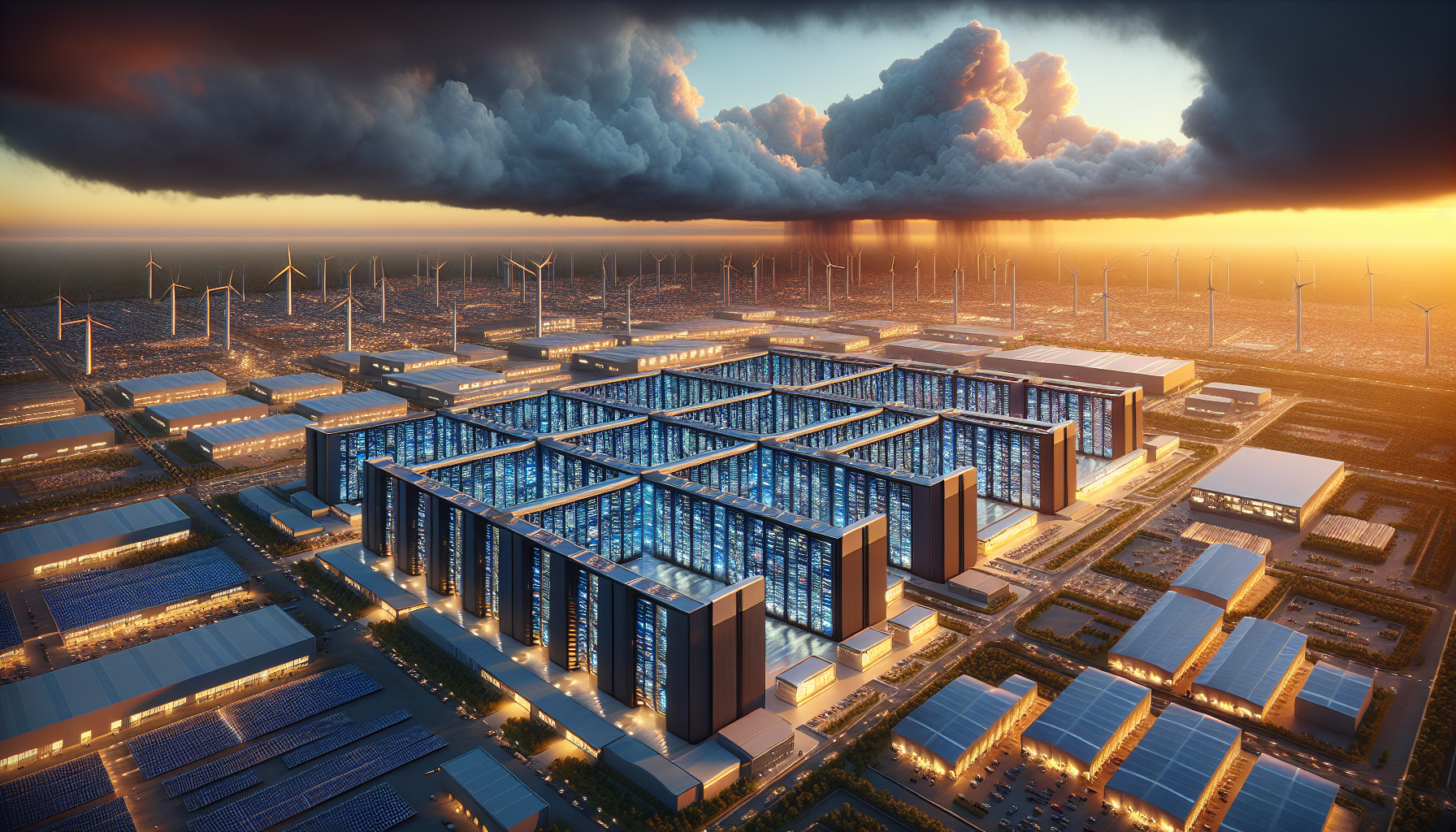
In the summer of 2025, the International Energy Agency published a projection that stopped boardrooms across the technology industry cold: by 2026, global data center electricity consumption would exceed 1,000 terawatt-hours annually, roughly equivalent to the entire electricity consumption of Japan. That projection is now tracking ahead of schedule. The AI boom is not just a software story. It is rapidly becoming one of the defining infrastructure challenges of the decade — and the electricity grid, built over a century for a different kind of industrial demand, is straining to keep pace.
The Numbers Behind the Surge
The scale of the problem is concrete and accelerating. A single large-scale AI training run for a frontier model — the kind used to produce systems like GPT-4o, Gemini Ultra, or Anthropic’s Claude 3 family — consumes between 50 and 150 gigawatt-hours of electricity, according to estimates from researchers at Carnegie Mellon University and independent energy analysts. That is equivalent to the annual electricity consumption of 4,500 to 13,500 average American households, spent on a single model training cycle that may last three to six months.
Inference — the ongoing process of serving responses to users — adds a different but equally significant load. Goldman Sachs estimated in mid-2025 that a ChatGPT query consumes approximately ten times the electricity of a standard Google Search. With AI-assisted search, copilot features, and autonomous agents now embedded across consumer and enterprise applications, inference load is growing faster than training load and shows no signs of plateauing. Goldman’s data center power demand model projects that AI-driven electricity consumption in the United States alone will reach 130 gigawatt-hours by 2028 — an 8% increase in total U.S. power demand driven almost entirely by one technology sector.
The hyperscalers have responded with capital expenditure at a scale that has no peacetime parallel in the technology industry. Microsoft, Google, Amazon, and Meta collectively committed more than $200 billion in data center investment in 2025, a figure that analysts at Morgan Stanley expect to grow to $280 billion in 2026. A significant share of that spending is not on servers. It is on power — substations, cooling systems, backup generation, and long-term electricity purchase agreements.
Grid Stress and the Utility Reckoning
The impact is landing hardest on regional electricity grids in the United States, Ireland, Singapore, and the Netherlands — jurisdictions that have historically attracted data center investment due to favorable tax regimes, land availability, or climate conditions suited to efficient cooling.
In Northern Virginia, the world’s largest data center market by capacity, Dominion Energy has acknowledged that it cannot deliver the power capacity that its pipeline of approved data center projects demands within the timelines those operators require. The utility has asked state regulators for permission to accelerate transmission infrastructure investment and has flagged that power delivery constraints will create multi-year delays for some facilities. Similar warnings have come from utilities serving data center clusters in Iowa, Texas, and the Phoenix metropolitan area.
The Irish grid operator EirGrid reported in early 2026 that data centers now account for approximately 21% of Ireland’s total electricity consumption, up from 14% in 2022. The operator has explicitly warned that without new generation capacity, the concentration of AI infrastructure in the Dublin region risks compromising grid reliability for the broader population. Ireland has implemented a temporary moratorium on new large-scale data center connections in the greater Dublin area while it expands transmission capacity.
The Corporate Response: Ownership, Not Just Purchase
Faced with grid constraints and rising electricity prices — commercial industrial power rates in the United States rose an average of 14% between 2023 and 2025 according to the U.S. Energy Information Administration — major technology companies are moving from buying electricity to owning generation.
Microsoft restarted the Three Mile Island nuclear unit in Pennsylvania in 2024, purchasing its entire output under a 20-year power purchase agreement to supply its data centers in the Mid-Atlantic region. Google has committed to operating on 24/7 carbon-free energy and has struck agreements with next-generation nuclear developers including Kairos Power and TerraPower for small modular reactor output expected to come online between 2030 and 2035. Amazon has acquired or secured exclusive offtake from solar and wind projects totaling more than 50 gigawatts of capacity globally.
The emerging pattern is that AI-scale compute is driving a fundamental restructuring of who builds and finances electricity generation. Technology companies, with stronger balance sheets and longer investment horizons than many regulated utilities, are becoming energy infrastructure owners — a category shift with significant implications for energy markets, regulatory frameworks, and the competitive dynamics of AI itself.
The Competitive Angle
Energy is becoming a first-order competitive variable in AI. Companies that secure reliable, low-cost, low-carbon power at scale will be able to train larger models more frequently, serve more inference requests at lower marginal cost, and make sustainability commitments that matter to enterprise customers operating under their own decarbonization obligations.
Conversely, companies that fail to solve the power problem face a hard ceiling on their AI ambitions. Building a frontier model requires not just chips and talent — it requires gigawatts. Nvidia’s Blackwell architecture chips, now widely deployed in hyperscaler training clusters, draw up to 10.2 kilowatts per GPU unit. A cluster of 10,000 Blackwell GPUs — a mid-sized training run by 2026 standards — requires roughly 100 megawatts of sustained power delivery, plus the cooling infrastructure to dissipate the associated heat.
For smaller AI companies and national AI initiatives in countries without abundant electricity or grid capacity, this dynamic creates a structural disadvantage that capital alone cannot easily overcome. The AI race is, increasingly, also an energy race — and the grid has become the next frontier.
Sources: International Energy Agency Data Centre Electricity Consumption Report (IEA, 2025); Goldman Sachs AI Power Demand Analysis (2025); Morgan Stanley Data Center CapEx Projections (2025); EirGrid Quarterly Generation Capacity Statement; U.S. Energy Information Administration Commercial Power Price Data; Carnegie Mellon University AI Energy Consumption Research


Discussion
Sign in to join the discussion.
No comments yet. Be the first to share your thoughts.