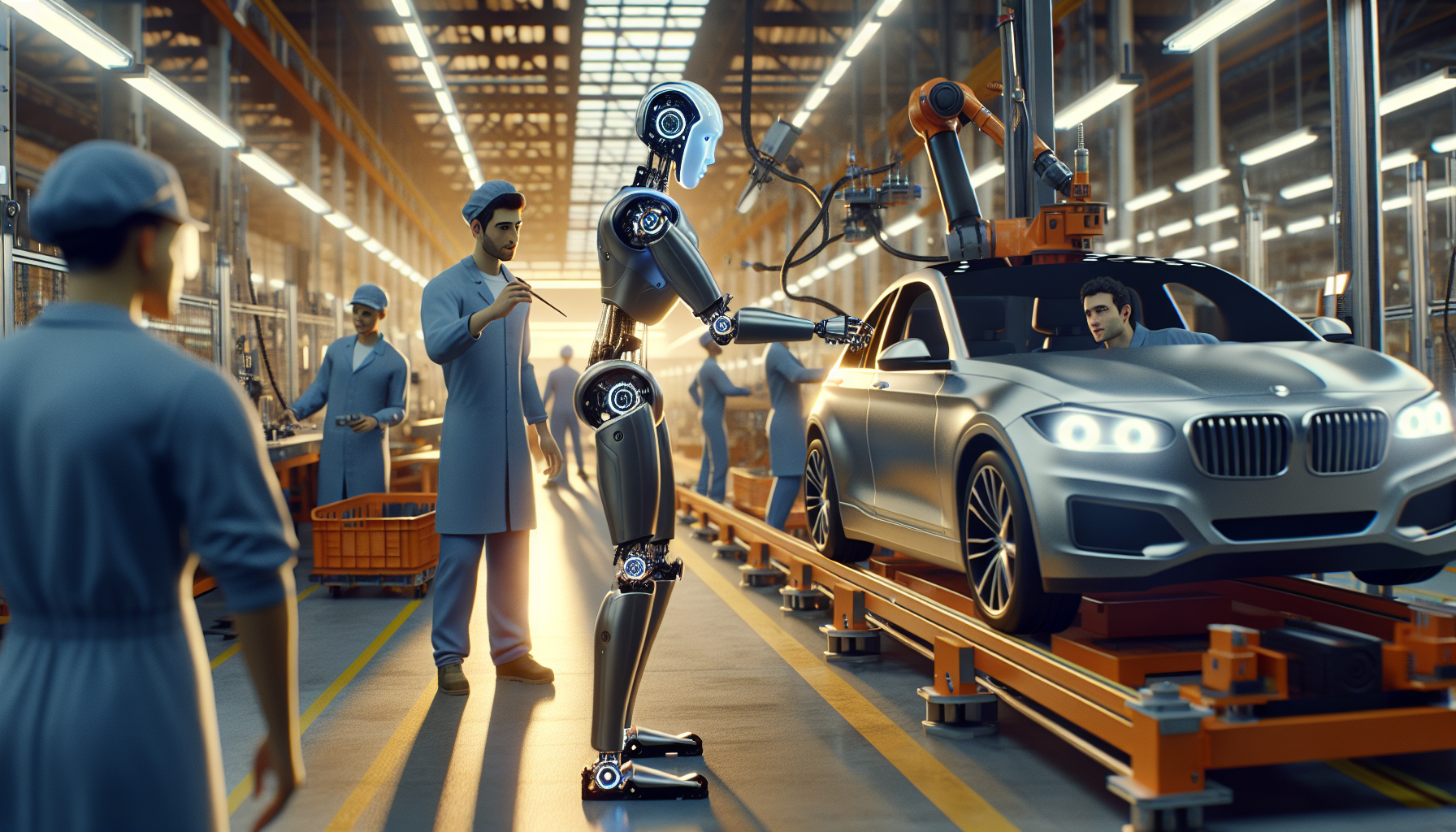
For most of the last decade, humanoid robots were a spectacle. Carefully choreographed demos wowed conference audiences while the machines quietly failed basic reliability tests behind closed doors. That era may be ending. In early 2026, several of the leading humanoid platforms have crossed a threshold that industry observers have long treated as theoretical: consistent, unsupervised task execution in live production environments.
From Warehouse to Assembly Line
The tipping point arrived quietly. Figure AI disclosed in March 2026 that its Figure 02 platform had completed more than 100,000 autonomous work cycles at a BMW Group plant in Spartanburg, South Carolina — the first publicly confirmed deployment of a humanoid robot in a high-volume automotive assembly context. The tasks were bounded — moving parts between stations, inserting fasteners, quality visual checks — but the deployment ran for 90 days without a safety incident requiring human intervention, a milestone the company described as “category-defining.”
Tesla’s Optimus program has taken a different route, deploying robots internally at its Fremont and Gigafactory Texas facilities before any external commercialization. CEO Elon Musk stated in the Q4 2025 earnings call that Tesla had over 1,000 Optimus units in internal operation, performing logistics and parts retrieval. He projected external sales would begin in “late 2026 or 2027,” with a target unit economics of under $20,000 at scale — a figure many analysts consider aspirational but no longer implausible given component cost curves.
1X Technologies, the Norwegian startup backed by OpenAI, has taken a services model approach: leasing its NEO humanoid to logistics operators on a per-shift basis. The company reported 47 enterprise customers as of Q1 2026, primarily in Scandinavia and the U.S. Midwest, with deployments spanning warehouse pick-and-pack, hospital linen handling, and retail overnight restocking.
The Intelligence Layer Changes Everything
What separates the 2026 deployments from earlier attempts is less mechanical — the hardware has been “good enough” for constrained tasks for several years — and more cognitive. The integration of large vision-language-action (VLA) models has dramatically reduced the time required to teach a robot a new task. Where traditional industrial robots required weeks of expert programming per task, modern humanoid platforms using VLA fine-tuning can generalize to new variations within hours.
Physical Intelligence (Pi), the San Francisco startup that raised $400 million in Series B funding in late 2025, has emerged as a key enabler. Its π0.5 model — a foundation model for physical manipulation — is licensed to multiple humanoid OEMs and effectively serves as the “operating system” for real-world dexterity. The model’s ability to handle novel objects and recover from dropped parts without explicit retraining has been cited by multiple customers as the decisive factor in production readiness.
“Two years ago, failure modes were the story,” said one manufacturing director at a Tier 1 automotive supplier who asked not to be named. “Now we’re having conversations about throughput and ROI.”
The Labor Question
The deployment of humanoid robots in manufacturing has reignited a debate economists and policymakers have been deferring since at least 2015. The International Federation of Robotics projects that 2.8 million humanoid units could be in commercial operation globally by 2030 — a number that, if realized, would represent the most rapid displacement of physical labor in industrial history.
The near-term evidence is more nuanced. Most current deployments target roles with chronic staffing shortages — overnight warehouse shifts, tasks in extreme temperatures, high-repetition injury-risk work. BMW’s Spartanburg plant, for instance, has maintained its human workforce while using Figure robots to absorb demand spikes it previously had to turn away contract labor to meet.
Whether that complementarity holds at scale remains the central uncertainty. The McKinsey Global Institute estimated in January 2026 that 12 million U.S. workers in transportation, warehousing, and manufacturing hold roles with greater than 50% task overlap with current humanoid capabilities — a figure that rises to 23 million by 2030 if software continues on its current improvement curve.
What Investors Are Pricing In
Capital markets have already bet heavily on the sector. The combined post-money valuation of the top five humanoid robotics companies — Figure, 1X, Agility Robotics (acquired by Amazon), Apptronik, and Fourier Intelligence — exceeds $25 billion, despite aggregate 2025 revenues of under $200 million. The implied revenue multiples reflect long-duration bets on compounding deployment curves, not current fundamentals.
The factories of 2026 are, for the first time, running genuine experiments with non-human coworkers. The results over the next 18 months will either validate those bets or reset expectations for the third time in a decade.
Sources: Figure AI deployment disclosures, Tesla Q4 2025 earnings call, 1X Technologies Q1 2026 customer report, International Federation of Robotics 2026 forecast, McKinsey Global Institute January 2026 labor analysis, Physical Intelligence funding announcement.


Discussion
Sign in to join the discussion.
No comments yet. Be the first to share your thoughts.