When President Trump signed off on the Stargate initiative in January 2025, the announcement drew its share of skepticism. A $500 billion commitment to domestic AI infrastructure, backed by three corporations with famously different cultures and incentives, seemed as likely to collapse under its own ambition as to deliver. Sixteen months later, the skeptics are quieter.
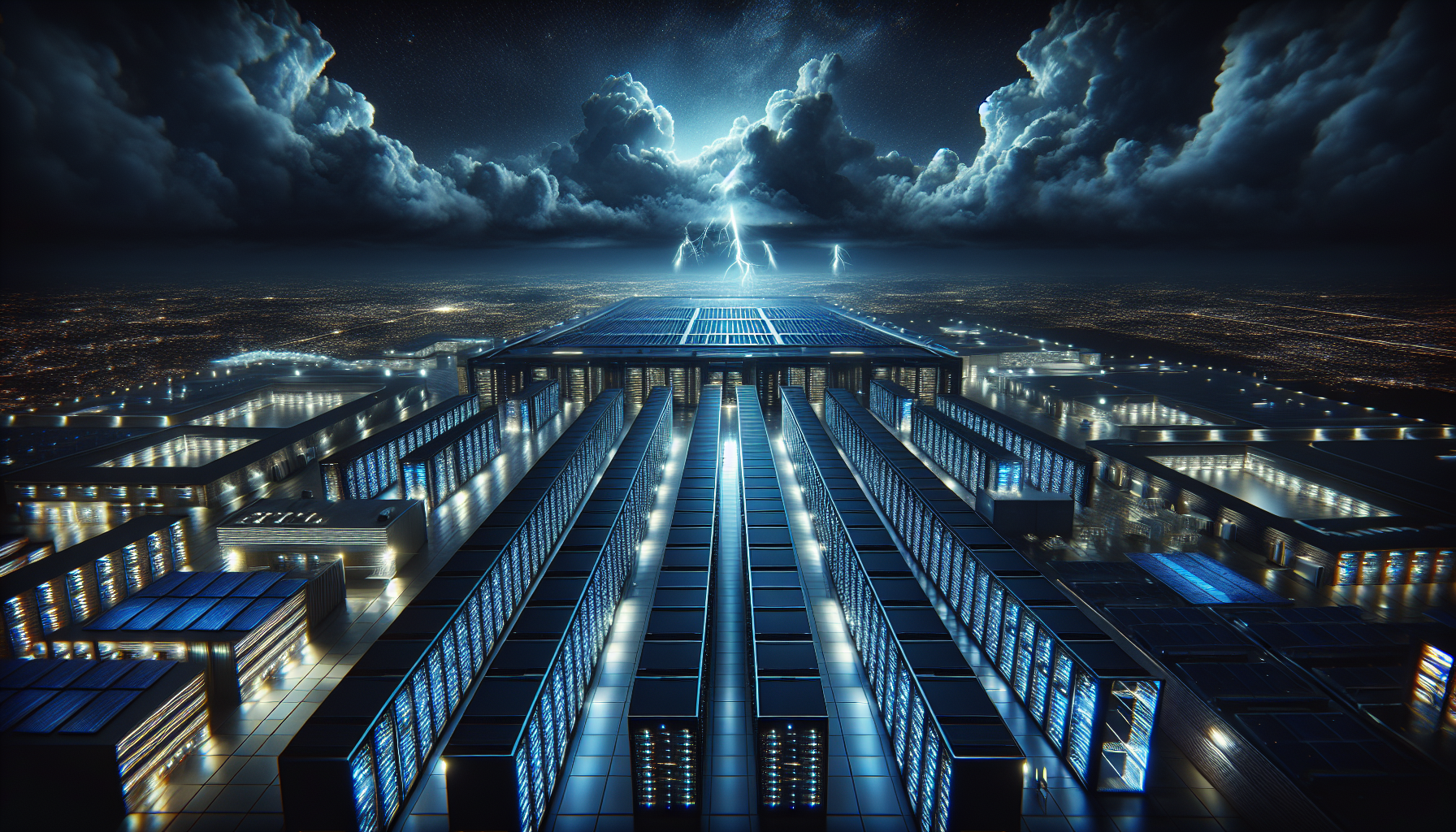
The Stargate Joint Venture — a tripartite structure between OpenAI, SoftBank, and Oracle — has broken ground on 16 data center campuses spanning Texas, Arizona, Wisconsin, Louisiana, and North Carolina. The first operational supercluster, a 400-megawatt facility outside Abilene, Texas, came online in Q1 2026 and is now running live inference workloads for OpenAI’s enterprise API customers.
The Numbers Behind the Buildout
The scale is difficult to overstate. According to filings with the Federal Energy Regulatory Commission reviewed by Clarqo, Stargate’s Texas campuses alone will draw an estimated 2.3 gigawatts of power at full build-out — roughly equivalent to the entire residential demand of San Antonio. Oracle, which is handling the physical infrastructure layer, has contracted for dedicated fiber corridors connecting the sites to its existing cloud backbone, with 400G optical links already provisioned between the Abilene and Phoenix nodes.
Capital deployment has tracked faster than the original 4-year timeline. SoftBank CEO Masayoshi Son confirmed in February that the consortium had deployed approximately $80 billion of its committed capital through end of 2025, front-loading spending on land acquisition, power interconnects, and custom rack designs optimized for NVIDIA’s GB300 NVL72 systems. NVIDIA itself has acknowledged Stargate as its single largest customer by GPU unit commitment for calendar 2026, with roughly 400,000 Blackwell-generation GPUs contracted for delivery across the year.
Power as the Real Bottleneck
The infrastructure story that matters most isn’t the chips — it’s the electrons. Every senior executive building large-scale AI infrastructure now uses the same phrase: power-constrained. Stargate’s team has moved aggressively to address this.
The consortium has signed long-term power purchase agreements with three nuclear plant operators, including a 20-year deal with Constellation Energy for dedicated capacity from the Byron Generating Station in Illinois. It has also partnered with Oklo, the advanced fission startup, for four modular reactor sites with initial capacities of 50 megawatts each, targeted for commercial operation in 2028. In Louisiana, a deal with Entergy will bring 600 megawatts of combined-cycle gas to a new Baton Rouge campus — a pragmatic concession to grid realities that drew criticism from environmental groups but kept the timeline intact.
“The lesson from the hyperscalers’ first decade is that power strategy is competitive strategy,” said one infrastructure analyst briefed on the project’s planning documents, who was not authorized to speak publicly. “Whoever locks up baseload capacity in the right geography wins the cost curve for the next ten years.”
OpenAI’s Strategic Logic
For OpenAI, Stargate is as much a defensive move as an offensive one. CEO Sam Altman has consistently argued that the next phase of AI capability gains — including AGI-class systems — will be compute-intensive in ways current cloud contracts cannot reliably guarantee. By owning the physical substrate, OpenAI gains optionality: the ability to run training runs of arbitrary size without negotiating spot capacity with hyperscalers who are simultaneously building competing models.
The business model is also evolving. Early plans to charge API customers a fixed rate for inference are giving way to a tiered structure in which enterprise clients can effectively reserve dedicated capacity on specific Stargate clusters — a model borrowed from financial data centers and colocation providers. OpenAI has reportedly approached a half-dozen Fortune 100 companies about anchor-tenant arrangements, with contract values in the hundreds of millions over multi-year terms.
Risks That Remain
Not everything is on track. Construction timelines in Wisconsin and North Carolina have slipped by approximately six months, partly due to permitting delays and partly due to supply chain constraints on custom power distribution equipment. Analysts at Morgan Stanley estimate that the 2027 capacity targets will require roughly $120 billion in additional capital beyond what has already been committed — a figure that implies continued heavy capital raises or debt financing by SoftBank.
There is also a competitive threat that has emerged since the original announcement: China’s state-backed AI infrastructure push, which has deployed an estimated 1.8 gigawatts of AI-specific compute capacity in 2025 alone, is narrowing the gap faster than many Western observers expected. Whether Stargate can sustain its head start will depend not just on how fast it builds, but on how efficiently it converts raw compute into capable, differentiated models.
The concrete is being poured. The real test starts now.
Sources: FERC public filings, Oracle earnings call transcripts (Q4 2025, Q1 2026), SoftBank investor presentation February 2026, NVIDIA partner briefing materials, Constellation Energy press release.


Discussion
Sign in to join the discussion.
No comments yet. Be the first to share your thoughts.