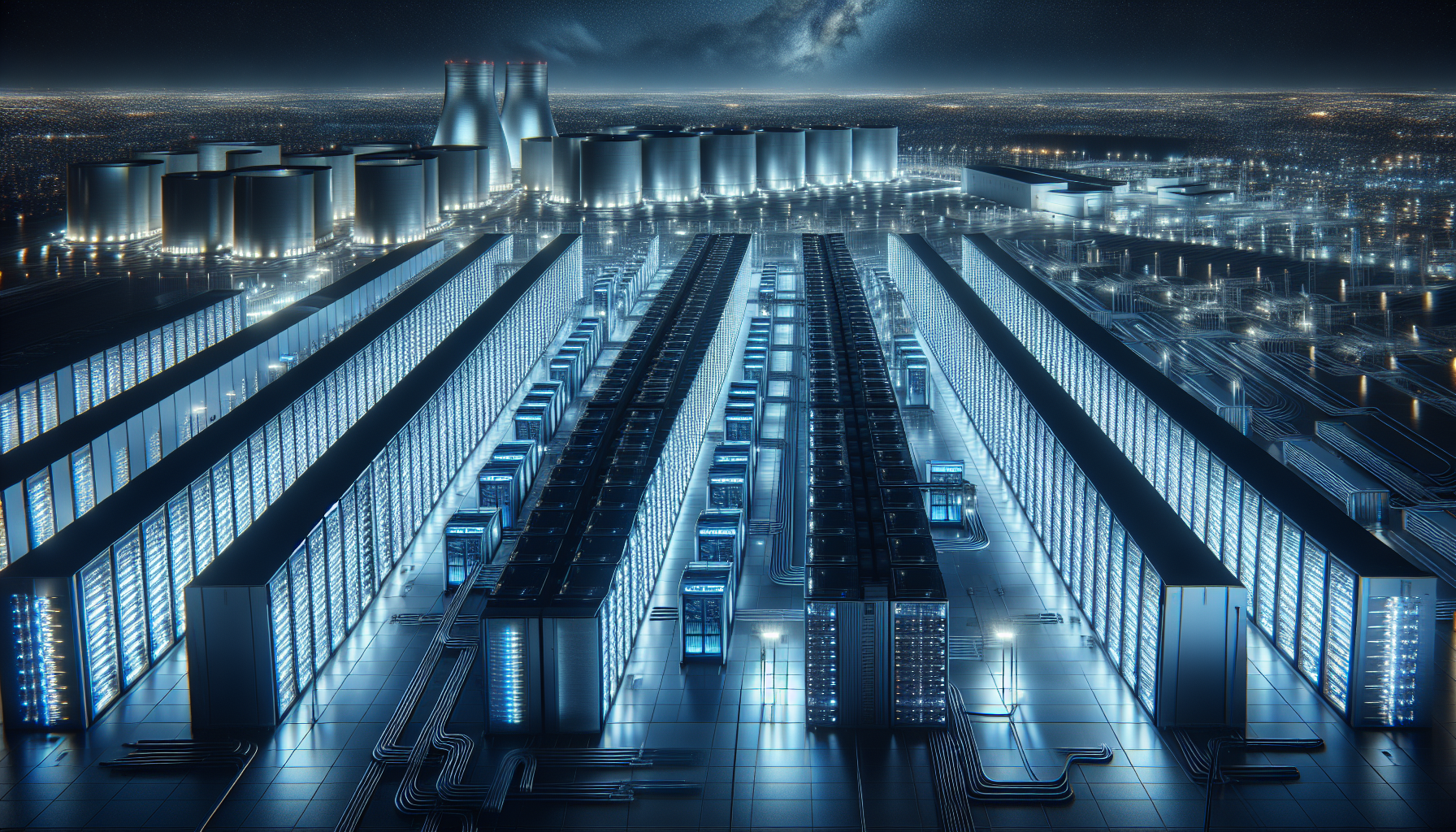
The United States added more data center capacity in 2025 than in the prior five years combined. The consequence is now inescapable: the power grid is struggling to keep up, and the companies building the AI economy are writing checks the electrical infrastructure may not be able to cash.
A Demand Curve Nobody Modeled
When utilities filed their 10-year demand forecasts in 2021, AI hyperscalers barely registered. By mid-2025, the picture had inverted. The Electric Power Research Institute estimates that U.S. data centers could consume up to 9.1% of total national electricity generation by 2030, up from roughly 4% today. Microsoft, Google, Amazon, and Meta collectively announced more than $320 billion in capital expenditure for compute infrastructure in 2025 alone — nearly all of it power-hungry GPU clusters running large language and multimodal models.
The crunch is most visible in Virginia’s “Data Center Alley,” which now hosts more than 35% of the world’s internet traffic routing capacity. Dominion Energy, the region’s primary utility, has disclosed a backlog of interconnection requests that would require double its current generating capacity to fulfill. Similar queues are forming in Texas, Arizona, and the Pacific Northwest.
“We are seeing interconnection requests that we simply cannot serve under current grid expansion timelines,” a Dominion executive told federal regulators in February 2026. “The mismatch between data center construction pace and transmission buildout is measured in years, not months.”
Nuclear, Gas, and the Renewables Gap
Faced with grid constraints, hyperscalers have moved aggressively into direct power procurement — often bypassing utilities entirely. Microsoft’s 20-year restart agreement with the Three Mile Island Unit 1 nuclear facility in Pennsylvania, signed in late 2023 and now delivering power, became a template. Google followed with a deal for output from Kairos Power’s small modular reactors (SMRs), expected online by 2030. Amazon has signed letters of intent with three SMR developers across the Southeast.
Natural gas is filling the gap in the near term. Data suggests that AI-driven electricity demand has pushed U.S. gas-fired generation to multi-year highs, partially reversing efficiency gains from renewable deployment. The Lawrence Berkeley National Laboratory estimates that for every dollar of AI compute revenue generated in 2025, approximately 1.4 kg of CO₂ was emitted — a metric that advocacy groups argue makes tech companies’ net-zero pledges mathematically strained without accelerated grid decarbonization.
Renewables are being deployed at record pace — the U.S. added 41 GW of solar in 2025 — but intermittency remains a structural problem for 24/7 compute loads. Battery storage economics, while improving, have not yet bridged the dispatchability gap at the scale hyperscalers require.
Policy Response: Too Slow, Too Fragmented
The Biden and Trump administrations both treated AI infrastructure buildout as a strategic national priority, but neither produced a coherent federal response to the power bottleneck. FERC’s Order 1920, requiring transmission planners to study long-range needs proactively, has faced legal challenges and slow implementation. Permitting reform legislation stalled in the Senate.
State-level responses vary dramatically. Texas has leaned into deregulated markets to attract data center investment; critics note that the ERCOT grid’s narrow reserve margins create systemic risk. California has imposed stricter efficiency standards on new data centers but has struggled to site new transmission.
The economic stakes are high. Oxford Economics estimates that each percentage point of AI-driven productivity growth is worth approximately $300 billion annually to U.S. GDP over a decade. But that gain evaporates if power constraints throttle the compute expansion that makes it possible.
What Comes Next
The next 18 months will likely determine whether the AI power crisis becomes a structural brake on the industry or a solved problem. Key indicators to watch: FERC’s transmission queue reform timeline, the pace of SMR first-of-kind deployments, and whether the $50 billion in grid infrastructure funding from the 2021 Infrastructure Investment and Jobs Act is deployed before demand outpaces supply.
For now, the hyperscalers are buying every megawatt they can find — and the rest of the economy is beginning to notice the bill.
Sources: Electric Power Research Institute (2025 load forecast), Lawrence Berkeley National Laboratory (2025 data center energy study), Dominion Energy FERC filings, Oxford Economics AI productivity modeling.


Discussion
Sign in to join the discussion.
No comments yet. Be the first to share your thoughts.