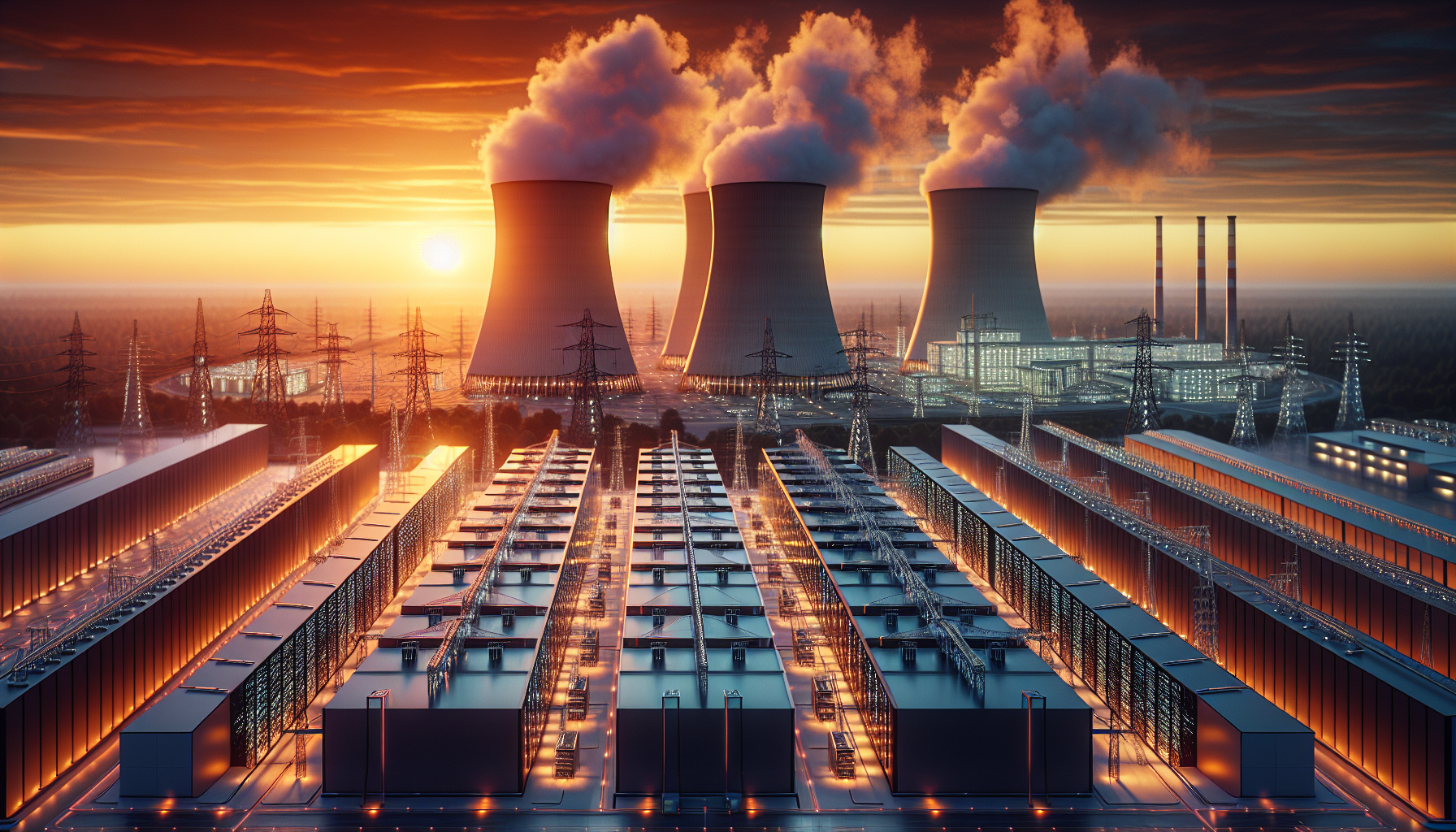
The servers never sleep, and neither does the power demand feeding them. As artificial intelligence workloads balloon from research curiosity to global infrastructure backbone, the technology industry has quietly engineered one of the most consequential energy pivots in modern history — a full-throated embrace of nuclear power that is reshaping electricity markets, reviving dormant reactors, and funding the next generation of atomic technology.
The numbers are difficult to overstate. Data centers consumed roughly 2.5% of global electricity in 2024, according to the International Energy Agency — a figure the IEA projected would double by 2026 as AI inference workloads scale. A single large language model training run now requires between 1 gigawatt-hour and 10 GWh of electricity. Running frontier AI inference at scale for millions of users continuously demands the kind of always-on, carbon-free power that wind and solar, for all their advances, cannot reliably deliver around the clock.
The Deals That Changed Everything
The inflection point arrived in late 2023 when Microsoft signed a landmark 20-year power purchase agreement to restart Unit 1 of Three Mile Island — yes, that Three Mile Island — operated by Constellation Energy. The deal, valued at approximately $3.4 billion over its term, was the clearest signal yet that Big Tech was willing to put serious capital behind nuclear reliability. Microsoft said the power would feed its AI infrastructure in the PJM grid region, which spans 13 eastern U.S. states.
Google followed with a multi-reactor agreement with Kairos Power, a startup developing high-temperature gas-cooled reactors, targeting 500 megawatts of capacity by 2030. Amazon Web Services went further still, acquiring a data center campus from Talen Energy that sits directly adjacent to the Susquehanna nuclear plant in Pennsylvania — cutting transmission losses to near zero and locking in roughly 960 MW of dedicated atomic power.
Oracle’s Larry Ellison announced plans for a 1.3 GW nuclear-backed data center campus in early 2025, describing it as “the largest data center ever built.” By early 2026, the company had broken ground on the first phase.
Small Modular Reactors: The Long Game
Beyond restarting existing plants, technology companies are betting heavily on Small Modular Reactors — compact, factory-built nuclear plants designed to be deployed in three to five years rather than the decade-plus timelines of conventional gigawatt-scale reactors. NuScale Power, X-energy, TerraPower (backed by Bill Gates), and Kairos Power are the leading U.S. contenders, each pursuing slightly different reactor designs and fuel types.
The U.S. Nuclear Regulatory Commission approved NuScale’s Standard Design Approval in 2022 — the first SMR design certified in the country. Commercial deployments are now anticipated between 2028 and 2032, and multiple tech companies have signed letters of intent for capacity.
“SMRs change the economic calculus entirely,” said one infrastructure analyst at a major investment bank who declined to be named. “You can site them adjacent to a data center, right-size the capacity, and avoid the long-distance transmission losses that erode the economics of remote renewables.”
The aggregate investment across nuclear deals, SMR equity stakes, and direct power purchase agreements now exceeds $100 billion when measured across the five largest cloud providers — a figure the Nuclear Energy Institute described to Reuters as “a structural realignment of the energy sector around computational demand.”
Grid Stress and the Political Dimension
The nuclear revival has not arrived without friction. Grid operators including PJM Interconnection and MISO have raised alarms about the speed of data center load growth, warning that adding hundreds of gigawatts of demand faster than new generation can come online risks reliability events — in plain language, blackouts.
State regulators in Virginia, Texas, and Georgia — three of the largest data center markets — have launched proceedings to determine how the costs of grid upgrades triggered by hyperscaler demand should be allocated. The core question: should residential ratepayers subsidize the transmission infrastructure that primarily serves trillion-dollar corporations?
Congress has moved cautiously. The ADVANCE Act of 2024 streamlined some NRC licensing procedures, and the 2025 American AI Infrastructure Act included loan guarantee provisions for nuclear projects serving AI workloads. But a comprehensive grid modernization bill remains stalled in the Senate.
The Calculus of Clean and Reliable
For technology companies under intense investor and regulatory scrutiny over their carbon footprints, nuclear offers a compelling combination: near-zero operational emissions, capacity factors above 90%, and land-use requirements a fraction of equivalent solar or wind installations.
Google’s 2025 environmental report noted that AI-driven demand growth had pushed its total electricity consumption to a level where renewable matching on a purely annual basis was no longer sufficient for its stated 24/7 carbon-free energy goals. Nuclear, the company wrote, “provides the firm, carbon-free baseline that intermittent sources cannot.”
The irony is not lost on longtime climate advocates: the technology most often blamed for accelerating energy consumption may end up being the catalyst that makes nuclear power economically viable in the 21st century. Whether that is a triumph of market forces or a cautionary tale about the true cost of intelligence at scale is a question the industry has not yet answered.
What is clear is that the machines will keep running — and the question of what powers them has moved from corporate sustainability report to strategic national infrastructure debate.


Discussion
Sign in to join the discussion.
No comments yet. Be the first to share your thoughts.