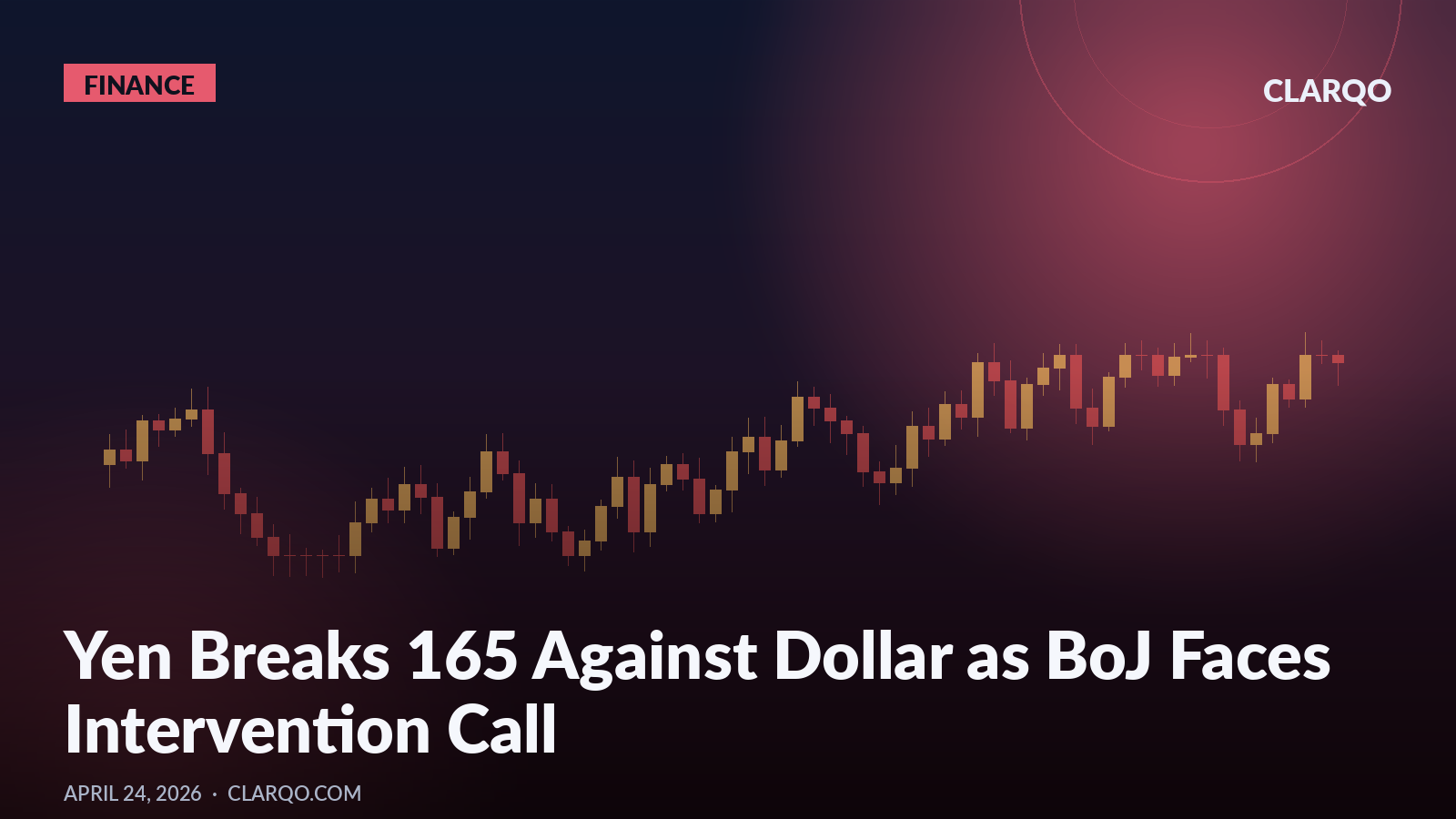
Yen Breaks 165 Against Dollar as BoJ Faces Intervention Call
The Japanese yen crossed 165 against the US dollar in overnight Asian trading on Thursday, a level last seen during the 1986 Plaza Accord era and one that economists say will force the Bank of Japan and the Ministry of Finance to confront an intervention decision within days. The move extends a 9% depreciation year-to-date and reignites a debate that has dogged Tokyo policymakers for three years: whether currency intervention without a parallel rate-hike cycle can do more than briefly slow the slide (Bloomberg FX data, April 24, 2026).
The Rate Gap Is Back in the Driver’s Seat
The proximate cause of the break through 165 is the widening interest rate differential between the Federal Reserve and the Bank of Japan. The Fed’s April FOMC minutes, released Wednesday, showed the committee leaning hawkish on its 2026 path: policymakers now see at most one 25 basis point cut in the second half of the year, down from the three cuts priced in by futures markets as recently as January. The BoJ, by contrast, raised its policy rate only to 0.75% at its March meeting and Governor Kazuo Ueda has publicly cautioned that further hikes depend on sustained wage growth through the spring shunto round.
The resulting gap — a US 10-year Treasury yield of 4.48% against a Japanese 10-year JGB yield of 1.62% — is the widest differential seen this cycle and is pulling yen-denominated capital into dollar assets at a pace Tokyo cannot easily offset. The Finance Ministry’s weekly flow data released Thursday showed net outflows of ¥2.3 trillion (about $14 billion) from Japanese investors into foreign bonds over the past week alone, the largest weekly reading since July 2024.
What Intervention Would and Wouldn’t Do
Japan last intervened in currency markets in July and October 2024, deploying a combined ¥15.3 trillion (roughly $100 billion) to push the yen back from the 161 and 154 levels respectively. Those episodes succeeded in creating two- to three-week pauses but did not reverse the underlying trend, which continued its grind weaker through 2025.
The playbook this week would likely mirror 2024: coordinated MoF-BoJ action, possibly with advance notification to the US Treasury, deployed in thin Asian trading hours to maximize shock value. Three constraints shape the decision:
- Reserve capacity. Japan holds roughly $1.23 trillion in foreign exchange reserves as of March 2026, the second-largest in the world after China. That is ample ammunition in absolute terms, but the marginal cost of each intervention rises as markets anticipate the playbook.
- US political backdrop. The Trump administration has been publicly skeptical of currency intervention by trading partners, and Treasury Secretary Scott Bessent has signaled he views aggressive FX action as potentially triggering a “manipulator” review under the 2015 Trade Facilitation Act.
- Domestic inflation pressure. Japanese core CPI rose to 3.1% year-on-year in March, above the BoJ’s 2% target for the 24th consecutive month. Imported inflation via a weak yen is increasingly a political problem, particularly for energy and food prices ahead of the July upper-house election.
Bank of America’s Tokyo FX desk put the probability of intervention within five trading days at 65% in a client note Thursday, conditional on the yen staying above 164 on a closing basis. Goldman Sachs pegged it lower at 45%, arguing that the MoF may wait for a more disorderly move before committing reserves.
The Longer Question Tokyo Is Avoiding
Intervention buys time. It does not close rate differentials. Unless the BoJ is prepared to accelerate its hiking cycle — something Ueda has explicitly refused to do on currency grounds — or the Fed pivots dovish on a weakening US labor market, the yen’s structural pressure remains intact. The 2024 interventions, which drew fire from market commentators for their short half-life, illustrate the trap: Tokyo is spending reserves to slow a move it is not willing to address with monetary policy.
For investors, the practical implications are three-fold. Equities tied to export revenue — Toyota, Sony, Tokyo Electron — benefit from yen weakness but have already priced much of the tailwind. Japanese bank stocks are the cleaner trade if the BoJ ultimately capitulates on rates. And dollar-yen volatility, which BoJ intervention mechanically amplifies, remains a setup that option desks in Tokyo and London have been positioning for through April.
The next catalyst is the BoJ’s April 30 policy meeting. If Ueda holds rates and the yen is still trading above 164, the pressure on the MoF to act becomes difficult to resist. Intervention is not a strategy — but in late April 2026, it may be the only tool Tokyo is willing to use.


Discussion
Sign in to join the discussion.
No comments yet. Be the first to share your thoughts.