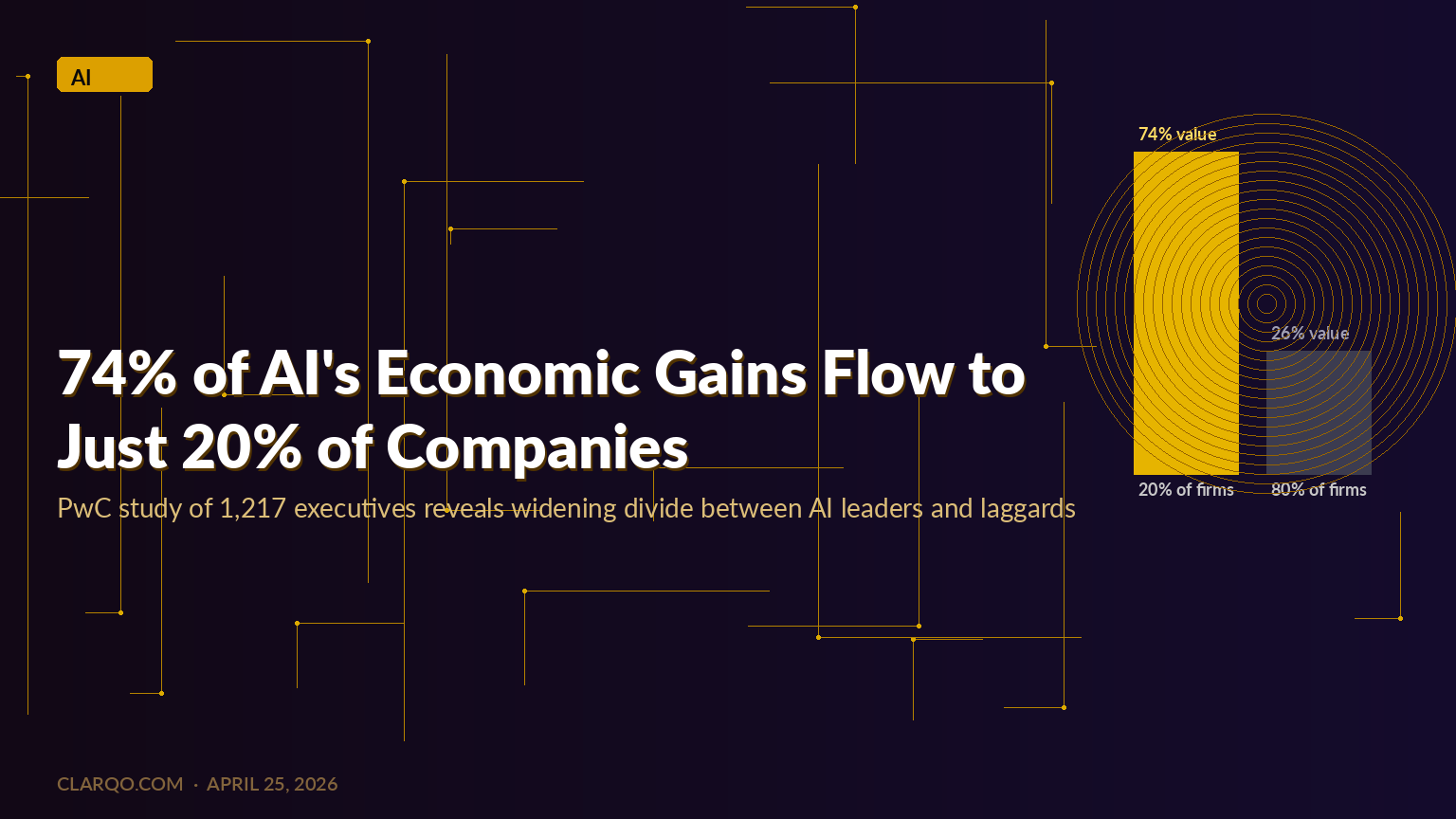
A new study from PwC makes the AI divide concrete in a way that boardroom conversations rarely do: nearly three-quarters of the economic value created by artificial intelligence is flowing to just one-fifth of companies deploying it. The rest — the majority — are running pilots, issuing press releases, and watching the gap widen.
The finding comes from PwC’s 2026 AI Performance Study, published April 13, which surveyed 1,217 senior executives primarily at large, publicly listed companies across 25 sectors globally. It is one of the most granular looks to date at why AI investment translates into financial returns for some organisations and not others.
The Numbers Behind the Divide
The headline is stark: 74% of AI’s economic value captured by 20% of organisations. But the performance differential is even more striking at the individual company level. PwC found that top-performing AI companies generate 7.2 times more AI-driven revenue and efficiency gains than the average competitor — not 20% more, not twice as much, but 7.2x.
The laggards are not sitting still, either. Most companies surveyed are actively deploying AI tools. The problem, PwC argues, is where they are pointing those tools. The majority are using AI to reduce operational costs and automate existing tasks. The leaders are using it to grow revenues, enter new markets, and reinvent their business models.
What Separates Leaders from Laggards
The research isolates several distinguishing factors. AI leaders are 2.6 times more likely to report that AI improves their ability to reinvent their business model. They are two to three times more likely to use AI to identify growth opportunities arising from industry convergence — for example, a logistics company expanding into last-mile retail analytics, or a bank entering health insurance underwriting through data partnerships.
PwC identifies industry convergence as the single strongest factor influencing AI-driven financial performance, ahead of cost efficiency gains. This is a meaningful finding: it suggests that the strategic ceiling for AI value is not in doing existing things faster, but in enabling businesses to do things they could not do before.
On the operational side, AI leaders run their deployments differently. They are 1.8 times more likely to deploy AI in multi-task, agentic modes — executing complex sequences within defined guardrails — and 1.9 times more likely to operate autonomous, self-optimising AI systems. They are increasing the volume of decisions made without human intervention at 2.8 times the rate of peers, while simultaneously investing more heavily in AI governance frameworks and cross-functional oversight boards.
The Compounding Problem
Perhaps the most concerning implication of the study is structural. AI leaders are not simply ahead — they are pulling away faster. Companies that have cracked the value equation are learning faster, scaling proven use cases more aggressively, and automating more decisions per quarter. Companies still running pilots are accumulating neither the operational data nor the organisational muscle memory needed to close the gap.
PwC’s conclusion is direct: without a deliberate shift in how AI is deployed — from productivity tool to growth engine — the majority of organisations will continue to capture diminishing returns relative to a small, compounding elite. The message for executives is not that AI is overhyped. It is that the way most companies are using it is.
Sources: PwC 2026 AI Performance Study (April 13, 2026), PwC press release, ResultSense, EME Outlook Magazine


Discussion
Sign in to join the discussion.
No comments yet. Be the first to share your thoughts.