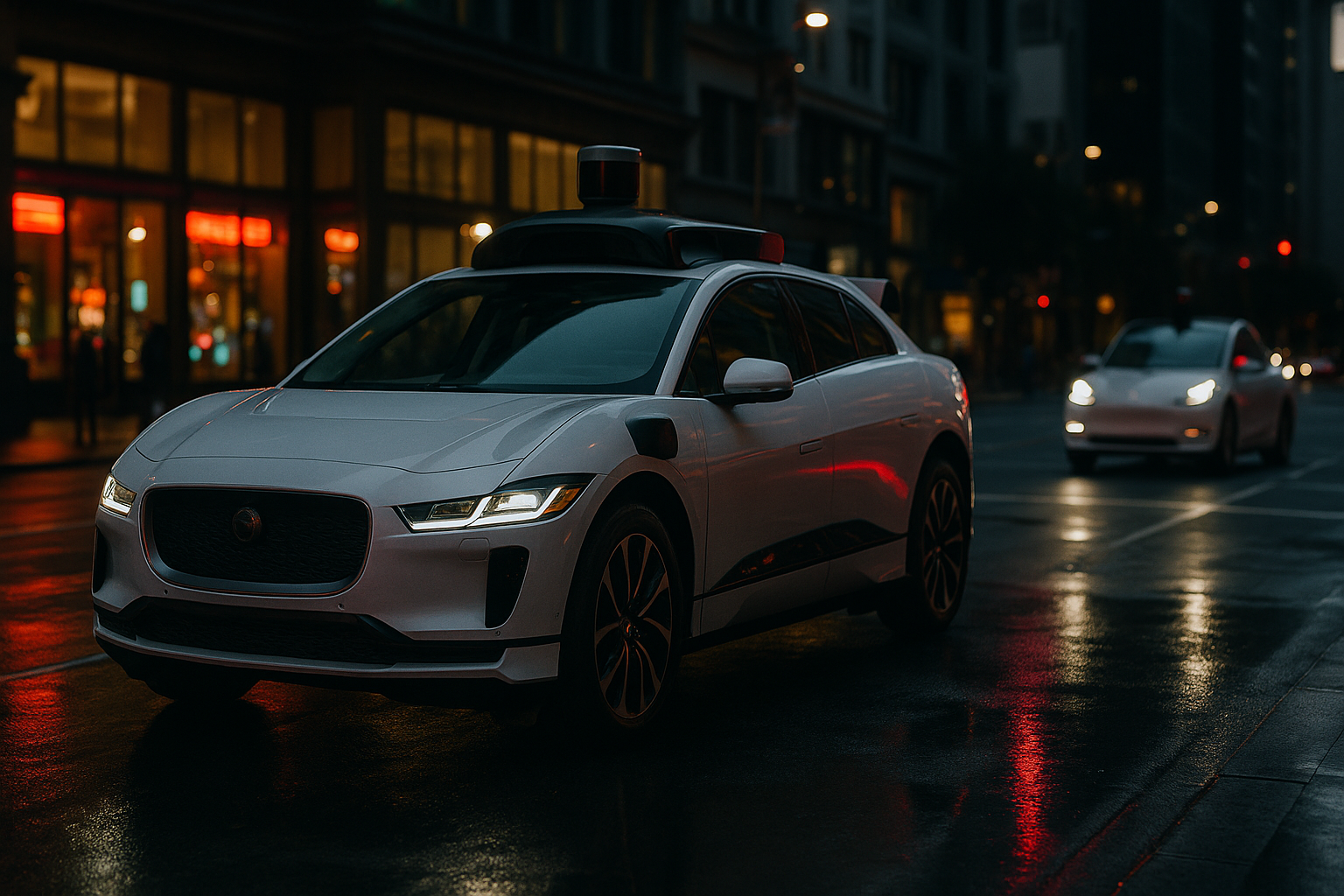
Alphabet’s Waymo confirmed this week that its driverless ride-hailing service is now serving more than 1 million paid rides per week across its U.S. metros, a fivefold increase since the company crossed 200,000 weekly rides in mid-2024. The milestone, disclosed in a blog post by co-CEO Tekedra Mawakana on April 25, 2026, makes Waymo the first autonomous-vehicle operator to reach commercial scale that rivals incumbent ride-hail rosters in any single city.
In parallel, Tesla announced that its Robotaxi service in Austin has been cleared by Texas regulators to operate without an in-cabin safety monitor on a defined set of highway corridors and is expanding its geofence to cover roughly 90 square miles of the metro area. The two announcements, landing within 36 hours of each other, mark the moment robotaxis stopped being a demo and started behaving like infrastructure.
Waymo’s Compounding Lead
Waymo now operates commercially in San Francisco, Phoenix, Los Angeles, and Austin (in partnership with Uber), and has open-waitlist programs in Atlanta, Miami, and Washington D.C. According to Mawakana’s post, the fleet has logged more than 200 million driverless miles to date, with insurance-claim rates reportedly 88% lower than human drivers in comparable urban operating zones (per Waymo-Swiss Re analysis published earlier this year).
The 1 million weekly rides figure is significant because it crosses a threshold Cruise — General Motors’ shuttered competitor — never reached before its 2023 collapse. Waymo’s unit economics are still publicly murky, but Alphabet’s Q1 2026 earnings call, held this week, characterized the Other Bets segment as “trending toward operating leverage as Waymo scales,” without providing standalone numbers. Citi analysts estimated last month that Waymo is approaching contribution-margin breakeven in Phoenix and SF.
Tesla’s Austin Expansion
Tesla’s Robotaxi service launched in Austin in June 2025 with a small fleet of Model Y vehicles, an in-cabin safety monitor, and a tightly drawn geofence. The Texas Department of Public Safety this week approved Tesla’s request to remove the safety-monitor requirement on selected I-35 and MoPac highway segments, contingent on Tesla maintaining its incident reporting cadence with state regulators.
The service area expansion brings Tesla’s effective coverage in Austin closer to parity with Waymo’s local footprint, although ride volumes remain orders of magnitude smaller. Tesla has not disclosed weekly ride counts, but Bloomberg estimated the company is currently completing fewer than 5,000 paid rides per week across all Robotaxi markets.
Tesla’s approach also remains technically distinct: a vision-only stack with no lidar, running on the FSD v13 codebase. That contrasts with Waymo’s heavy sensor suite and lidar-fused mapping. The two platforms now share roads in Austin, giving regulators their first real-world side-by-side data set of the two dominant AV philosophies.
What Comes Next
The robotaxi conversation is shifting from “will it work?” to “who controls the platform?” Uber, which partners with Waymo in Austin and Atlanta, is positioning itself as the routing and demand layer for any AV fleet. Lyft signed a partnership with Mobileye-backed Holon last month. And Tesla, with its captive vehicle fleet and direct-consumer app, is the only operator pursuing a fully vertical model.
For cities, the operational implications are concrete: curb-space management, emergency-vehicle interaction protocols, and mass-transit integration are now budget-line items, not theoretical concerns. San Francisco’s MTA published its first AV-impact report this week, finding measurable congestion improvements on key corridors but flagging concerns about deadhead miles between rides.
The milestone year for autonomous ride-hailing is no longer five years away. It is happening — unevenly, and in public.
(Sources: Waymo blog (April 25, 2026), Alphabet Q1 2026 earnings call, Tesla press release, Texas DPS bulletin, Bloomberg, Reuters, SFMTA AV report.)


Discussion
Sign in to join the discussion.
No comments yet. Be the first to share your thoughts.