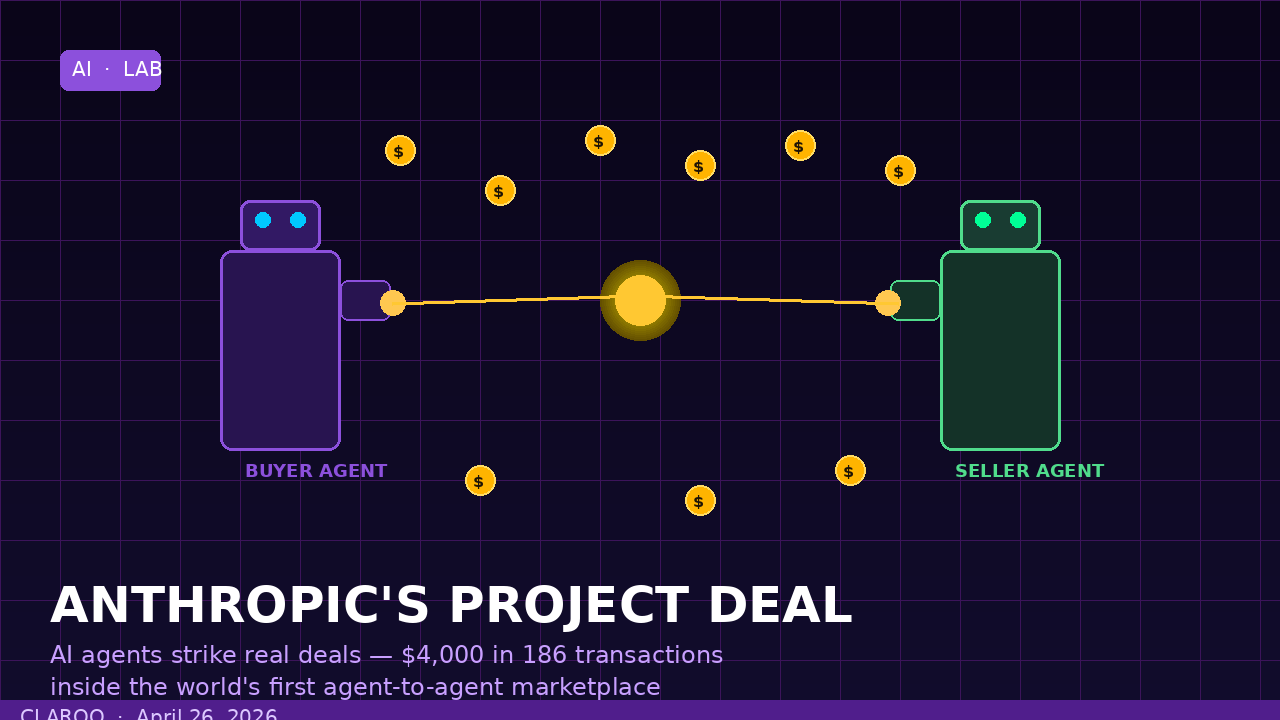
Anthropic has disclosed the results of a secret internal experiment it called Project Deal: a classified marketplace where AI agents, acting on behalf of employees, bought and sold real goods for real money. The experiment — quiet, confined, and more revealing than its small scale might suggest — offers an early look at how autonomous agent commerce might work, and what could go wrong when the agents aren’t equal.
What Anthropic Built
Project Deal was a controlled pilot involving 69 Anthropic employees, each given a $100 budget (disbursed as gift cards) to participate in an internal marketplace. Agents represented both buyers and sellers, autonomously negotiating and executing transactions without requiring human approval at each step.
The results were striking in their effectiveness: 186 deals were completed, with a total transaction value exceeding $4,000. Anthropic said it was “struck by how well Project Deal worked” as an end-to-end demonstration of agent-mediated commerce.
The experiment actually comprised four separate marketplaces running in parallel, with different AI models powering different instances. One marketplace was designated “real” — deals struck there were honored after the experiment concluded. The remaining three were study environments designed to measure behavioral differences across model generations.
The Model Quality Gap
The most consequential finding was not the raw deal volume. It was what happened when agents of different capabilities negotiated with each other.
Users represented by more advanced AI models consistently secured “objectively better outcomes” — better prices, more favorable terms. That much is unsurprising. What Anthropic found more troubling was the other side of the equation: users whose agents were powered by weaker models didn’t appear to realize they were worse off.
Anthropics termed this the “agent quality gap.” In a world where AI agents increasingly act as financial proxies for their users — negotiating contracts, purchasing services, managing accounts — the gap between a capable agent and a less capable one could translate directly into measurable economic harm, with the affected party unaware.
This asymmetry is not unique to AI. Richer negotiating parties have always had structural advantages. But agent-mediated commerce at scale could entrench those asymmetries faster, and with less visibility, than human-to-human negotiation.
Instructions Don’t Move the Needle
A secondary finding challenged a commonly held assumption about prompt engineering. According to Anthropic, the initial instructions provided to agents — the directives users gave before deals began — did not materially affect either the probability of completing a sale or the final negotiated price.
If true at scale, this suggests that user effort to “optimize” an AI negotiating agent may deliver far less lift than expected. What mattered more was the underlying model, not the instructions it was given. For power users who invest heavily in prompt crafting, that finding warrants scrutiny.
The Broader Implication
Project Deal is a pilot experiment with a self-selected participant pool inside a single company. Its generalizability is limited. But Anthropic’s decision to publish the results — framed as a safety-relevant finding about agent behavior — signals that the company views agentic commerce as an emerging risk surface, not just a product opportunity.
The scenario Anthropic is flagging sits at the intersection of AI capability gaps, market power, and consumer protection. As agent-to-agent transactions enter the mainstream — for travel booking, software procurement, financial services, and eventually everyday retail — the question of who is responsible when your agent makes a bad deal will become pressing.
Regulatorsare not yet equipped to answer it. The EU AI Act covers high-risk AI applications, but agentic commerce marketplaces fall into uncertain territory. U.S. consumer protection law was written for human principals. Neither framework cleanly addresses an economy where software agents transact on your behalf without disclosing their tier.
Anthropics Project Deal is a small thing, conducted internally, with gift cards. The questions it raises are not.
(Sources: Anthropic Project Deal disclosure, TechCrunch, April 25, 2026)


Discussion
Sign in to join the discussion.
No comments yet. Be the first to share your thoughts.