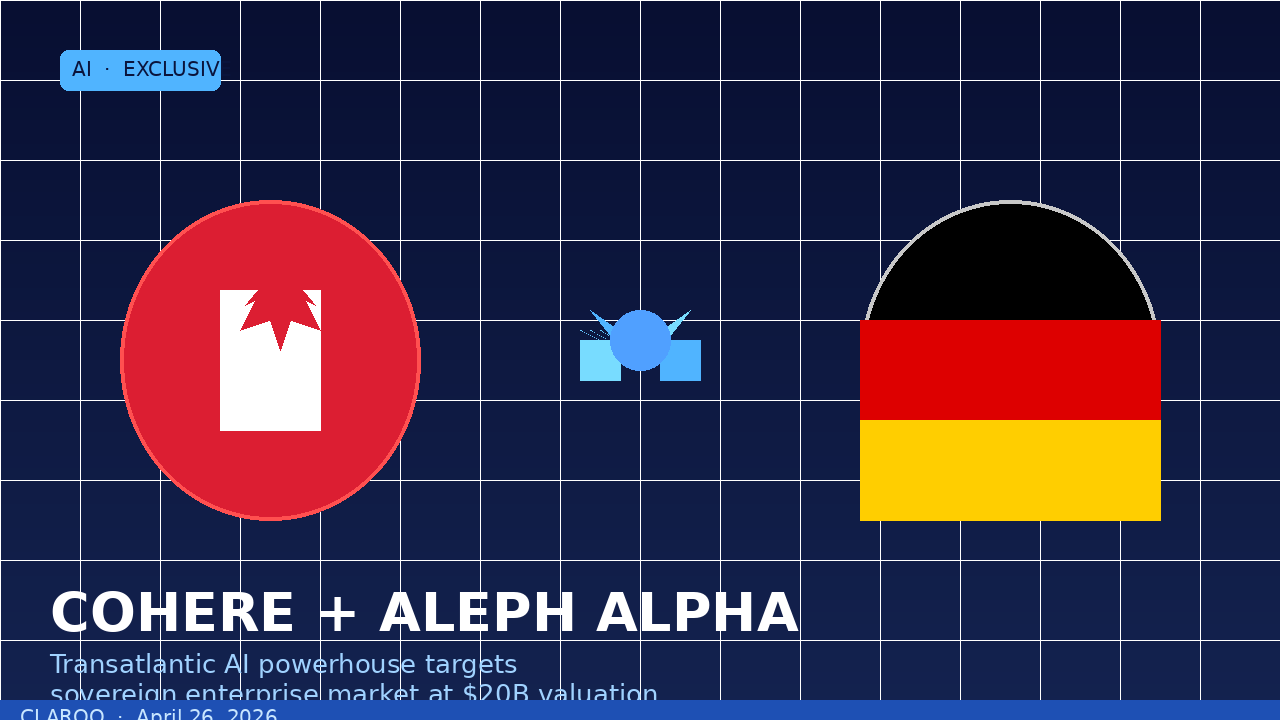
Canadian AI startup Cohere is acquiring German counterpart Aleph Alpha, creating what both companies describe as a transatlantic AI powerhouse aimed squarely at enterprises and governments that need AI solutions outside American control. The deal, announced April 25, 2026, values the combined entity at approximately $20 billion — a significant step up from Cohere’s last valuation of $6.8 billion.
The Deal: Structure and Scale
Cohere will lead the merged entity, absorbing Aleph Alpha’s 250-person team and its specialized European-language models. Schwarz Group — the retail conglomerate that owns Lidl and Kaufland — is acting as both a major shareholder in Aleph Alpha and the lead investor in Cohere’s Series E round, committing €500 million (~$600 million) in structured financing.
In exchange, Schwarz Group expects the merged company to use STACKIT, the sovereign cloud service operated by its IT subsidiary Schwarz Digits. The valuation of roughly $20 billion, first reported by German business outlet Handelsblatt, is substantially above what Cohere’s revenue alone would justify: the company reported $240 million in annual recurring revenue for 2025, while Aleph Alpha had previously generated little revenue and posted significant losses.
The bet is on combined strategic value, not current economics.
Sovereignty as a Go-to-Market
The explicit mission of the merged company is sovereign AI — offering enterprises in heavily regulated sectors an alternative to U.S.-based providers. Target verticals include defense, energy, finance, healthcare, manufacturing, and telecommunications, as well as public-sector customers in Europe and Canada.
The political dimension was visible at the announcement. Germany’s digital minister Karsten Wildberger and his Canadian counterpart Evan Solomon both appeared at the press conference alongside Cohere CEO Aidan Gomez and Aleph Alpha co-founder Samuel Weinbach. Canada and Germany formalized their Sovereign Technology Alliance in February 2026, explicitly aimed at reducing “strategic technology dependencies” — a reference, barely coded, to U.S. Big Tech.
“Cohere will become a Canadian-German company,” Gomez said at the press conference. The alignment is not accidental: as trade tensions between the U.S. and its allies intensified in early 2026, European and Canadian enterprise buyers began looking harder for alternatives.
What Aleph Alpha Brings
Aleph Alpha developed specialized models optimized for European languages and regulated enterprise workflows, including the PhariaAI suite targeting healthcare and public institutions. While the company lost strategic focus after a 2024 pivot and the departure of co-founder and CEO Jonas Andrulis, its team retains deep expertise in small language models, multilingual tokenizers, and privacy-preserving AI architectures — areas Gomez explicitly called “complementary” to Cohere’s larger LLM focus.
The Competitive Landscape
Cohere and Aleph Alpha are not the only non-American AI companies exploring consolidation. Elon Musk’s xAI has reportedly discussed a three-way partnership with France’s Mistral AI and coding assistant Cursor — though Mistral’s management has reportedly been reluctant, wary of diluting its own sovereign positioning.
Whether European enterprise buyers will view a Canadian-German alliance as sufficiently sovereign remains an open question. Some analysts note that a future Cohere IPO could shift ownership in unpredictable directions, potentially undermining the independence pitch.
For now, the merger creates one of the few credible challengers to the OpenAI-Microsoft axis with both product depth and government backing. The deal is pending regulatory and shareholder approval.
(Sources: TechCrunch, Handelsblatt, CNBC, Government of Canada press release, April 24–25, 2026)


Discussion
Sign in to join the discussion.
No comments yet. Be the first to share your thoughts.