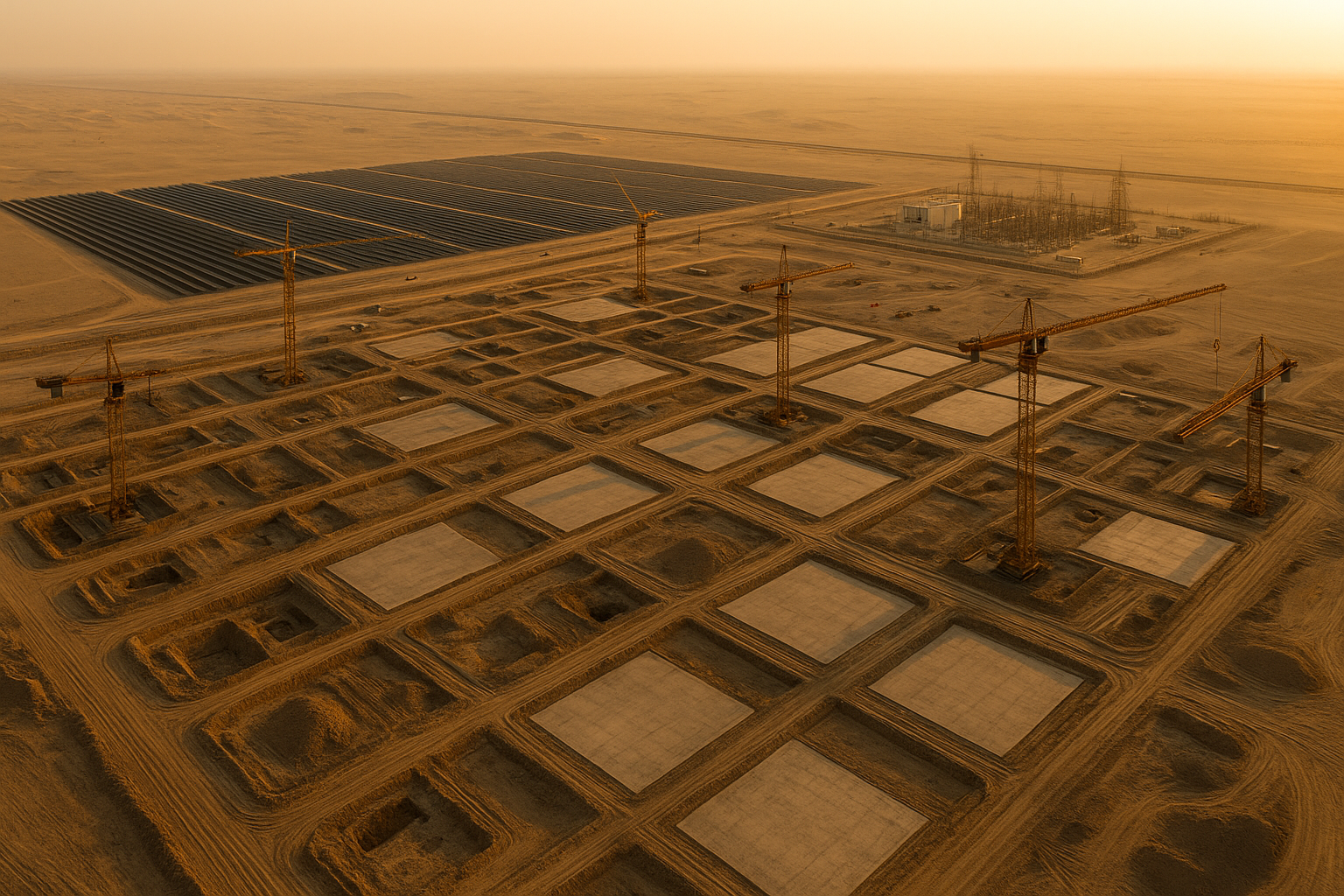
The first turn of earth at Khalifa Industrial Zone Abu Dhabi on Sunday marked the formal start of construction on Stargate UAE, the five-gigawatt artificial-intelligence compute cluster announced last May by OpenAI, G42, Oracle, Microsoft, Nvidia, Cerebras, and SoftBank. The site, roughly forty kilometres south of the capital, is now the largest sovereign-AI infrastructure project under construction anywhere in the world, surpassing in scale even the Abilene, Texas flagship of the original US Stargate programme.
According to a joint statement issued Sunday by OpenAI and G42, the first 200-megawatt phase is expected to come online by mid-2027, with the full five-gigawatt capacity targeted for 2030. UAE Minister of State for Artificial Intelligence Omar Sultan Al Olama, addressing the groundbreaking, called the project “the cornerstone of a sovereign compute layer that will serve the entire Global South” and confirmed that 20 percent of the cluster’s compute will be reserved for use by US partners under the bilateral framework signed at the White House in March.
A US-aligned answer to Chinese compute
The financial structure remains the one outlined in the May 2025 announcement: G42 leads on land, power, and roughly 60 percent of the upfront capex, with OpenAI, Microsoft, and Oracle splitting operating responsibilities. Nvidia is expected to ship the first 100,000 Blackwell Ultra GPUs to the site in Q4 2026, according to a Reuters report Saturday citing two people familiar with the procurement schedule, with Cerebras WSE-4 wafer-scale systems forming a secondary inference layer.
The project also serves a clear geopolitical purpose. Under the US-UAE AI Compact signed in March, all GPUs deployed at Stargate UAE remain subject to US export-control oversight, with mandatory chip-tracking telemetry and quarterly audits by the Bureau of Industry and Security. In return, G42 has formally divested its remaining holdings in Chinese AI ventures, completing a process that began with its 2024 commitment to Microsoft. Western diplomats describe the arrangement as the template Washington now wants to replicate with Saudi Arabia’s HUMAIN and India’s IndiaAI Mission.
Power, water, and the desert problem
Five gigawatts of AI compute requires roughly the same electricity as the city of Vienna, and Sunday’s announcement included new detail on how that power will be sourced. A 3.2-gigawatt solar-plus-storage array is being built simultaneously at the Al Dhafra extension site, alongside a 1.5-gigawatt nuclear allocation from the Barakah expansion announced last November. The remaining shortfall will be met by a dedicated 800-megawatt combined-cycle gas plant — a concession that environmental groups privately criticised but which Emirati officials defended on baseload grounds.
Cooling is the harder constraint. The site will use closed-loop liquid cooling for over 80 percent of its racks, sharply reducing freshwater needs, but G42 confirmed the project will still consume an estimated 13 million cubic metres of desalinated water per year by 2030. Saudi-style direct seawater cooling was studied and rejected on corrosion grounds.
What it signals for the wider market
For OpenAI, Stargate UAE adds to roughly 12 gigawatts of contracted compute now under construction across the United States, the United Kingdom, and the Gulf. For G42, it cements the firm’s transition from a regional AI champion to a globally significant infrastructure operator. And for the rest of the AI industry, it marks the moment at which sovereign compute became a category that every major government will be measured against. As one Western diplomat in Abu Dhabi put it on the sidelines of Sunday’s ceremony: “This is what an ‘AI alliance’ looks like in concrete.”


Discussion
Sign in to join the discussion.
No comments yet. Be the first to share your thoughts.