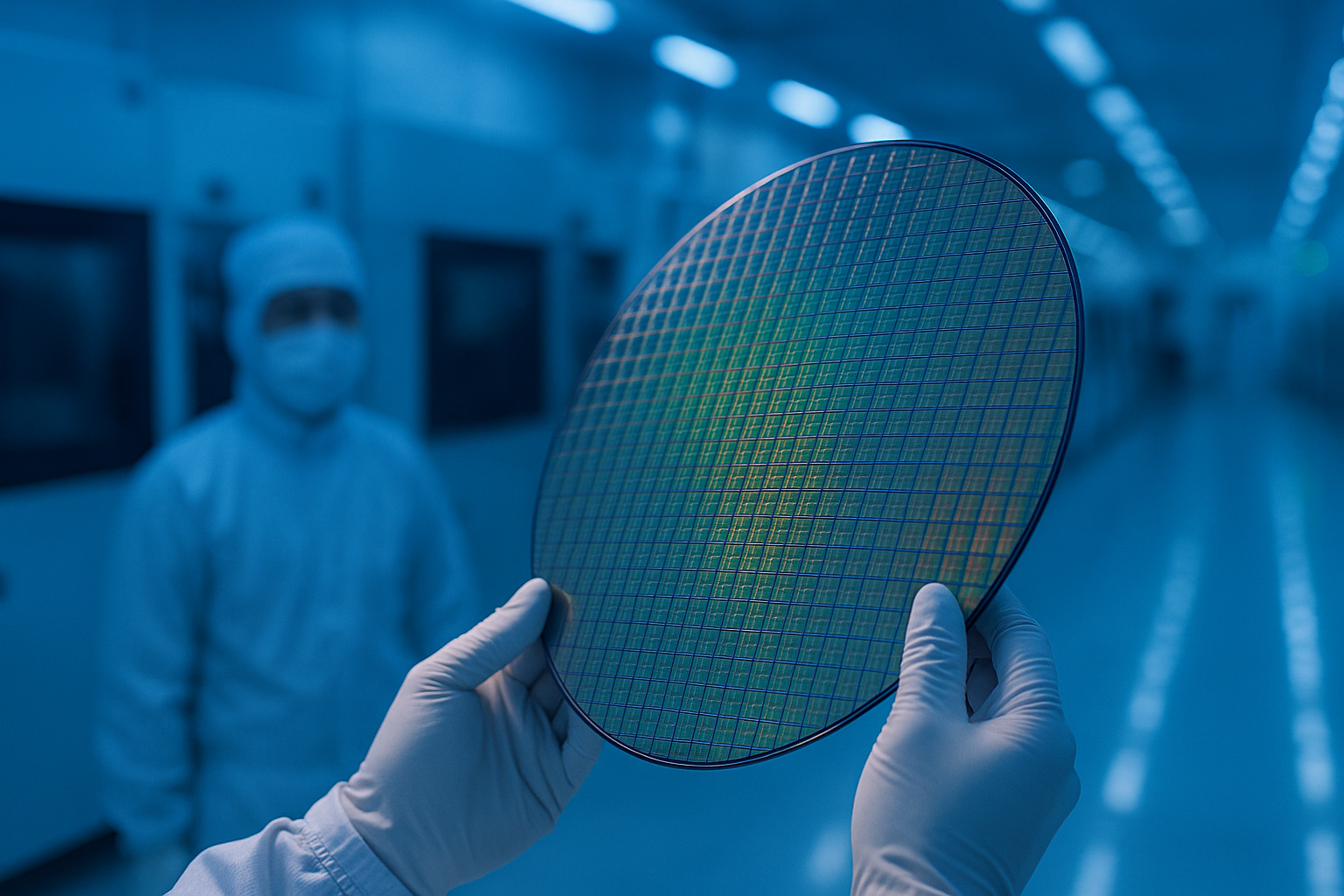
Semiconductor Manufacturing International Corporation has stabilized its 5-nanometer process at yields above 60 percent, according to two TrendForce notes published Friday and corroborated by reporting from Nikkei Asia and the Financial Times over the weekend. The Shanghai-based foundry is now manufacturing Huawei’s new Kirin 9020 mobile system-on-chip in commercial volumes at its Shanghai SN2 fab, marking the first time a Chinese company has reached 5nm-class production without access to extreme ultraviolet lithography.
The development is the most concrete sign yet that the US export-control regime imposed in October 2022, and tightened in 2023 and 2024, has slowed but not halted China’s progress to advanced nodes. ASML, the Dutch monopoly supplier of EUV scanners, has been barred from selling the machines to Chinese customers since 2019; SMIC has reportedly reached 5nm using older deep-ultraviolet equipment via multi-patterning, a costly workaround that Western analysts had assumed would cap yields well below commercial thresholds.
A workaround that Washington said could not work
SMIC’s N+2 process, the company’s internal name for its 5nm node, relies on quadruple-patterning DUV lithography — a technique in which each chip layer is exposed up to four times to compensate for the lower resolution of older scanners. The approach roughly doubles wafer cost compared with EUV-based 5nm at TSMC or Samsung, but TrendForce now estimates SMIC’s defect density has fallen to 0.21 per square centimeter, comparable to TSMC’s N5 process in late 2020.
Huawei’s HiSilicon design subsidiary is the primary customer. The Kirin 9020, which began shipping inside the Mate 70 Pro+ released last month, contains roughly 18 billion transistors across an 88-square-millimeter die, according to a TechInsights teardown published Sunday. That density places it within striking distance of the Apple A17 Pro on TSMC’s N3E node, though benchmark scores reviewed by Nikkei show it trailing by approximately 22 percent on multi-core CPU performance and 31 percent on GPU.
Capacity remains the binding constraint
The yield milestone does not mean China can replace foreign capacity at scale. SMIC’s combined 5nm output across its SN1 and SN2 facilities is estimated by TrendForce at roughly 18,000 wafers per month, against TSMC’s monthly N3-family capacity of more than 140,000 wafers. Huawei is reportedly absorbing the entirety of SMIC’s 5nm output, with allocations split between Kirin smartphone chips and the Ascend 910C AI accelerator, a Nvidia H100-class part that has begun shipping to Chinese hyperscalers including ByteDance and Alibaba Cloud.
A second SMIC plant currently under construction in Lingang, near Shanghai, is targeted to add another 30,000 wafers of monthly 5nm capacity by the third quarter of 2027, according to Chinese-language filings cited by Nikkei. Even with that addition, China’s domestic 5nm-class capacity would remain below 15 percent of TSMC’s contemporaneous output, leaving Huawei and Chinese AI firms reliant on overseas supply for the foreseeable future.
A diplomatic problem for Washington
The Bureau of Industry and Security has not commented publicly, but two former Commerce officials told the Financial Times that the SMIC milestone is likely to accelerate the next round of export-control tightening, which is already in interagency review. Options under discussion include expanding the entity list to cover SMIC’s downstream tool suppliers and tightening the so-called foreign direct product rule to capture wafers manufactured anywhere using US-origin equipment that has been exported to China since 2019.
For allied capitals, the political optics are awkward. The same week that SMIC’s 5nm yield was being reported, the US-UAE AI Compact was finalized with mandatory chip-tracking telemetry on Nvidia GPUs deployed at Stargate UAE — a regime designed to prevent leakage to China. Beijing’s domestic progress complicates the case that such controls are sustainable indefinitely. “At some point in the late 2020s, China will be designing and manufacturing competitive frontier chips entirely outside the US-allied stack,” Gregory Allen of CSIS told Reuters Sunday. “The question is no longer whether but when, and what that means for the rest of the export-control architecture.”


Discussion
Sign in to join the discussion.
No comments yet. Be the first to share your thoughts.