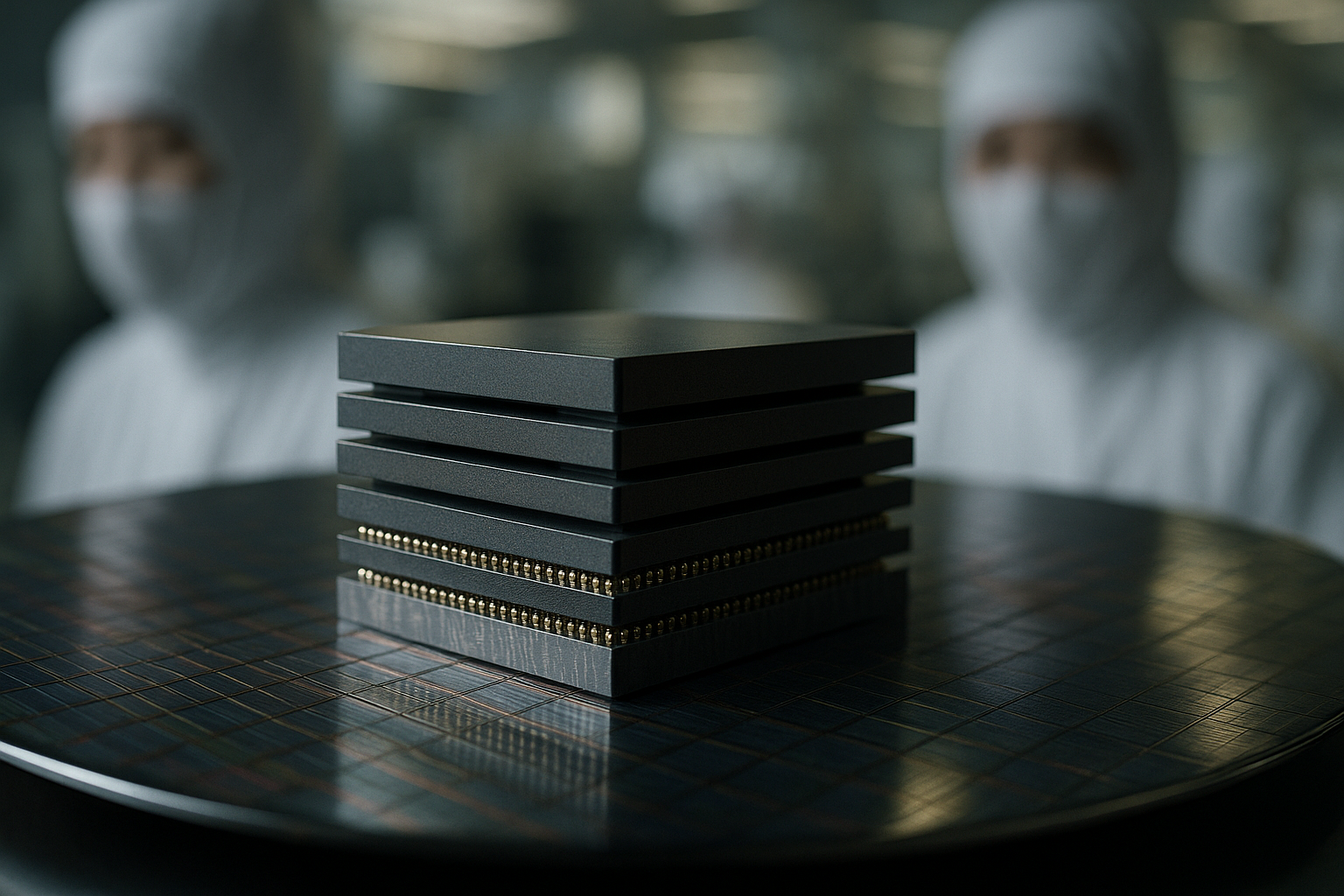
Samsung Electronics and SK Hynix have begun volume shipments of HBM4 high-bandwidth memory to Nvidia for use in the upcoming Rubin generation of accelerators, both companies confirmed in separate filings and customer briefings this week, marking the formal start of a memory generation that will define AI-infrastructure economics through the rest of the decade. SK Hynix, which held roughly 55% segment share through 2025, said its 12-high HBM4 stacks have completed final Nvidia qualification and are being delivered to TSMC’s CoWoS-L packaging lines in Hsinchu and Tainan. Samsung, after eighteen months of public catch-up effort, said its own 12-high HBM4 product cleared Nvidia qualification in late March and is now shipping in initial volume (Korea Economic Daily; Reuters).
Rubin pulls memory forward
The Nvidia Rubin generation, formally unveiled at GTC last month, pairs each R100 GPU compute die with up to 384 GB of HBM4 across eight 12-high stacks, roughly double the per-package capacity of the Blackwell B200, and quadruples package-level memory bandwidth to about 13 TB/s per GPU according to Nvidia’s published specifications. The HBM4 standard, finalized by JEDEC in October 2024, doubled the per-stack I/O width to 2,048 bits and pushed pin speeds to 8 Gbps, opening a memory tier that outpaces the rest of the data-center bus hierarchy.
For SK Hynix, getting first into Nvidia’s qualification window matters because Rubin’s ramp curve is steep. Nvidia has guided to at least 1.6 million Rubin packages shipped in the calendar year following launch, with each package consuming eight HBM4 stacks - a 12.8 million stack annual demand floor at full ramp, against industry capacity that TrendForce estimates at roughly 14 million HBM4 stacks in 2026. That leaves almost no slack for yield slips or share losses, and explains why Samsung’s qualification milestone, even at lower initial allocation, was met with a nine percent rally in the company’s stock the day it was confirmed.
The trade balance shows it
The two companies’ combined HBM revenue is on track to exceed $48 billion in 2026 according to Bank of Korea figures published this week, up from approximately $26 billion in 2025, and now accounts for roughly 14% of South Korea’s total goods exports. Korea’s semiconductor trade surplus hit $42 billion in Q1 2026, the first time it has crossed $40 billion in a single quarter, the Korea Customs Service reported on April 21. The won has strengthened to 1,295 against the dollar from 1,420 a year ago, with currency strategists at JPMorgan citing HBM-driven export receipts as a primary driver alongside Bank of Korea’s terminal-rate signaling.
The strength is asymmetric. Korea’s non-memory chip exports - logic, foundry services, NAND - have grown roughly 6% year on year, while HBM and HBM-adjacent DRAM have grown 84% over the same window per BoK data. The country’s broader manufacturing PMI nonetheless slipped to 50.2 in April from 51.4 in March, suggesting AI-memory tailwinds are not yet broad-based.
Samsung still trailing on margin
Even with a qualified product, Samsung is entering HBM4 from behind. SK Hynix reported gross margin of 45.7% in its Q1 2026 results last week, the highest in the company’s history and a function of HBM3E mix. Samsung’s memory division reported a more modest 31.2% in the same quarter, and management was explicit on the earnings call that HBM4 yield is still tracking below SK Hynix’s published numbers - approximately 65% versus 81% - a gap that will compress until Samsung’s Pyeongtaek P3 line stabilises in the second half.
The HBM4 transition is the clearest example yet of AI demand decoupling Korea’s chip economy from the cyclical PC and smartphone DRAM market that defined the previous decade. Whether Samsung can close the yield gap fast enough to capture meaningful share of Rubin’s ramp - or whether SK Hynix’s first-mover advantage compounds into a structural lead - will be the dominant Korean equity-market question for the next four quarters.


Discussion
Sign in to join the discussion.
No comments yet. Be the first to share your thoughts.