Problem
Bitcoin miners have found a better story than Bitcoin mining.
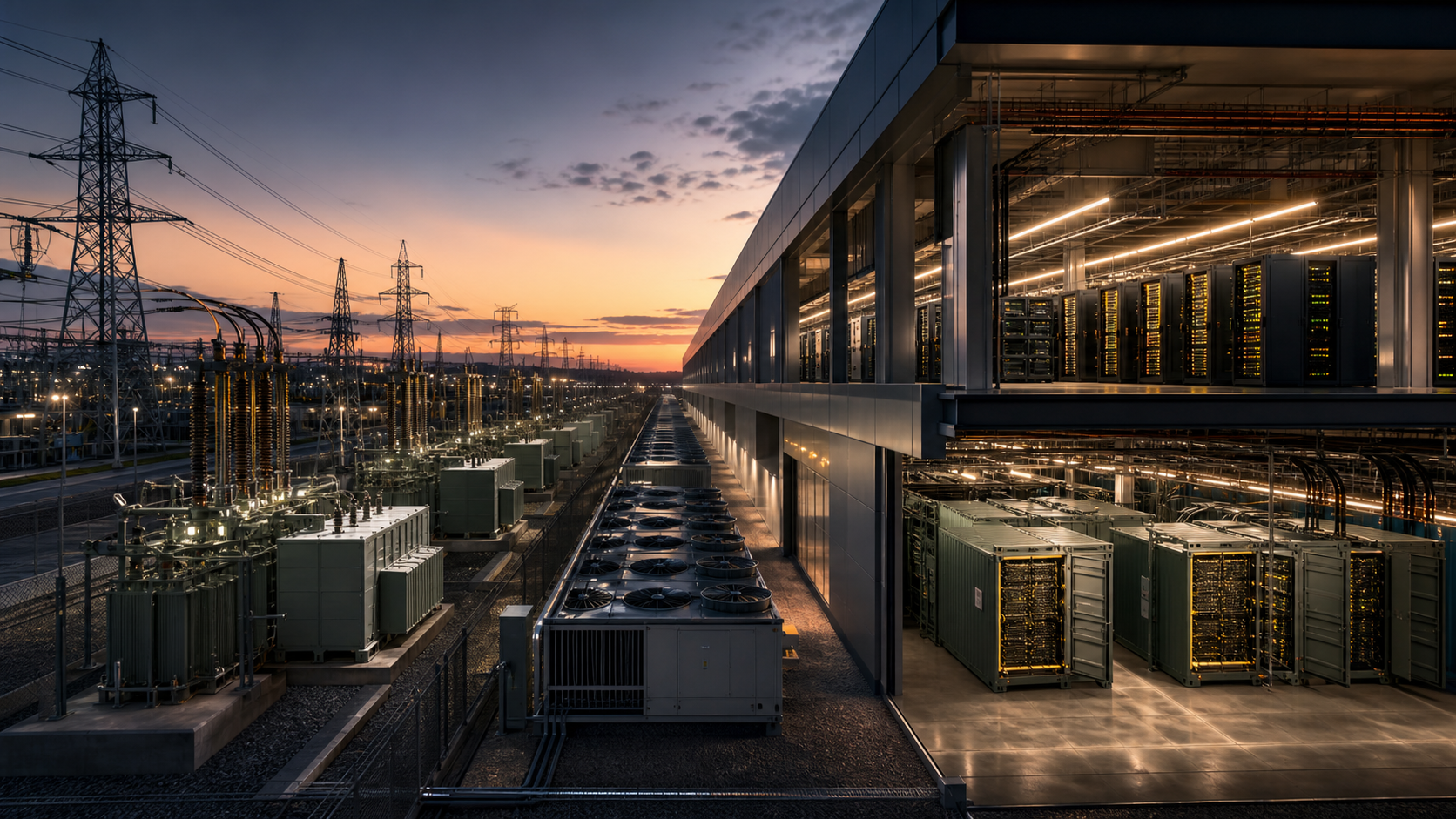
They are not selling hash rate now. They are selling power access, data-center shells, grid relationships, and long leases to AI customers that need capacity faster than utilities can bless a new campus. The pitch is simple: mining was the training ground for operating large electrical loads; AI is the customer that can pay real estate-style rent for the same scarce input.
That is why the phrase “AI infrastructure” has become a market re-rating tool. It moves the miner from a commodity cycle into a landlord frame. The revenue is supposed to become contracted. The tenant is supposed to be creditworthy. The asset is supposed to be power-first real estate with a compute wrapper.
Supposed to is doing work.
The latest test case is Hut 8. On May 6, the company announced the first phase of its Beacon Point campus in Texas: a 15-year, $9.8 billion lease for 352 MW of IT capacity. Hut 8 said the tenant is a high-investment-grade company, but did not name it. It also said the transaction lifts total contracted AI data-center capacity to 597 MW and aggregate base-term contract value to about $16.8 billion.
That is the new mining bull case in one release: disclose enough lease math to look like infrastructure, keep enough counterparty mystery to keep speculation alive, then point to the remaining gigawatts.
The hard question is not whether miners have valuable power positions. Many do. The hard question is whether investors are paying for contracted data-center cash flow, or for the option that every mining megawatt can be turned into AI rent.
Analysis
Beacon Point is not a small pivot.
Hut 8 says the 352 MW lease requires about 500 MW of utility capacity and is the first phase of a 1,000 MW utility-capacity campus. Initial energization is expected in the first quarter of 2027, with first data-hall delivery expected in the third quarter of 2027. The lease is triple-net, includes a 3% annual base-rent escalator, and is expected to produce about $655 million of average annual net operating income after stabilization, according to the company.
This is a landlord contract, not a mining contract. In a triple-net structure, the tenant economics should be less exposed to daily Bitcoin price and network difficulty than self-mining revenue. The asset owner is underwriting power, land, construction, financing, and delivery. The tenant is underwriting the AI workload.
That is a cleaner story than mining. It is not a riskless one.
Hut 8’s own release names the risks in unusually useful language: construction cost overruns, delays, supply-chain issues, permitting, technical challenges, financing conditions, transmission limits, generation limits, and large-load power requirements. Translation: the lease is only as good as the developer’s ability to turn interconnection rights and site control into live, liquid-cooled capacity on time.
This is where miners have an edge and a liability.
The edge is speed to power. Bitcoin miners already spent years hunting cheap energy, negotiating with utilities, buying land, building substations, and learning how to curtail load. That matters because AI infrastructure is less bottlenecked by land than by deliverable electricity. Hut 8 said it has executed an interconnection agreement for 1,000 MW at Beacon Point with AEP Texas and has a broader 8,375 MW pipeline across diligence, exclusivity, development, commercialization, and construction.
The liability is that mining campuses were built for a different load profile. ASIC mining tolerates more operational roughness than AI training and inference. GPU campuses need higher uptime, denser racks, more advanced cooling, deeper fiber planning, and tenant-grade operational discipline. A mining box can be curtailed like a flexible industrial load. A hyperscale AI tenant paying long-term rent wants reliability first and optional curtailment later.
That difference shows up in the economics.
Core Scientific’s Q1 is the cleanest public comparison. The company reported that colocation revenue rose to $77.5 million from $8.6 million year over year, while digital-asset self-mining revenue fell to $30.1 million from $67.2 million. It attributed the mining decline to a strategic shift toward colocation, a 45% decline in Bitcoin mined, and an 18% decrease in the average Bitcoin price.
That is the whole trade. Mining revenue is immediate but volatile. AI colocation revenue is delayed but contracted. The market prefers the second sentence. Accountants prefer to wait until the building exists.
Other miners are moving the same way. Cipher Mining signed an AWS lease for 300 MW over 15 years, according to Data Center Dynamics, after a separate Fluidstack deal backed by Google. TeraWulf has used a similar Google-backed Fluidstack structure. The pattern is becoming clear: miners bring power and sites; AI clouds or hyperscalers bring demand; large technology companies sometimes add credit support because the real bottleneck is not enthusiasm, it is financeable capacity.
Hut 8 also showed why financing is central. A week before the Beacon Point announcement, it said it closed $3.25 billion of investment-grade senior secured notes for the River Bend project, with a 16.5-year fully amortizing tenor and no recourse to Hut 8. That matters because the miner-to-landlord transition consumes capital before it produces stabilized rent. Non-recourse project debt is the clean version. Equity dilution or balance-sheet stress is the less clean version.
Investors are paying for the clean version.
After the Beacon Point release, Hut 8 shares rose 37%, according to Investing.com. The reaction was not just to one lease. One lease does not explain the whole move unless the market believes the model can repeat. Hut 8 encouraged that reading by presenting Beacon Point as the second campus commercialized under its power-first development model, after River Bend.
That is where valuation can get sloppy.
Contracted capacity deserves a different multiple from uncontracted land and power. A signed 15-year lease with an investment-grade tenant is not the same as a site under diligence. A tenant with disclosed credit support is not the same as a confidential tenant. A campus with financing closed is not the same as a campus that still needs project debt. And a megawatt serving Bitcoin miners is not automatically a megawatt serving NVIDIA-scale AI racks.
The market knows this. It just sometimes forgets when a press release includes billion-dollar contract value and a large enough power number.
Implications
The useful way to evaluate miner-to-AI stories is to split them into three buckets.
First: live contracted rent. This is capacity that has been delivered or is billable. It should be valued closest to infrastructure cash flow, with tenant credit, lease term, operating obligations, and debt structure doing most of the work.
Second: contracted but undelivered capacity. Beacon Point sits here. The lease is valuable, but the cash-flow bridge runs through construction, equipment procurement, utility timing, financing, and cooling execution. This deserves a premium to raw pipeline and a discount to stabilized rent. That is not pessimism. It is construction finance with better branding.
Third: conversion optionality. This is the broad pipeline, the spare power position, the idea that mining load can be redirected to AI demand. It can be valuable. It can also be the part of the story most likely to absorb speculative excess. Optionality should not be capitalized like rent until a tenant, financing plan, delivery schedule, and power path are real.
For miners, the incentive is obvious. Bitcoin mining remains exposed to hash price, network difficulty, halvings, treasury marks, and power cost. AI data-center leasing offers longer contracts and a bigger addressable capital pool. It also gives miners a way to explain why owning power rights is a platform, not just an input.
For AI customers, miners are useful because they are not starting from a blank map. They already control locations that can take big loads. Some have utility relationships. Some can move faster than traditional developers. In an AI buildout where hyperscalers are competing for electrons, weird former mining sites can become rational infrastructure.
For investors, the discipline is to avoid treating every miner as a future data-center REIT.
The winners will look less like crypto operators with a new slide deck and more like project-finance sponsors that happen to have learned power markets through mining. They will name tenants when they can. They will secure non-recourse funding. They will deliver capacity on schedule. They will show revenue shifting from coin production to contracted colocation without hiding the capex bill under adjectives.
The rest will sell optionality.
That can work for a while. Markets like optionality, especially when it comes with megawatts and AI demand. But the landlord story only compounds if the rent shows up.
Bitcoin miners do not need to become perfect hyperscalers to justify a re-rating. They need to prove that their best power positions can support creditworthy, financeable, high-density tenants.
The trade is not Bitcoin versus AI. It is volatile production revenue versus hard-to-build contracted rent.
That is a better business if the leases are real, the power arrives, and the financing does not eat the equity before the tenant turns on the racks.


Discussion
Sign in to join the discussion.
No comments yet. Be the first to share your thoughts.