Blackwell Ultra is no longer a roadmap slide.
That is the easy headline. It is also the least useful one.
Nvidia’s GB300 ramp has crossed into real shipment and deployment. Microsoft says Azure delivered the first at-scale production cluster with more than 4,600 NVIDIA GB300 NVL72 systems, built for OpenAI workloads. Nvidia says Microsoft, CoreWeave, and Oracle Cloud Infrastructure are deploying GB300 NVL72 systems at scale for low-latency and long-context inference. Dell shipped the first GB300 NVL72 rack-scale solution to CoreWeave in July 2025. Supermicro said in September that it had begun volume shipments of NVIDIA HGX B300 systems and GB300 NVL72 racks worldwide.
So yes, the product is moving.
The harder question is whether it is moving through the full data-center stack quickly enough to matter. A GPU in a shipment table is not a deployed inference factory. The gap between those two states is where the economics now live.
The Problem
The market still talks about AI hardware as if the chip is the product. For Blackwell Ultra, that framing is outdated.
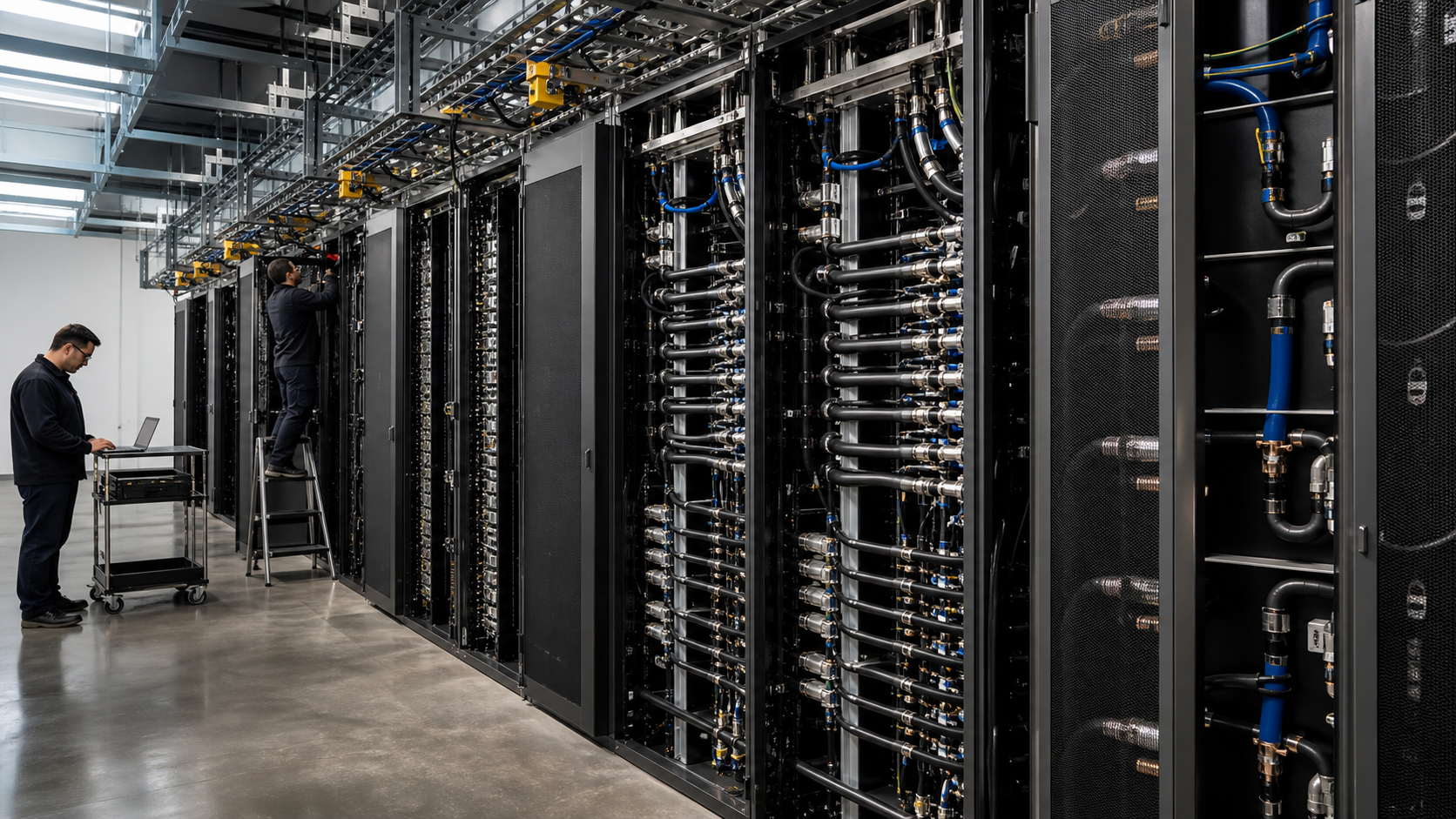
GB300 NVL72 is a rack-scale system. Microsoft describes each rack as 72 Blackwell Ultra GPUs, 36 Grace CPUs, 37TB of fast memory, 130TB/s of NVLink bandwidth within the rack, and 800Gb/s per GPU of cross-rack InfiniBand bandwidth. Nvidia’s own description is similar: the system ties 72 Blackwell Ultra GPUs and 36 Grace CPUs into one liquid-cooled rack-scale platform.
That means “shipping early” is only half the story. The other half is whether the customer has the facility, cooling loop, network fabric, power distribution, orchestration layer, and deployment team ready when the rack lands.
TrendForce flagged this before the first public deployment stories arrived. In March 2025, it said Nvidia was expected to launch GB300 ahead of schedule in Q2 2025, but warned that ODM partners would need extra time for testing and customer validation because GB300 changed computing performance, memory, networking, and power management versus GB200. It expected chip and compute-tray production by May, then full-rack shipments to scale only after rack configuration, power specification, and SOCAMM designs moved into mass production in Q3.
That sequence matters. The chip can be early while the cluster is still late.
The Analysis
The evidence now says supply is past the prototype stage. Dell’s CoreWeave shipment was the first public marker. Supermicro’s September update was more important because it used the language customers care about: volume shipments, pre-validated solutions, rack-scale delivery, and data-center-scale deployment.
Supermicro also named the problem it is trying to solve. Data-center customers face network topology, cabling, power delivery, and thermal-management challenges. Its pitch is not just servers. It is pre-validated blocks that arrive closer to “time-to-online.”
That phrasing is useful because it exposes the real bottleneck. The limiting factor is no longer just Nvidia wafers or HBM supply. It is the pace at which integrators and cloud operators can convert dense racks into stable, networked production clusters.
Power and cooling are the cleanest proof. TrendForce estimated 2024 mainstream HGX AI servers at 60-80kW, GB200 NVL72 at 125-130kW, and GB300 rack systems at 135-140kW. It also said most industry players would keep using liquid-to-air cooling, while GB300’s design gives each chip its own cold plate and increases demand for quick-disconnect fittings.
That is not a footnote. A rack that pulls roughly 140kW changes site selection, room design, water-side cooling, electrical distribution, fire planning, commissioning, and maintenance. It also changes failure modes. Dense systems do not fail politely.
Microsoft’s deployment shows what good execution looks like, but also how much must go right. Azure says the GB300 cluster required collaboration across hardware, systems, supply chain, facilities, and other disciplines. It says building frontier AI infrastructure requires rethinking computing, memory, networking, datacenters, cooling, and power as a unified system. It specifically cites standalone heat-exchanger units, facility cooling, new power-distribution models, storage, orchestration, and scheduling work.
That is not standard server procurement. That is industrial project management with GPUs attached.
The same is true for networking. Microsoft says its GB300 cluster uses a full fat-tree, non-blocking architecture with NVIDIA Quantum-X800 InfiniBand to scale training to tens of thousands of GPUs. Within the rack, NVLink gives the 72 GPUs a shared accelerator domain. Across racks, the fabric has to avoid turning expensive silicon into a queue.
This is why the shipment narrative can mislead. Blackwell Ultra can be real, on time, and in production while useful capacity still ramps unevenly. Microsoft can scale quickly because it has spent years co-designing AI infrastructure with Nvidia. CoreWeave can move fast because its entire business is GPU-cloud deployment. That does not mean every enterprise buyer or regional cloud can absorb GB300 at the same speed.
The Implications
For Nvidia, the good news is that the GB300 demand story is no longer theoretical. The company has credible public deployment signals from Microsoft, CoreWeave, OCI, Dell, and Supermicro. That supports the idea that Blackwell Ultra is already part of the production AI cycle, not a late-2026 promise.
The risk is that investors overread shipments as immediate revenue-quality proof for everyone downstream. Rack-scale AI infrastructure recognizes demand faster than it recognizes usable capacity. There is a period where capital is committed, equipment is delivered, and engineering work still has to catch up.
For cloud buyers, the lesson is sharper. Do not ask only whether a provider has GB300 allocation. Ask whether it has power rights, cooling capacity, fabric capacity, spares, deployment labor, and workload orchestration already validated at cluster scale. The chip SKU is becoming the shallow diligence question.
For the broader AI market, Blackwell Ultra confirms the new constraint. The industry is no longer waiting for Nvidia to ship a faster accelerator. It is waiting for the physical internet of AI - power rooms, cooling loops, fibers, switches, racks, schedulers, and technicians - to absorb the accelerator it already bought.
The shipment headline is real.
The acceleration is only real if the rack comes online.


Discussion
Sign in to join the discussion.
No comments yet. Be the first to share your thoughts.