Problem
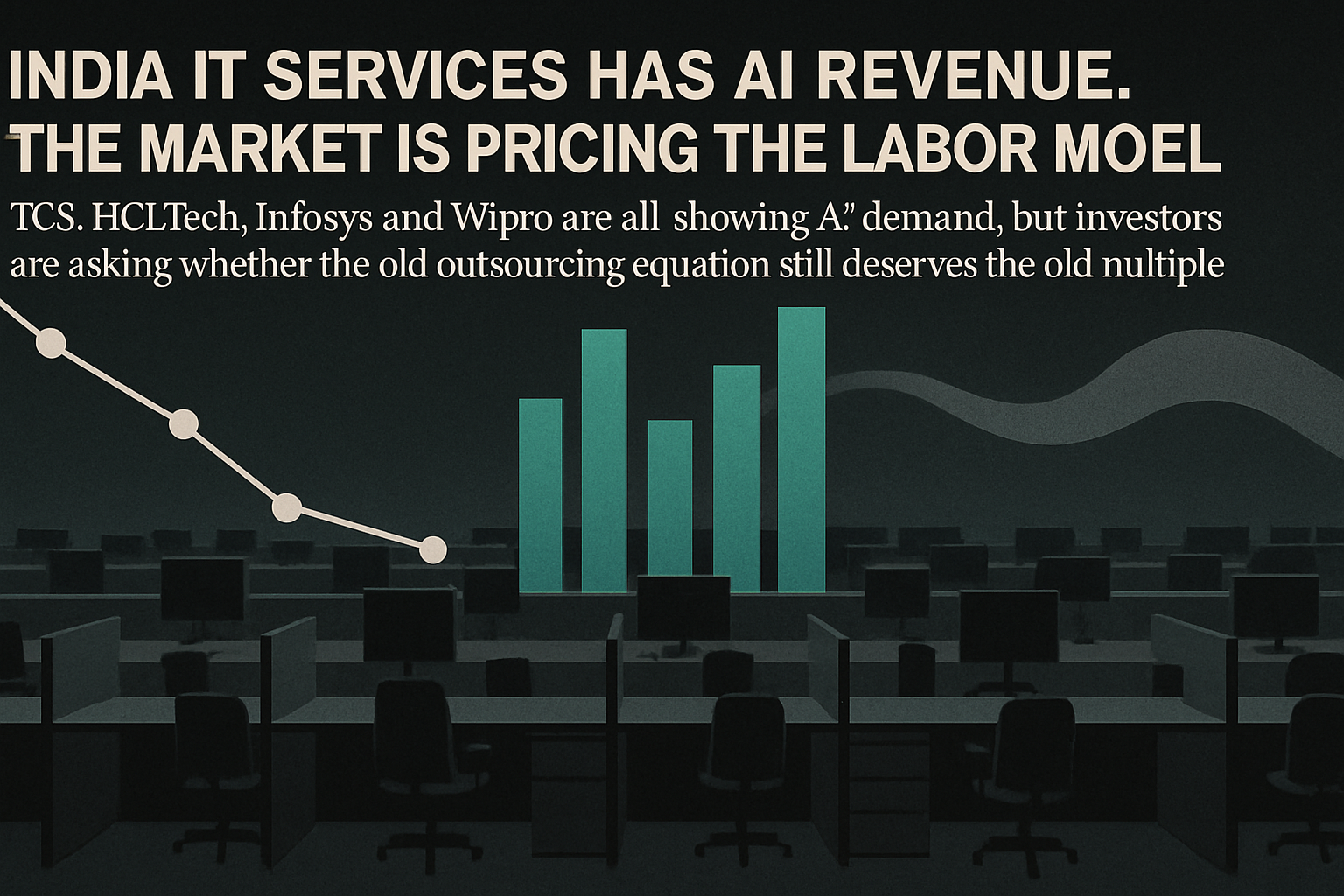
India’s IT services sector is not losing the AI cycle because clients refuse to spend on AI.
That is the wrong diagnosis. The harder problem is that clients do want AI, but not necessarily in the labor-arbitrage format that made TCS, Infosys, Wipro and HCLTech global outsourcing machines.
The quarterly evidence is now awkward. TCS said Q4 FY26 annualized AI revenue crossed $2.3 billion, while Q4 revenue was $7.62 billion and full-year FY26 revenue was $30.02 billion, down 0.5 percent in reported dollars and down 2.4 percent in constant currency. HCLTech said annualized Advanced AI revenue crossed $620 million, with FY26 revenue up 3.9 percent in constant currency and new-deal TCV at $9.3 billion.
Those are not press-release crumbs. They are large enough to prove enterprise AI services exist.
Yet the market is not behaving as if AI services are a clean new growth layer. Reuters reported on May 12 that India’s IT index fell 3.6 percent to its lowest level since May 2023, with TCS, Infosys, HCLTech and Wipro down between 2.5 percent and 4 percent. The same report said the sector was down 25.4 percent so far in 2026, far worse than the Nifty 50’s 9.7 percent decline.
That is the repricing. Investors are not asking whether Indian IT can sell AI projects. They are asking what those projects do to utilization, pricing, headcount, margins and duration.
Analysis
The old outsourcing model was brutally legible.
A client had a technology backlog. An Indian IT firm supplied trained engineers, delivery discipline and offshore scale. Revenue grew with project scope and headcount. Margin depended on utilization, pyramid structure, wage discipline and offshore mix. The public-market story was simple enough to model in a spreadsheet without needing a philosophy of software.
AI breaks the clean part of that equation.
It does not remove services demand. In some areas it creates more of it: strategy, migration, data cleaning, governance, model integration, testing, security, process redesign and change management. That is why the TCS and HCLTech AI numbers matter. TCS also said it ended Q4 with a $12 billion TCV and trained more than 270,000 associates to higher proficiency in AI and ML. HCLTech listed AI Factory, semiconductor design, simulation and AI-led business transformation wins.
The issue is not demand. It is unit economics.
Infosys made that visible on its Q4 FY26 call. Asked about headcount, utilization and pricing, CFO Jayesh Sanghrajka said Q4 volumes were softer and utilization was lower, which is why headcount was lower. He added that full-year headcount was still up by 5,000. More important, he said pricing was stable and that most growth in the year had been pricing-led because volumes were softer, which “corroborates with the fact that the AI revenue are coming at a better pricing” in the company transcript.
That sounds positive. It is also exactly why the market is nervous.
Pricing-led growth can protect revenue while the delivery model changes. It can also hide a volume problem. If AI lets clients buy fewer hours for the same outcome, the vendor can earn better rates on the AI work and still face pressure on the broad pool of traditional labor hours.
Wipro shows the same tension from a different angle. Business Standard reported that Wipro’s Q4 FY26 IT services revenue was $2.6 billion, up just 0.2 percent quarter-on-quarter in constant currency. Order inflows were $3.5 billion, large-deal TCV was $1.4 billion, and adjusted operating margin was 17.2 percent. But Q1 FY27 guidance was minus 2 percent to flat in constant currency, and the article noted continued investment in AI platforms plus lower-margin deal ramp-ups as margin pressures.
That combination is not a collapse. It is more uncomfortable: AI demand, slow conversion, good margins for now, weak guidance, and a model still anchored to human utilization.
Investors can live with any one of those facts. They are selling the package.
The February selloff showed the same fear before Q4 results arrived. Reuters, via MarketScreener, reported that Indian software exporters lost $22.5 billion in market value in a week as AI tools raised concern about disruption to outsourced work. The IT index was down about 7 percent for the week. Analysts quoted in the report split between “knee-jerk” and structural-risk interpretations, which is usually what markets do when the old profit formula has stopped being obvious.
The missed angle is that AI services may be both a revenue opportunity and a multiple problem.
If Indian IT sells AI transformation as high-value consulting, it can defend pricing. If it sells AI-enabled productivity back to clients, it may compress the billable base that once supported scale. If it withholds productivity gains, clients will test vendors against foundation-model companies, cloud platforms, internal engineering teams and global capability centers. There is no version where the old body-count model simply receives an AI surcharge and carries on.
That is why TCS’s margin performance matters. The company reported Q4 operating margin of 25.3 percent and FY26 operating margin of 25 percent, up 70 basis points year-on-year, even while AI investments increased. It also ended Q4 with 584,519 employees, down from 607,979 a year earlier in the fact sheet. A smaller workforce, better margin and rising AI revenue is one possible answer to the market’s question.
But it is not yet an industry answer. HCLTech grew, Wipro guided weakly, Infosys described pricing-led growth with softer volumes, and the sector index still traded like AI was a threat to the revenue base.
Implications
The next phase of India IT coverage should stop treating AI commentary as a separate paragraph.
AI revenue needs to be read beside headcount, utilization, pricing, large-deal conversion and margin guidance. A vendor that grows AI revenue while reducing low-value headcount and holding margins is becoming more software-like. A vendor that grows AI revenue while traditional volumes sag and deal ramps slow is just replacing one dollar with a harder dollar.
For clients, the negotiation changes. They will ask vendors to prove productivity in code migration, testing, support, documentation, analytics and back-office processes. They will expect some savings upfront. They will also pay for work that has real integration risk. That favors firms with domain knowledge and delivery control, not firms that merely wrap third-party models in familiar account language.
For investors, the cleanest metric is not “AI revenue.” It is AI revenue per employee, paired with margin and client retention. If that number rises because vendors are moving up the value chain, the sector has a new story. If it rises because the denominator is shrinking while total growth stays weak, the story is cost defense.
India’s IT giants are still important. They know enterprise systems, regulatory constraints, legacy code and client politics better than most AI labs. That matters because enterprises do not modernize by dropping a chatbot into a forty-year-old mainframe and hoping procurement applauds.
But the market is right to be harsher now. AI demand is real. The old outsourcing multiple was built on something narrower: the belief that global software work would keep scaling through lower-cost human delivery.
That belief is being repriced. The winners will be the firms that can make AI services less dependent on selling more people, without giving away the economics to the client or the model provider.


Discussion
Sign in to join the discussion.
No comments yet. Be the first to share your thoughts.