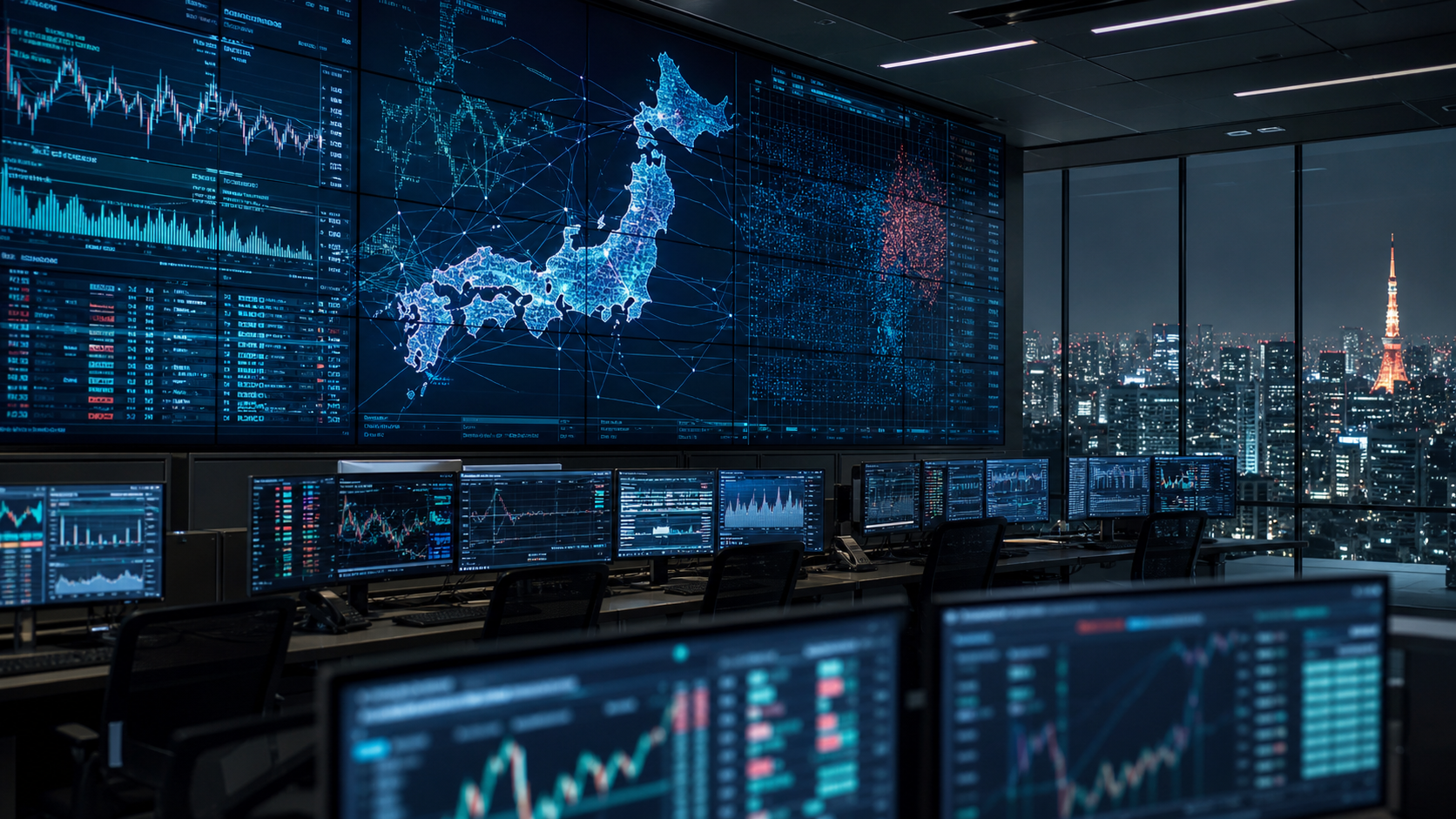
Japan is not treating AI in finance as a chatbot rollout.
It is treating it as infrastructure risk.
That is the useful read from two moves that look separate at first glance. Japan Exchange Group is expanding AI use inside market surveillance and exchange operations. At the same time, Japan’s megabanks and financial regulators are hardening around frontier-AI cyber threats, including access to Anthropic’s Mythos model.
One side is operational adoption. The other is operational defense.
Together, they show where AI finance is actually going: into the systems that keep markets credible and banks alive.
The Problem
Most bank AI stories still sound like office productivity stories. Summarize documents. Draft emails. Help call-center staff. Cut back-office friction.
That matters. It is not the center of the risk.
The financial-stability question is different. What happens when AI touches the market-surveillance process, exchange reliability, cyber defense, fraud triage, and critical-bank operations? These are not productivity surfaces. They are control surfaces.
Japan is moving AI into those surfaces before the regulatory vocabulary fully settles.
JPX said on April 28 that Japan Exchange Regulation has been using AI in market-surveillance operations since 2018 to investigate unfair trading practices such as market manipulation. The company also said it is developing internal AI infrastructure for tasks including market surveillance, listed-company information review, disclosure checking, and customer-response improvement.
That is not generic experimentation. It is the exchange operator applying AI to market fairness, disclosure quality, and operational response.
The Analysis
The surveillance foundation is not new. In March 2018, Japan Exchange Regulation and the Tokyo Stock Exchange announced the introduction of AI to market-surveillance operations. The system was designed to help prioritize suspicious orders after existing surveillance systems identified trades likely to involve unfair trading. JPX said the aim was to support staff in deciding investigation priority and improve the quality of surveillance work.
That 2018 design is important because it was not AI as a market cop. It was AI as a triage layer. Human investigators still mattered. The model helped route scarce attention.
The 2026 update suggests the function is broadening. JPX now frames AI as part of a medium-term management plan, with uses across surveillance, listed-company operations, and investor-facing services. Its April update says JPX is building an AI assistance service for its JPX Market Explorer platform and using generative AI internally to improve work efficiency and service value.
That is the adoption side.
The defense side is moving just as fast.
Japan’s Financial Services Agency issued an AI Discussion Paper Version 1.1 on March 3, 2026, updating its preliminary discussion points for sound AI use in the financial sector. The FSA said previous public-private forum discussions covered AI use status, AI risk management and governance, and situations requiring clarification on how regulations apply.
Then the frontier-model cyber problem arrived.
Reuters reported on May 13 that Japan’s three largest banks were expected to gain access to Anthropic’s Mythos model in about two weeks, citing a person with direct knowledge. The report named MUFG, Mizuho, and Sumitomo Mitsui as the banks expected to get access, while the banks declined to comment. Nippon.com, citing Jiji Press, also reported that the three megabanks were working to gain access to Claude Mythos to enhance cybersecurity measures.
Two days later, MLex reported that Japan’s FSA had launched a working group on AI-related threats in the financial sector, bringing together financial institutions, the Bank of Japan, technology companies, and Anthropic Japan to coordinate understanding and responses.
That sequence matters. Japan’s banks are not merely adopting a frontier model to automate work. They are trying to access it because models like Mythos could change the cybersecurity threat model. A bank that cannot test against the same class of tool attackers may use is blind by design.
The regulatory response is therefore not “AI is dangerous, stop.” It is closer to “AI is already entering the threat environment, so financial institutions need shared defensive capability.”
That is a more mature framing than simple AI optimism or simple AI panic.
The Implications
Japan is showing the next stage of AI finance.
First, AI becomes an internal productivity tool. Then it becomes a surveillance and risk triage layer. Then it becomes part of cyber defense against other AI systems. At that point, AI policy is no longer a narrow question of model governance. It becomes operational resilience policy.
For exchange operators, this means the key governance question is not whether AI is allowed in surveillance. It is how much explainability, audit logging, escalation discipline, and model-drift monitoring regulators should require when AI helps decide which trading activity deserves human investigation.
For banks, the risk is two-sided. If they move too slowly, they face attackers and fraud rings using stronger models than their defenders. If they move too quickly, they may import powerful models into legacy environments with weak access control, poor data boundaries, or unclear accountability.
For regulators, Japan’s path is a useful signal. The FSA is not waiting for a grand, finished AI law before convening banks, the central bank, technology firms, and model providers around concrete threats. That is practical. It is also messy. Financial infrastructure is too important to govern through vibes, but too exposed to wait for perfect rules.
The deeper point is that AI in finance is becoming less about who writes the fastest memo and more about who controls the system map.
Surveillance systems decide what looks suspicious. Cyber systems decide what gets blocked. Disclosure systems decide what needs attention. Credit, compliance, and market-operations systems decide where human judgment is spent.
That is where AI changes finance.
Not at the chatbot. At the control layer.


Discussion
Sign in to join the discussion.
No comments yet. Be the first to share your thoughts.