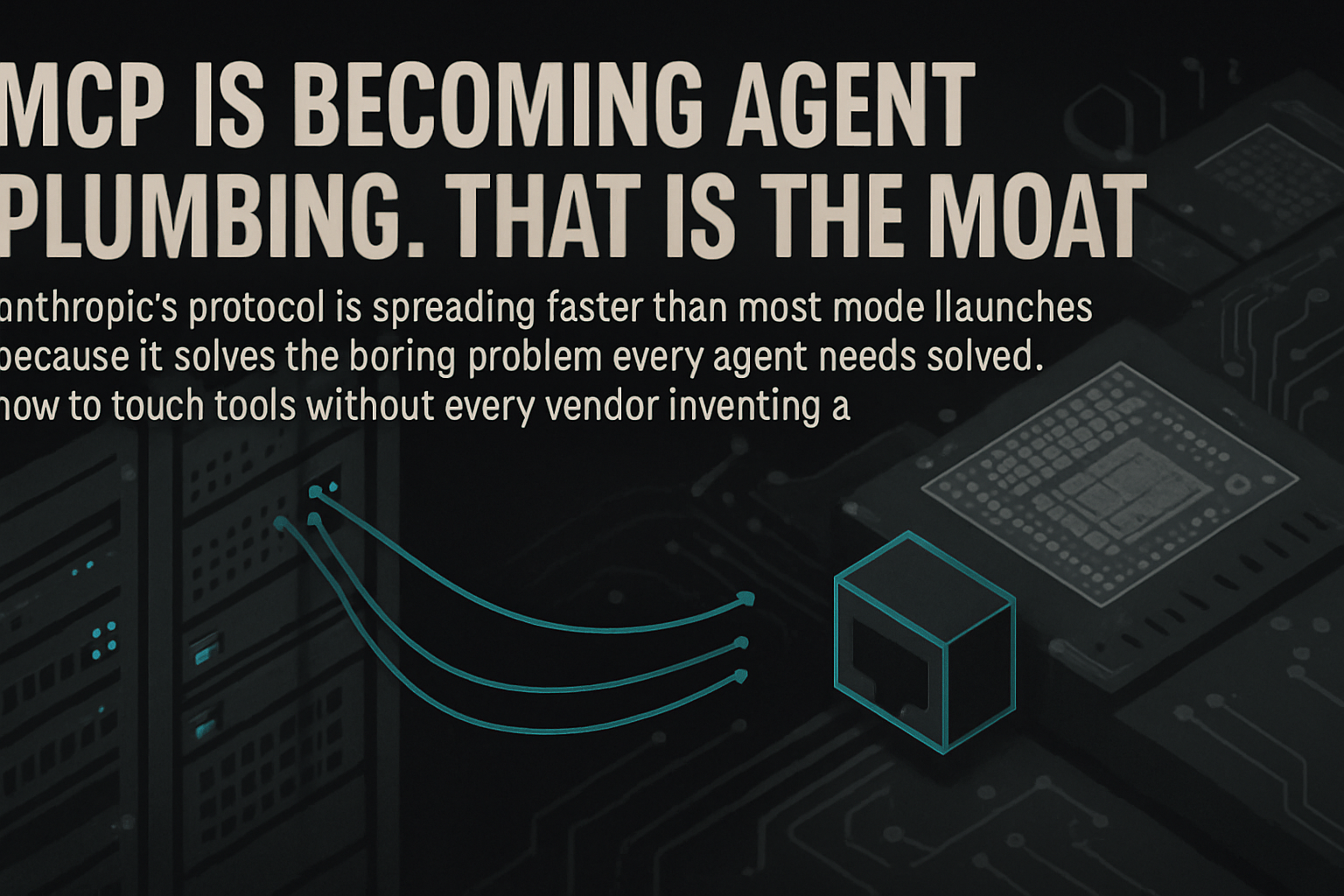
The important Anthropic story is not only Claude.
It is the pipe around Claude.
Anthropic introduced the Model Context Protocol on November 25, 2024 as an open standard for connecting AI assistants to data sources, business tools, and development environments. The pitch was simple: stop writing custom connectors for every tool. Expose systems through MCP servers. Let MCP clients connect to them.
That sounded like developer plumbing at launch. It now looks like market structure.
A March 2026 arXiv paper on production MCP deployments says the protocol had reached more than 10,000 active servers and 97 million monthly SDK downloads by early 2026. Treat that number carefully. It is SDK downloads, not active human users. But even with that caveat, the adoption curve is hard to wave away.
MCP is barely sixteen months old. It is already showing up where defaults are made.
The Problem
Agents need tools. That is the whole trick.
A model that can reason but cannot read a repo, query a database, open a support ticket, inspect a calendar, or call a payment API is a fancy autocomplete loop. The useful agent is the one with controlled access to the systems where work actually happens.
Before MCP, every vendor had an obvious incentive to make that access proprietary. Build the connector layer. Own the integration surface. Make developers choose your agent runtime because their tools are already wired there.
Anthropic’s move attacked that layer before it hardened. MCP did not make Claude smarter. It made Claude easier to connect. More importantly, it gave everyone else a neutral-looking way to connect too.
That is why protocol adoption matters more than another benchmark table. Benchmarks tell buyers what a model can do in isolation. Protocols decide which tools it can reach in production.
The Analysis
The first signal was Anthropic’s launch design. The company did not just publish a spec. It shipped Claude Desktop support, SDKs, and prebuilt servers for systems like Google Drive, Slack, GitHub, Git, Postgres, and Puppeteer. It also named early adopters including Block and Apollo, plus development-tool companies such as Zed, Replit, Codeium, and Sourcegraph.
That matters because MCP started inside the developer workflow. It did not wait for a central procurement cycle. Developers could install a server, point an assistant at local or remote context, and see whether the tool chain became less dumb.
The second signal was governance. On December 9, 2025, the Linux Foundation announced the Agentic AI Foundation, anchored by Anthropic’s MCP, Block’s goose, and OpenAI’s AGENTS.md. Anthropic also said it was donating MCP to the Agentic AI Foundation, co-founded with Block and OpenAI and backed by Google, Microsoft, AWS, Cloudflare, and Bloomberg.
That is the moment MCP stopped looking like an Anthropic feature and started looking like shared infrastructure.
The third signal is competitor adoption. OpenAI now documents MCP as part of its Agents SDK. Its JavaScript guide says MCP is an open protocol for standardizing how applications provide tools and context to LLMs, and that the SDK supports hosted MCP server tools, streamable HTTP MCP servers, and stdio MCP servers. OpenAI’s April 2026 Agents SDK update also lists tool use via MCP among the primitives in its agent harness.
Microsoft moved the same way. In May 2025, it said MCP integration was generally available in Copilot Studio, letting builders add apps and agents into Copilot Studio and connect them with knowledge sources and APIs. Microsoft also framed the benefit as lower manual upkeep: connect to an MCP server and agents inherit updated actions and information as systems change.
That is lock-in, but not the old kind.
The lock-in is not “Claude is the only model that can use this.” It is “teams start organizing their tool surface around a protocol, and every agent vendor has to speak it.” Once internal systems expose MCP servers, the switching cost moves away from model weights and into workflow topology. The vendor that best uses the installed connector layer has an advantage even if another model wins the weekly reasoning contest.
This is where MCP’s adoption is different from a normal SDK fad. A library can be swapped. A protocol that becomes the integration point between agent runtimes and enterprise tools becomes architecture.
The comparison with older developer protocols is instructive. Microsoft’s Language Server Protocol was announced in June 2016 with Red Hat and Codenvy, and it became important because editors and language tools could stop building one-off integrations. Kubernetes took a different path: it joined CNCF in 2016 and reached graduated status in March 2018. MCP compressed the neutrality step much faster: launch in late 2024, Linux Foundation home in late 2025, broad vendor implementation by early 2026.
That speed is the story.
The Implications
The good version of MCP is obvious. It gives enterprises a standard way to expose tools to agents. It lowers integration waste. It weakens proprietary connector traps. It lets smaller vendors build against one interface instead of begging every model company for native support.
The risky version is also obvious. Tool access is power. Tom’s Hardware reported in April 2026 that OX Security found a design-level MCP vulnerability affecting official SDKs across Python, TypeScript, Java, and Rust, with a supply chain spanning more than 150 million downloads and up to 200,000 server instances. That does not mean MCP is doomed. It means the protocol succeeded quickly enough to inherit infrastructure-grade blast radius before the security model fully caught up.
For Anthropic, that is both a win and a trade. MCP makes Claude more useful, but it also gives rivals the same connector path. The strategic value is not exclusivity. It is agenda-setting. Anthropic helped define the socket that agents now expect.
For OpenAI, Microsoft, Google, and everyone else, MCP is less a concession than an admission. The agent market cannot scale if every tool connection is bespoke. Model quality still matters. But the durable layer may be the one that decides which tools are visible, which calls require approval, which context gets loaded, and which errors an agent can recover from.
That is why MCP’s adoption spike matters.
The protocol is becoming boring. In infrastructure, boring is usually the point.


Discussion
Sign in to join the discussion.
No comments yet. Be the first to share your thoughts.