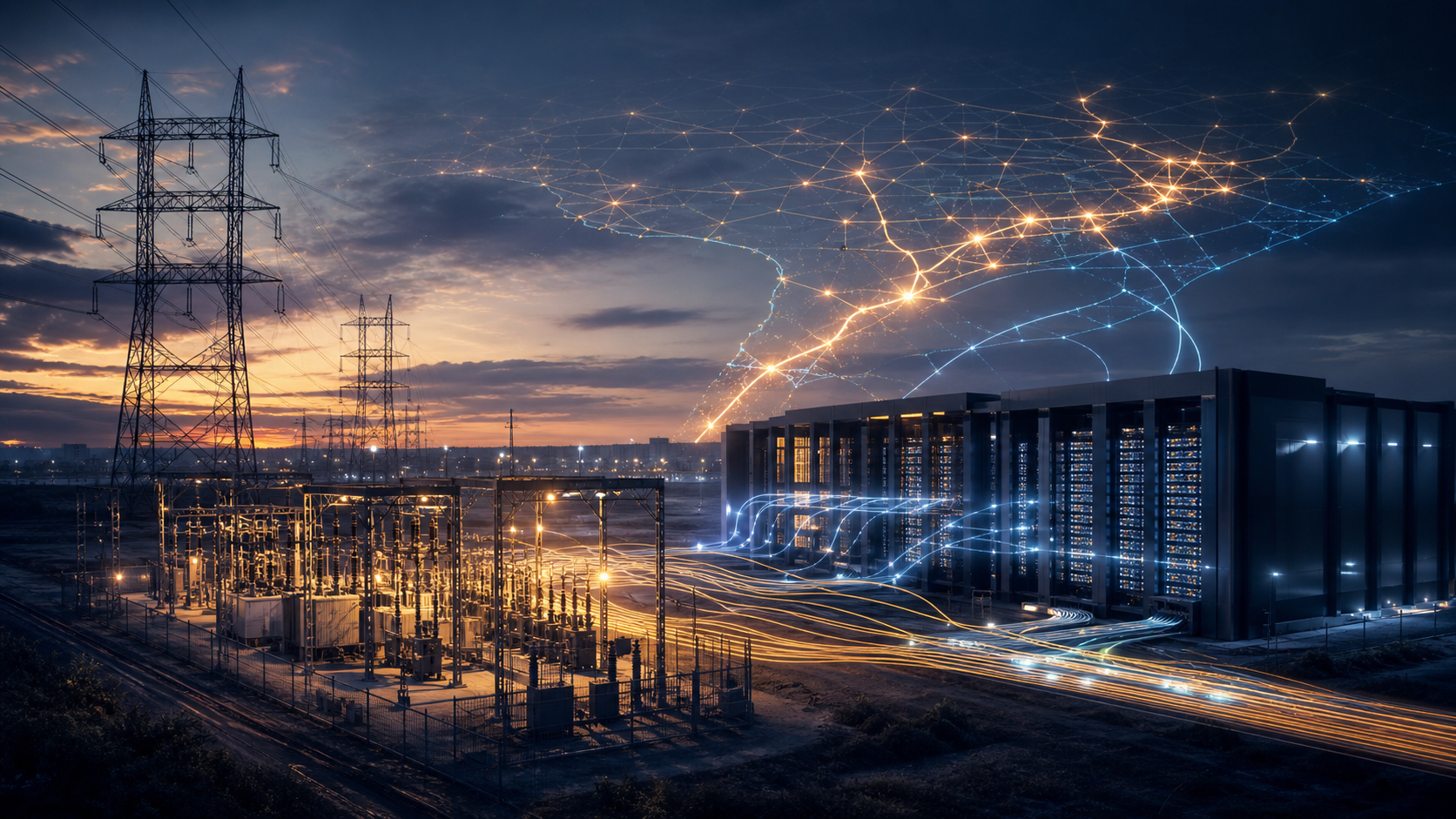
AI Data Centers Have Turned Power Access Into the New Capacity Market
PJM expects roughly 30 gigawatts of data-center-driven demand growth between 2025 and 2030, and Dominion Energy says it was already studying more than 30 gigawatts of additional data-center capacity requests in Virginia as of July 2025.
That is the useful number in the AI infrastructure build-out. Not the number of GPUs ordered. Not the size of the latest campus rendering. The scarce asset is now a credible path from requested megawatts to energized load.
This changes the competitive map. Operators with land, substations, utility relationships, on-site generation and flexible commissioning schedules have a different product from operators with announcements. The former can sell capacity. The latter may only hold a grid-connection option.
Requested Capacity Is Not Energized Capacity
Dominion’s 2025 integrated resource plan update is blunt about the scale of the gap. The utility said it had connected six new data-center campuses in 2025 as of October 1, with ultimate capacity of 456 MW, and expected eight total connects for the year with ultimate capacity of 561 MW. On the same page, Dominion said that, as of July 31, 2025, it had 16,913 MW of requested capacity under firm ESA or CLOA contracts and was studying another 30,132 MW at the earlier ELOA stage (Dominion Energy 2025 IRP update).
The distinction matters. A signed or studied request is not power in a building. It is a claim on engineering attention, transmission planning, procurement, permitting and future generation adequacy.
PJM’s regional planning data show why this is not only a Dominion problem. In its 2025 review, PJM said summer peak usage would climb by about 70 GW to 220 GW over 15 years, above the 165 GW record set in 2006. It also said data-center demand could grow by roughly 30 GW from 2025 to 2030. PJM had processed more than 170,000 MW of new generation requests since 2023, with 30,000 MW of generation projections left in the transition queue to be processed in 2026. Its new cycle process opens in April with a one-to-two-year review timeline, depending on system impact (PJM).
This is the new AI capacity market. Compute buyers are underwriting a project developer’s ability to compress the time between a paper megawatt and a live megawatt.
Ireland Has Already Written the Rulebook
Ireland is further along in admitting the bottleneck into policy.
In December 2025, Ireland’s Commission for Regulation of Utilities said data centers had grown from 5 percent of national electricity demand in 2015 to 22 percent in 2024. With contracted demand, EirGrid forecast data-center electricity use rising from 9.4 TWh in 2025 to 14.6 TWh in 2034, or 31 percent of national electricity demand (CRU).
The regulator’s answer was not another aspiration about clean data centers. It made power deliverability part of the admission ticket.
New data centers must provide generation or storage, on-site or nearby, matching their requested maximum import demand capacity. That capacity has to participate in the wholesale market. Developers also must meet at least 80 percent of annual demand with additional renewable electricity generated in Ireland, with a six-year glide path. System operators must judge whether a requested connection sits in a constrained or unconstrained part of the network.
That policy is a useful preview for other AI markets. It separates serious projects from speculative queue inflation. It also creates incumbent advantages. A company with energy-development capability, balance-sheet patience and a site near usable network capacity can keep moving.
EirGrid’s broader adequacy work explains the pressure behind the rule. The system operator said Ireland recorded a new peak demand of 6,024 MW on January 8, 2025, the first time demand had passed 6,000 MW. Its median scenario forecasts electricity demand rising 45 percent between 2023 and 2034, with peak demand up 24 percent by 2034. Under more challenging conditions, EirGrid sees a 600 MW to 800 MW capacity gap from 2028 to 2032 (EirGrid).
Data centers are not the only source of growth. Heat pumps, EVs, housing and industry all matter. That is exactly the point. AI campuses are arriving at grids that already have other claims on the same wires.
The Reliability Constraint Is Becoming Operational
The bottleneck is no longer just whether the grid has enough capacity on a spreadsheet. It is whether a large computational load behaves in a way operators can model.
On May 4, 2026, NERC issued a Level 3 alert on computational loads, including AI training, crypto mining and traditional data-center uses. The alert says entities generally lacked sufficient processes, procedures or methods to address risks associated with computational loads. NERC is working on a “Computational Load Entity” category that would currently include loads of 20 MW or more connected at 60 kV with more than 1 MW of IT load (NERC).
The technical requirements read like a commissioning checklist for the AI economy. Planners want expected minimum and maximum MW, seasonal power factor, build-out schedules, ramp rates, UPS settings, protection models, on-site generation behavior and whether the facility is used for training, inference, crypto mining or mixed workloads. A training cluster is not merely a commercial tenant.
Texas is applying the same logic through cost allocation. Enrolled Senate Bill 6 requires large-load interconnection standards in ERCOT, including at least a $100,000 initial transmission screening fee, proof of site control and financial commitment requirements for transmission infrastructure. It also lets ERCOT direct large-load customers with on-site backup generation to deploy that generation or curtail load during energy emergency conditions (Texas SB 6).
The message is consistent across markets: if a data center wants to behave like a power plant-sized customer, it will be treated less like ordinary commercial load and more like a grid participant.
Power Procurement Is Becoming Product Strategy
The most credible operators are pairing compute announcements with power strategy.
OpenAI, Oracle and SoftBank said in September that Stargate’s new sites, together with Abilene and CoreWeave projects, brought the platform to nearly 7 GW of planned capacity and more than $400 billion of investment over three years. The same announcement highlighted SB Energy’s role in providing powered infrastructure for a fast-build Milam County, Texas site (OpenAI). The power language is not decorative. It is the project.
Equinix has taken a smaller but more mature route. Bloom Energy said in February 2025 that its fuel-cell agreement with Equinix exceeded 100 MW across 19 U.S. data centers, with about 75 MW operational and another 30 MW under construction (Bloom Energy). That does not solve the hyperscale AI problem by itself. It shows the direction of travel.
The winners in this phase will not be the companies with the loudest capacity targets. They will be the ones that can show contracted power that survives regulatory review, infrastructure that can pass commissioning, and customers willing to wait for the real energization schedule.
That is a colder market than the AI build-out story usually admits. It favors operators that already know utility procurement, energy regulation and local politics. It penalizes capital-light narratives. It turns geography into strategy again.
The chip shortage never disappeared. But the more important shortage now sits outside the server rack. AI capacity is becoming a question of which megawatts are real, which are merely requested, and who pays when the difference shows up on the grid.


Discussion
Sign in to join the discussion.
No comments yet. Be the first to share your thoughts.