China Wants AI Compute to Behave Like a Utility. That Is the Hard Part.
China is trying to change the unit of competition in AI infrastructure.
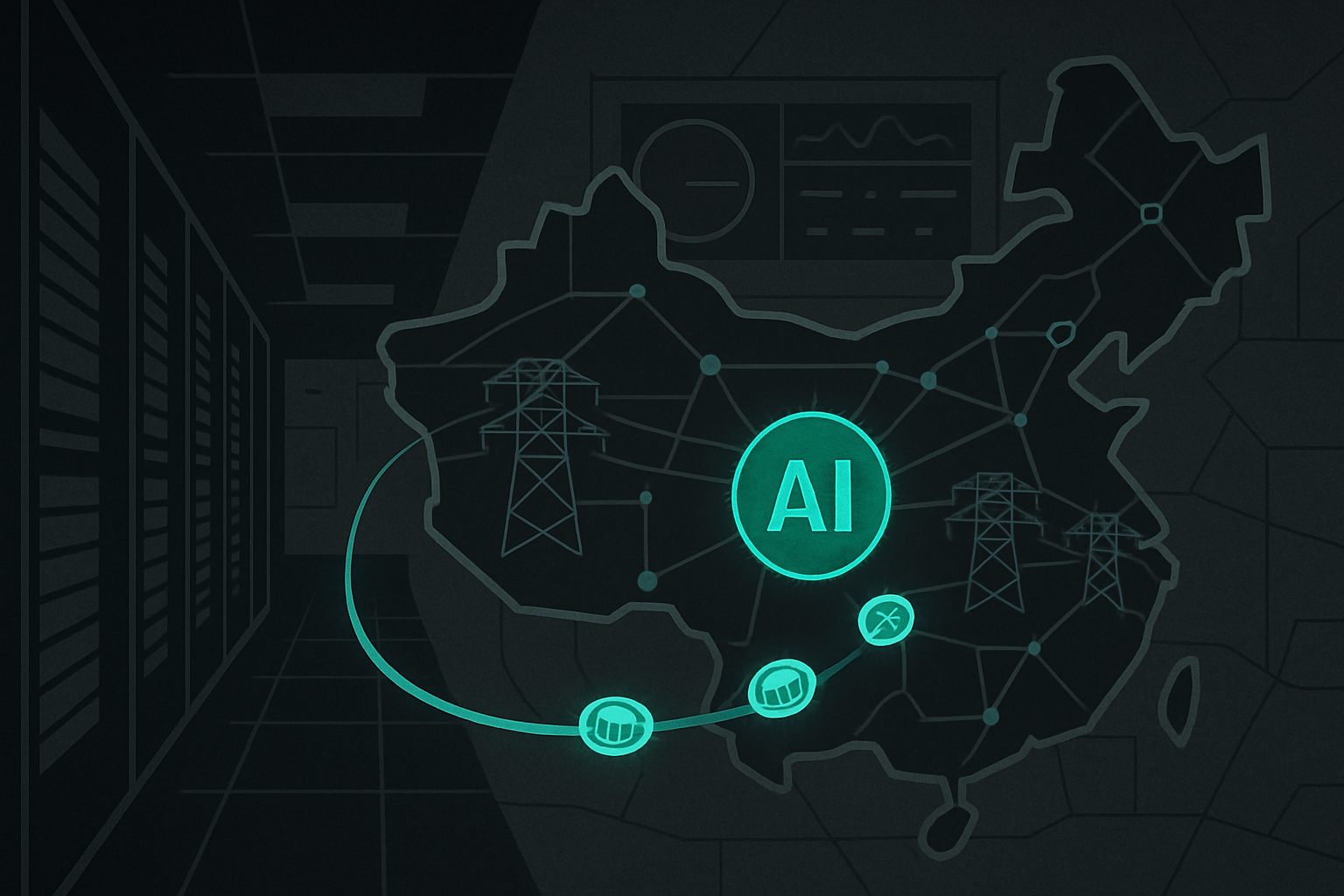
The familiar cloud model sells capacity as inventory. A developer rents GPUs, commits to a region, absorbs price volatility, and hopes the model bill does not become the product. Beijing is now pushing a different frame: AI compute as routed public infrastructure, closer to electricity, mobile data, or long-haul rail than ordinary cloud capacity.
That is the interesting part. Not that China wants more data centers. Every large economy does. The sharper claim is that compute should become a national network, with tokens treated as a measurable commodity and public planning used to lower the cost of access.
State media has started saying the quiet part in plain language. South China Morning Post reported on May 17 that CCTV and Xinhua described the national computing network as a “computing version of the state grid”. The same reports compared tokens to mobile data: small, countable units that can be packaged, routed, and sold at mass-market scale.
That analogy is useful. It is also dangerous.
The Token Becomes the Billing Unit
The policy logic starts with demand. China’s average daily token calls exceeded 140 trillion by late March 2026, according to data from the National Data Administration reported by the State Council’s English site. That was more than 1,000 times the roughly 100 billion daily calls recorded at the start of 2024, and more than 40 percent above the 100 trillion daily level at the end of 2025, the same report said (State Council/Xinhua).
That number matters less as a precision instrument than as a political signal. It gives planners a demand curve. It lets telecom operators talk about AI usage the way they already talk about mobile data packages. It lets industrial ministries argue that compute access is no longer a specialized cloud procurement problem. It is becoming a general-purpose input.
The shift also gives Beijing a way to avoid the weakest version of sovereign AI policy. Many countries say they need local models, local data centers, and local chips. Fewer can explain how small firms, local governments, factories, universities, and application developers are supposed to buy usable inference capacity without recreating the same concentrated cloud market they already dislike.
China’s answer is to route the resource.
The national computing network is being placed inside a broader infrastructure category. The National Development and Reform Commission has described the “six networks” as water, power, computing power, next-generation communications, urban underground pipelines, and logistics. NDRC director Zheng Shanjie said in March that investment in those networks and related priority areas was initially estimated to exceed 7 trillion yuan in 2026 (NDRC).
That does not mean 7 trillion yuan is going into AI data centers. It means compute is being put in the same planning bucket as physical networks that support the real economy. That is the policy move.
Utility Language Solves a Political Problem
The utility frame gives the state three benefits.
First, it turns AI access into a distribution problem. If tokens are like mobile data, then the state can ask why access is expensive, uneven, or stuck inside a few platforms. That invites telecom-style packaging and public-infrastructure-style buildout. It also gives incumbents such as telecom carriers a role in AI demand aggregation.
Second, it turns regional imbalance into an engineering problem. China has spent years building “east data, west computing” infrastructure to connect eastern demand with western power and land. The compute-utility story extends that logic. The point is not only to build clusters where electricity is cheap. It is to make the capacity feel reachable from where demand lives.
Third, it connects compute to energy policy. On May 8, the State Council said Chinese authorities had issued an action plan for the mutual empowerment of AI and energy. By 2030, the plan aims for significantly increased clean-energy supply capacity for AI computing-power infrastructure. The National Energy Administration said the plan is intended to ensure safe and reliable energy supply for compute infrastructure, push greener and lower-carbon infrastructure, and improve coordination between computing power and electricity (State Council/Xinhua).
That link is not decorative. Inference is not weightless because the product is software. Tokens are produced in buildings with power feeds, cooling constraints, network links, chip shortages, and utilization risk. If China wants tokens to become cheap like mobile data, it needs a system that can smooth demand, place workloads near available electricity, and avoid leaving expensive accelerators stranded in the wrong location.
This is where the hyperscaler comparison becomes useful.
The US cloud model is excellent at selling premium, flexible capacity to customers that can pay. It is less obviously designed to make AI inference feel like a public utility. Hyperscalers optimize for margins, platform lock-in, region-level reliability, and capex discipline. A national compute network optimizes, at least in theory, for access, routing, industrial policy, and strategic resilience.
Those are different markets.
The Counterpoint: Networks Do Not Create Scarcity-Free Compute
The best argument against Beijing’s framing is simple: calling compute a utility does not make it one.
Electricity is fungible at the user end. A kilowatt-hour from one plant can serve the same appliance as a kilowatt-hour from another plant, subject to grid constraints. AI compute is messier. Model architecture, chip type, memory bandwidth, interconnect quality, software stack, latency tolerance, data location, and security rules all matter. A token from one workload is not interchangeable with a token from another.
Even the mobile-data analogy has limits. Mobile carriers can oversubscribe networks because most users do not saturate the network at the same time. AI workloads can arrive as synchronized bursts from agents, factories, search products, finance systems, and government services. When demand spikes, the bottleneck is not only billing. It is available accelerator time.
There is also a governance problem. A routed national network needs rules for allocation. Who gets cheap capacity first: state labs, export manufacturers, local governments, consumer apps, schools, banks, or start-ups? If token packages are subsidized, who pays for the subsidy? If compute is prioritized by strategic value, then “public utility” starts to look like rationed industrial capacity.
That is not automatically bad policy. It may be more honest than pretending AI infrastructure is a neutral marketplace. But it is not the same thing as cloud becoming electricity.
The Real Test Is Price Discovery
The next useful signal is not another headline about a national computing network. It is whether China can make token pricing boring.
Utilities work when the user can treat the input as predictable. Mobile data became economically powerful when developers stopped worrying about every megabyte. Electricity became industrial infrastructure because factories could plan around supply, tariffs, and reliability. AI compute will only play the same role if firms can forecast token costs, service quality, and availability.
That is why the telecom packaging detail matters. It suggests Beijing wants AI usage to move from bespoke cloud procurement into plans, quotas, bundles, and monitored access. That could broaden adoption quickly if the network works. It could also hide real costs if packages are politically priced before capacity is actually abundant.
For global AI competition, the strategic difference is clear. The US is scaling AI through hyperscaler balance sheets and private platform markets. China is trying to graft compute onto state-directed infrastructure planning, telecom distribution, and energy coordination. One system may allocate capital faster. The other may spread access wider if routing and pricing work.
The word “if” is carrying a lot of load.
China’s compute-utility buildout is not just a data-center story. It is a claim that AI inference should become a metered, routed, semi-public input for the economy. If that claim holds, the winners will not only be chip vendors or cloud providers. They will be the operators that can make tokens feel as ordinary as bandwidth.
If it fails, the result will be familiar: expensive clusters, uneven access, administrative slogans, and developers still hunting for cheap inference wherever they can find it.


Discussion
Sign in to join the discussion.
No comments yet. Be the first to share your thoughts.