The Problem
The easy read on the UAE’s new tourist bank account is that visitors can now spend more easily. That is true. It is also the least interesting part.
On April 30, 2026, the Central Bank of the UAE said it had launched digital bank account opening services through the “Tourist Identity” initiative with the Federal Authority for Identity, Citizenship, Customs and Port Security and Abu Dhabi Commercial Bank. The official announcement says non-resident visitors can open digital bank accounts using Tourist Identity, with ICP providing a trusted digital identity on arrival through biometrics and facial recognition, and ADCB integrating that identity flow into its mobile banking app (CBUAE, April 30, 2026).
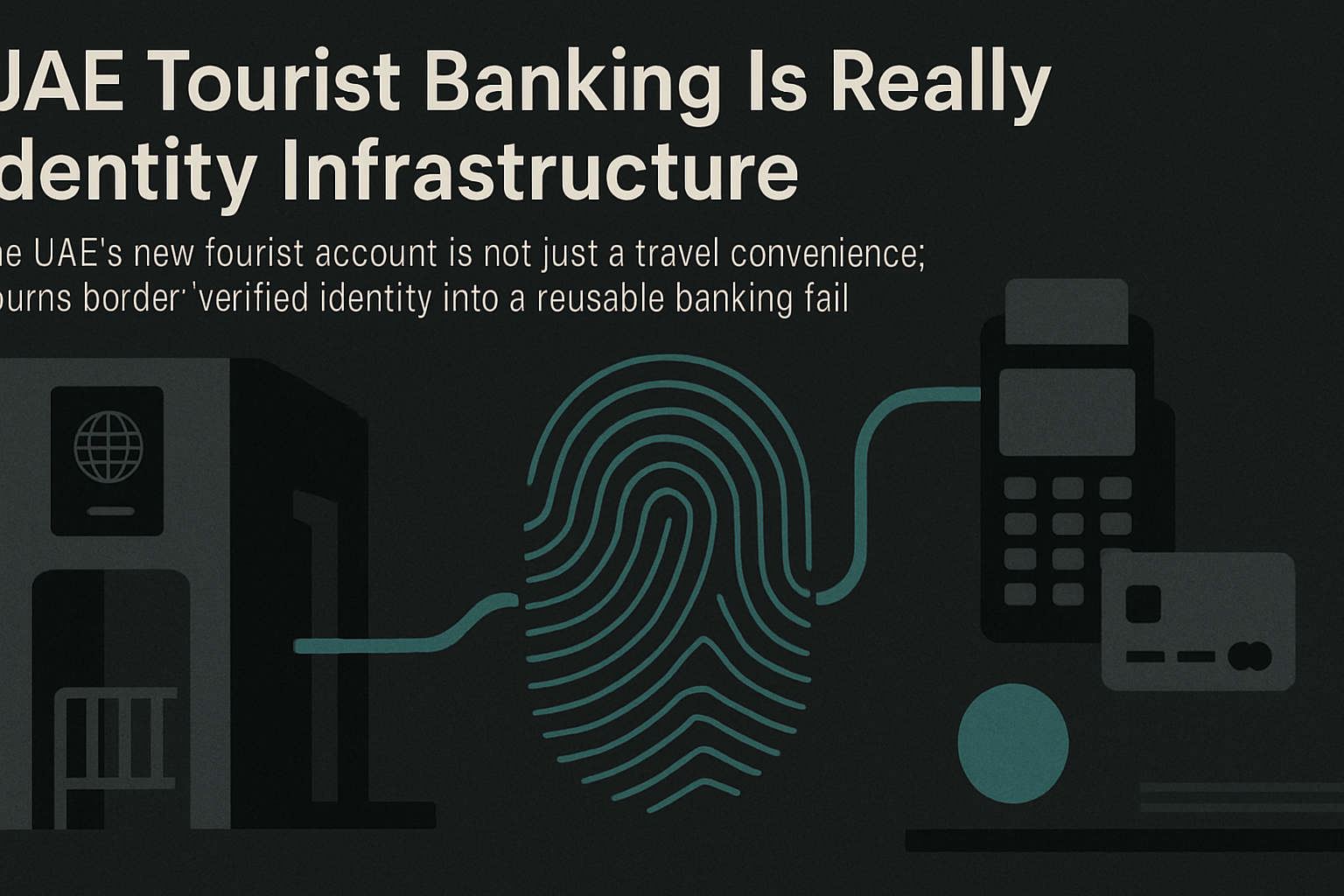
That makes the product look like a banking feature. Structurally, it is a handoff between the border, the identity authority, the central bank, and a commercial bank.
The account is narrow by design. ADCB describes the Instant Tourist Account as a digital-only AED savings account for international guests, opened through the ADCB mobile app. Visitors must be at least 18, physically present in the UAE, hold a valid tourist or visit visa, and have a valid passport. Transit visas and 96-hour visas are excluded (ADCB product page).
So this is not a disguised resident account. It is a controlled entry point.
The account lasts only for the visitor’s stay, visa validity, or a maximum of six months plus a seven-day grace period. It cannot be converted into a resident account. If the customer later obtains a UAE residence visa, ADCB says the tourist account must be closed and a new resident account opened. The monthly maintenance fee is AED 25 on the product page, waived at a AED 2,500 balance; the key facts statement lists AED 26.25 including VAT (ADCB KFS).
The restrictions matter because they show the UAE is not relaxing customer checks. It is relocating the first identity proof point.
The Analysis
Most digital banking launches start with the bank and add identity as a compliance step. This one starts with the state identity layer and lets banking attach to it.
The CBUAE announcement says the Tourist Identity is developed by ICP and supported by biometric and facial-recognition technologies. It also says the initiative uses ICP’s platform integrated with ADCB’s mobile app, allowing visitors to open accounts within minutes and receive digital debit cards for immediate use (CBUAE). ICP’s quoted statement goes further: it describes a Virtual Tourist Identity system using biometric identification and AI algorithms inside a UAEKYC biometric identification framework.
That is the core story. The tourist account is a consumer-facing proof that UAEKYC can pass usable identity assurance into regulated financial onboarding.
ADCB’s key facts statement preserves the banking controls. It says ADCB may rely on information from government authorities or third parties for identity verification, visa validation, immigration status checks, and ongoing eligibility monitoring. It also says all transactions remain subject to ADCB monitoring, limits, and financial-crime controls (ADCB KFS).
The account also limits what a tourist can do. Funds are held in AED only. The debit card is for domestic UAE use only. International transfers are limited to one pre-registered, whitelisted external bank account in the customer’s own name. Cheque books, lending products, wealth products, insurance, extra current accounts, and fixed deposits are excluded.
That is not frictionless finance. It is bounded finance.
The distinction is important. The UAE is not saying a tourist should get the same financial privileges as a resident. It is saying a border-verified person can be given a small, temporary, monitored banking container that connects to domestic payment infrastructure.
The CBUAE’s own language points there. The announcement links the service to digital payments, consumer protection, less cash use, and integration with the national payment scheme Jaywan and instant payment platform Aani. Al Etihad Payments, a Central Bank subsidiary, describes Aani as an instant payments service for customers of licensed financial institutions and payment service providers, with transfers up to AED 50,000 on a 24/7 basis (Aani). It describes Jaywan as the UAE’s domestic card scheme, localizing debit-card transaction processing and keeping payment-related data in the UAE (Al Etihad Payments).
That makes the sequence clearer. Identity first. Account second. Domestic payment rails third.
CBDC is not the center of this story. The UAE has a digital-dirham agenda, but this launch does not require a central bank digital currency to matter. It works with ordinary bank accounts, debit cards, mobile banking, instant payments, and domestic card rails. The strategic move is not tokenizing the dirham. It is giving the state a reusable way to turn a temporary visitor into a verified participant in the domestic financial system.
That is a more immediate lever than CBDC because it can be deployed through banks now.
The Implications
The first implication is for banks. Tourist onboarding becomes a test case for splitting KYC labor between state identity systems and regulated financial institutions. The bank still owns risk, monitoring, account limits, complaints, and financial-crime obligations. But the identity packet starts upstream.
That can compress onboarding time without removing controls. It also creates a cleaner audit trail. A bank can point to government identity verification for who the person is, then apply its own policy to what that person may do.
The second implication is for tourism policy. The UAE is trying to make arrival feel like account activation. That sounds small until it is linked to hotel deposits, transport, retail, domestic QR payments, refund flows, entertainment spending, medical tourism, and real-estate visits. A visitor with a verified identity and a domestic payment instrument is easier to serve, easier to monitor, and easier to retain.
The third implication is competitive. Financial centers have spent years talking about open banking, CBDCs, and tokenized deposits. The UAE is showing a more practical route: build national identity assurance, connect it to banks, then make payment rails available inside defined risk limits. It is less theatrical. It is also closer to production.
The risk is that convenience becomes infrastructure before the governance debate catches up. Biometric tourist identity creates a valuable data bridge between border control, banking, and payments. That bridge can reduce fraud and cash dependence. It can also expand state visibility into non-resident financial activity.
That tension is the point. The UAE tourist account is not just a better way to pay for dinner in Abu Dhabi. It is a controlled experiment in how a state-backed identity layer can create financial access for people who are inside the country but outside the resident system.
Payments get the interface. Identity gets the power.


Discussion
Sign in to join the discussion.
No comments yet. Be the first to share your thoughts.