The Problem
Brazil already solved the easy part of instant payments. Pix made real-time bank-account payments normal.
The harder problem is turning that payment system into an embedded checkout rail without making every user bounce through a bank app, copy a code, scan a QR code, or re-authenticate in a separate environment at the worst possible moment in the purchase flow.
That is the useful read on Brazil’s Open Finance payment-initiation push. Banco Central do Brasil and the National Monetary Council published rules in July 2024 to simplify the Open Finance payment journey, reduce online payment steps, and make Pix by proximity possible. The official government notice said the system should be available to customers from February 28, 2025, after testing that began in November 2024 (Ministry of Finance / BCB notice).
The regulation matters because it changes what Open Finance is for. In its first life, Open Finance was mainly a consent and data-sharing regime. A user could authorize one institution to access account or transaction information held by another. Useful, but still abstract. The new payment journey moves the same consent architecture into the act of paying.
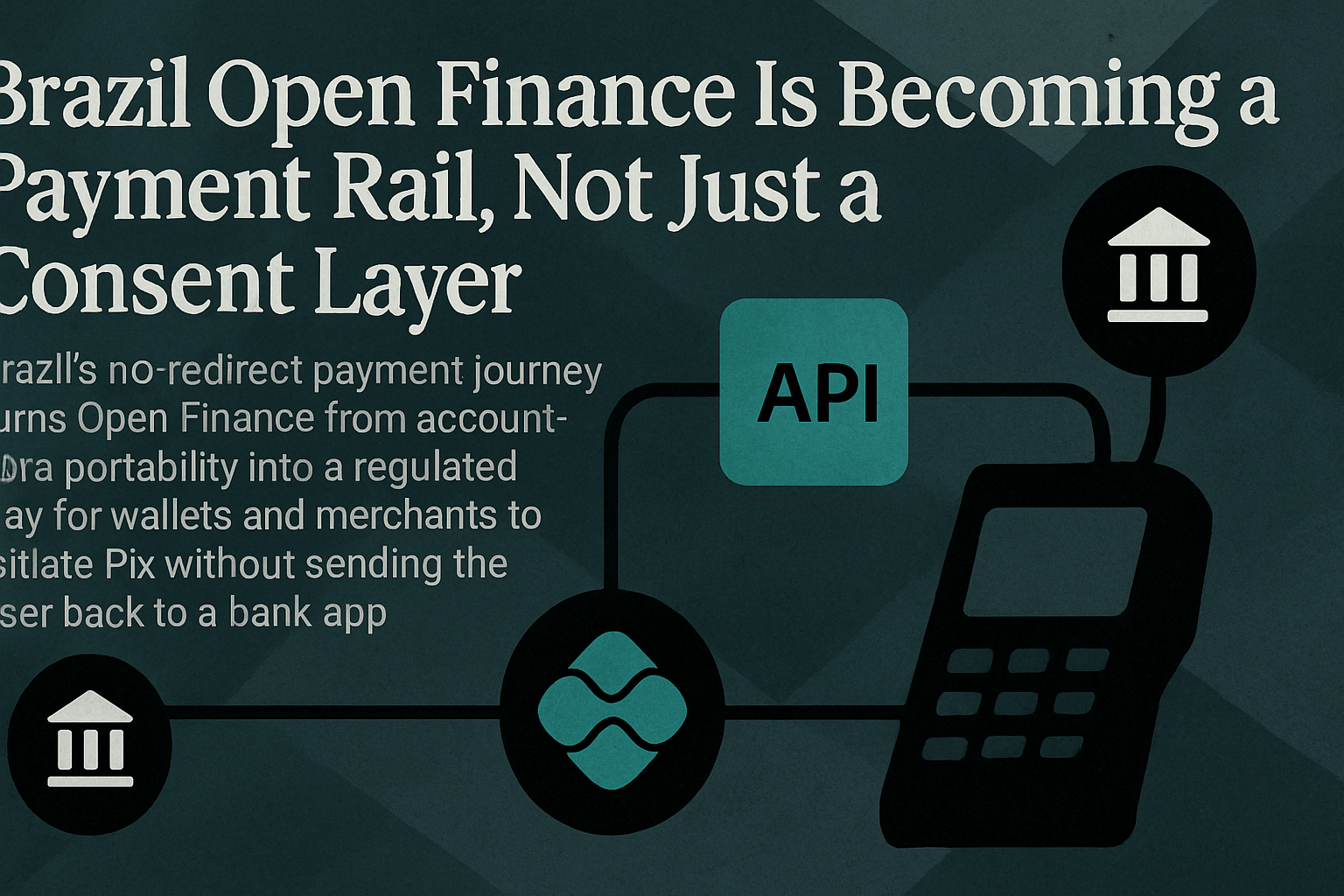
Under the no-redirect model, a customer can pre-link an account in a digital wallet or merchant environment, then pay by Pix without being sent into a bank app or another browser tab. For proximity payments, the wallet receives transaction details from the merchant terminal and uses Open Finance APIs to initiate the payment from the account the user already linked. A February 2025 BCB explainer said the wallet model was already being offered by Google with C6, PicPay, and Itau, and that account-holding institutions participating in Open Finance would have to allow access for authorized payment initiators from February 28 (BCB explainer PDF).
That is a small interface change with a large institutional consequence.
The Analysis
The phrase “no redirect” sounds like a UX cleanup. It is more than that.
The redirect was the visible reminder that the bank still owned the decisive moment. A merchant, wallet, or fintech could start the user journey, but the bank app usually pulled the customer back for authentication and confirmation. That preserved bank control. It also made Open Finance feel like a detour bolted onto Pix.
The no-redirect journey tries to separate authorization from interruption. The customer still gives consent. The payment initiator still has to be authorized and participate in Open Finance. The account-holding institution still controls the underlying account and settlement. But the purchase can happen in the wallet or commerce environment after a prior account link.
Open Finance Brasil’s own developer documentation shows how far that model is being pushed. Its Jornada Sem Redirecionamento 2.2.0 pilot, updated May 4, 2026, was scheduled for February 6 to April 21, 2026. The pilot covers new entrants and new functionality, including Pix Automático, desktop support, and expansion to business customers. For mandatory Pix account holders entering the journey, the required testing scope includes immediate and scheduled payments, Pix Automático, individual and business users, and mobile and desktop environments (Open Finance Brasil developer area).
That detail is important. This is not just tap-to-pay for Pix. The architecture is being tested across recurring payments, scheduled payments, desktop commerce, and business flows. The payment initiator is becoming an interface layer over account money.
Pix supplies the rail. Open Finance supplies the permissioned front door.
That is also why the comparison with Pix has to be precise. Pix is the settlement and payment scheme success story. It is ubiquitous because the Banco Central made it interoperable, cheap at the user layer, available around the clock, and embedded across bank accounts. In 2024, Pix recorded 63.8 billion transactions, according to Febraban’s analysis based on Banco Central and card-industry data (Folha / Febraban).
Open Finance payment initiation is nowhere near that scale. Finsiders Brasil, citing Banco Central data, reported that Pix payment initiation through Open Finance moved R$3.2 billion in 2024, with almost 7.4 million transactions for the year (Finsiders Brasil).
The gap is the point. Open Finance does not need to replace Pix. It needs to make Pix usable in places where the old journey was too clumsy: wallet tap-to-pay, merchant checkout, marketplaces, recurring authorization, and account-based payments initiated outside the bank’s own interface.
That creates a different competitive question. Banks still hold the accounts. But payment initiators can own the user surface where the payment decision happens. The bank becomes the account and risk engine behind a transaction that the customer experiences elsewhere.
That is not a theoretical shift. It is exactly where card networks, wallets, acquirers, e-commerce platforms, and banks fight for economics and data. Pix compressed the cost of moving money. No-redirect Open Finance attacks the control of the payment moment.
The Implications
For banks, the risk is not that Open Finance drains deposits overnight. The risk is interface dilution. If a user can link an account once and then pay from a wallet, merchant app, or marketplace without returning to the bank, the bank’s app becomes less central to everyday payment behavior.
That does not make the bank irrelevant. It still owns the account relationship, compliance burden, fraud controls, liquidity, and dispute handling. But it weakens the habit loop. In payments, the interface is where loyalty, offers, credit prompts, merchant steering, and data capture tend to live.
For wallets and merchants, the opportunity is cleaner. Pix by proximity and e-commerce no-redirect flows give them a route to account-based payments that can feel closer to card checkout than traditional Pix. The customer does not need to copy a code, scan a QR code, leave the merchant, and hope the handoff back works. The payment can happen where the purchase started.
For the Banco Central, this is the second act of Brazil’s payments strategy. Pix built the shared rail. Open Finance payment initiation is trying to make that rail programmable at the edge without letting unregulated actors touch customer funds. Open Finance Brasil’s dashboard definition is careful on that point: a payment initiator provides initiation service but does not at any time hold the transferred funds (Open Finance Brasil dashboard).
The failure mode is also clear. If consent setup is confusing, if account linking breaks, if banks implement the APIs grudgingly, or if fraud controls make the journey feel unpredictable, the no-redirect model will remain a specialist flow used by a few wallets and fintechs. Brazil has seen enough payment UX miracles to know that a mandated API is not the same thing as a working consumer habit.
But the direction is hard to miss. Open Finance is moving from “let another institution see my data” toward “let another institution initiate my payment.” That is a much sharper product.
Brazil is not building a second Pix. It is building the layer that lets Pix escape the bank app.


Discussion
Sign in to join the discussion.
No comments yet. Be the first to share your thoughts.