Problem
The U.S. deepfake fight just moved from policy argument to operations queue.
On May 19, the Federal Trade Commission began enforcing Section 3 of the TAKE IT DOWN Act against platforms that fail to comply with its notice-and-removal requirements for nonconsensual intimate imagery. The FTC’s business guidance says the law covers intimate real photos and videos as well as “digital forgeries” created or altered with software, an app or artificial intelligence. That means AI-generated abuse is not a side case. It is inside the enforcement perimeter.
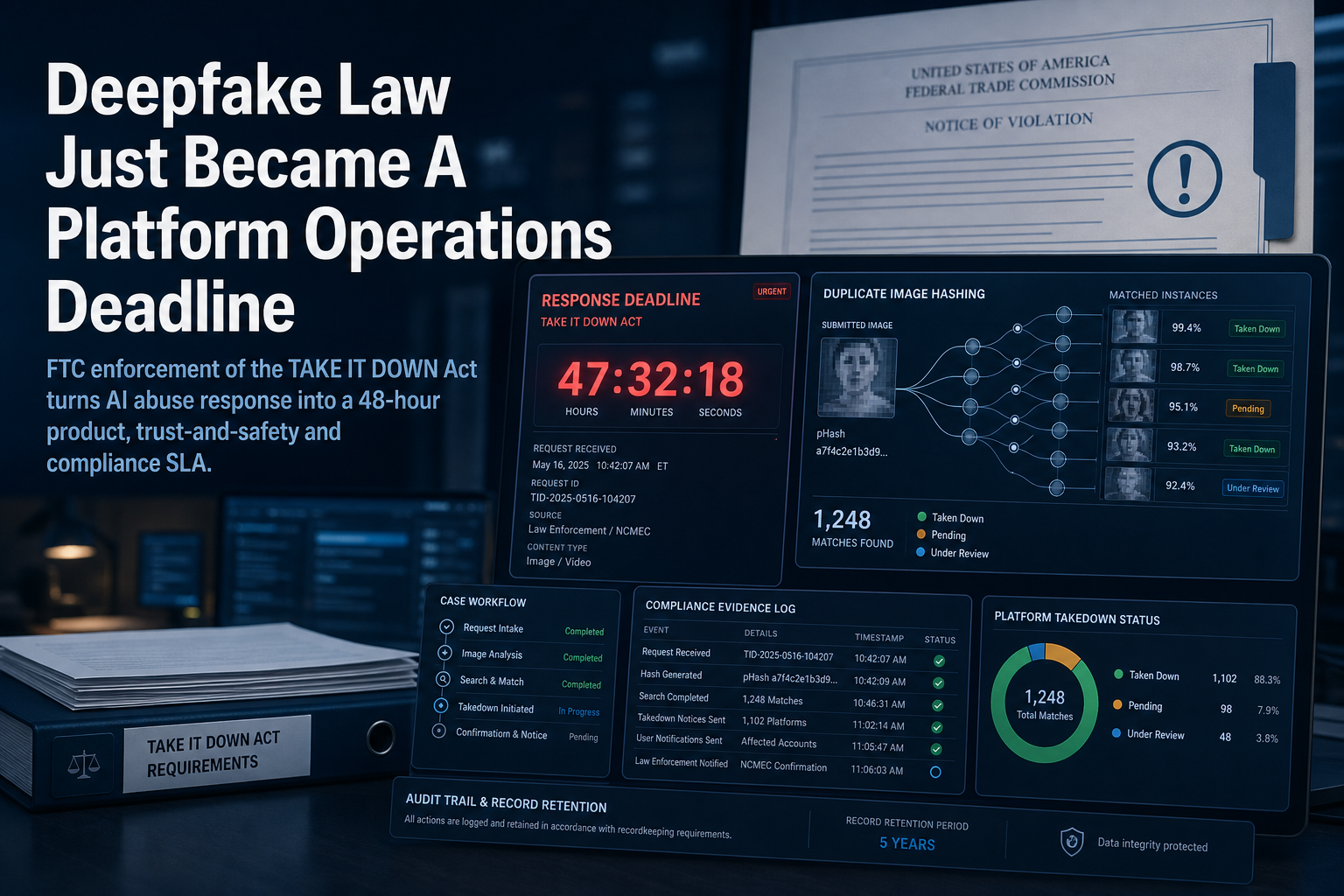
For platform operators, the important number is not a model benchmark. It is 48 hours. Once a covered platform receives a valid request, it must remove the material and known identical copies within that window, according to the FTC’s May 19 enforcement note and its business compliance guide.
The second number is penalty exposure. The FTC says violations may bring civil penalties of $53,088 per violation.
This is where the story leaves the courtroom and enters the backlog. Compliance now depends on whether a platform can receive a request, validate it, find matching content, remove it, suppress known duplicates, provide status visibility and keep evidence. The law creates a human harm problem. The enforcement mechanism creates a product reliability problem.
That is the shift. Deepfake regulation is no longer only about criminalizing perpetrators or writing AI-content disclosure rules. It is becoming a service-level agreement for platform response.
Analysis
The FTC is being explicit about operational expectations. Its compliance guide says covered platforms must provide plain-language information about the notice-and-removal process. Victims should not need to understand a company’s internal abuse taxonomy to get a takedown request into the right pipe.
The agency’s enforcement note also says platforms should be prepared to demonstrate compliance and make it easy for people to track the status of their requests. It gives examples such as confirmation or report numbers and status updates. That sounds small. It is not. A reporting number turns a victim’s request into an auditable workflow object. A status update turns moderation from a black box into something regulators can inspect.
The Act’s operational burden is not only first removal. It includes known identical copies. A platform that removes one URL while leaving the same image elsewhere has not solved the problem. For product teams, that points toward hashing, duplicate clustering and escalation tools. For legal and trust teams, it points toward evidence retention, exception handling and documented response times.
This is not a generic content-moderation rule. It is narrower and sharper. The content category, deadline, duplicate obligation and penalty hook are specific. Platforms can argue about edge cases, but they cannot treat the process as optional policy hygiene.
The FTC also launched TakeItDown.ftc.gov so people can report platforms that fail to remove covered material quickly or lack a removal process. That matters for enforcement discovery. The agency now has a dedicated intake path for platform failures.
The earlier warning phase was not subtle either. On May 11, FTC Chairman Andrew Ferguson sent letters to more than a dozen technology companies, including Amazon, Alphabet, Apple, Automattic, Bumble, Discord, Match Group, Meta, Microsoft, Pinterest, Reddit, SmugMug, Snapchat, TikTok and X, reminding them to comply by May 19. The FTC’s press release said covered platforms include websites, apps and online services such as social media, messaging, image or video sharing and gaming platforms.
That list is the clue for operators. This is not just a social-media rule. Messaging, gaming, dating, image-hosting and community platforms can all sit inside the perimeter if they meet the covered-platform definition. Compliance may discover the law first. Engineering will own the clock.
AI changes the practical load. Nonconsensual intimate imagery was already hard to moderate when the evidence was a real file posted by one user. Synthetic and altered media add volume, ambiguity and evasion pressure. Bad actors can generate variants. Crops, filters, watermarks and re-uploads can break naive exact-match systems. The law’s “known identical copies” language does not require platforms to solve every possible near-match problem. But a platform that cannot identify straightforward duplicates will have a hard time explaining why it is operationally ready.
That creates an uncomfortable systems-design problem. Platforms need enough automation to find copies fast, but enough human process to avoid compounding harm through mistaken handling, poor communication or exposure of sensitive material to too many reviewers. They need a low-friction path for victims, but not an easily abused weapon for false takedowns. They need speed, accuracy and auditability. Pick only two and the third becomes the enforcement memo.
The FTC guidance does not prescribe a technical architecture. A social network, private messaging service, gaming platform and niche image host do not share the same stack. But the output requirement is clear enough to shape architecture: intake, verification, removal, duplicate handling, status tracking and records.
The market effect will show up in tooling. Trust-and-safety vendors, hash-matching services, moderation workflow systems and legal operations platforms now have a cleaner buying trigger. Before, the pitch was risk reduction. Now it is deadline compliance. That changes budget conversations. “We should improve abuse reporting” becomes “we need evidence that valid requests close inside 48 hours.”
Implications
For platform leaders, the immediate work is not a white paper on AI safety. It is a table of covered surfaces. Which products allow uploads, image sharing, messaging, profile media, direct messages, group posts or game chat? Which teams own abuse intake? Which systems can find known copies? Which logs prove timing? Which vendors see sensitive content? Which executive signs off when the queue misses the clock?
For AI companies, the enforcement perimeter is a warning about distribution. If an AI image tool pushes generated content into a community layer, hosting layer or sharing feature, it may inherit operational obligations that look more like platform governance than model governance. A generation API is one thing. A product that helps users publish, store, forward or remix intimate synthetic imagery is another. The law follows the service surface.
For regulators outside the U.S., this is a useful template because it avoids one common failure mode in AI policy: trying to define the whole technology before enforcing anything. The TAKE IT DOWN Act targets a concrete harm and gives platforms a concrete response obligation. It does not settle the broader debate over AI-generated media, identity, consent or speech. It makes one category of abuse operationally actionable.
The risk is uneven implementation. Large platforms can build dedicated pipelines. Smaller covered services may rely on manual review, vendor tools or hurried policy pages. That is where enforcement will matter. If the FTC only pressures the obvious giants, the long tail will lag. If it starts testing process quality across smaller services, compliance tooling becomes table stakes.
The broader lesson is simple. AI content rules become real when they turn into queues, clocks and evidence. The FTC has now put a clock on one of the clearest harms in synthetic media.
That clock is 48 hours. For product teams, it is already running.


Discussion
Sign in to join the discussion.
No comments yet. Be the first to share your thoughts.