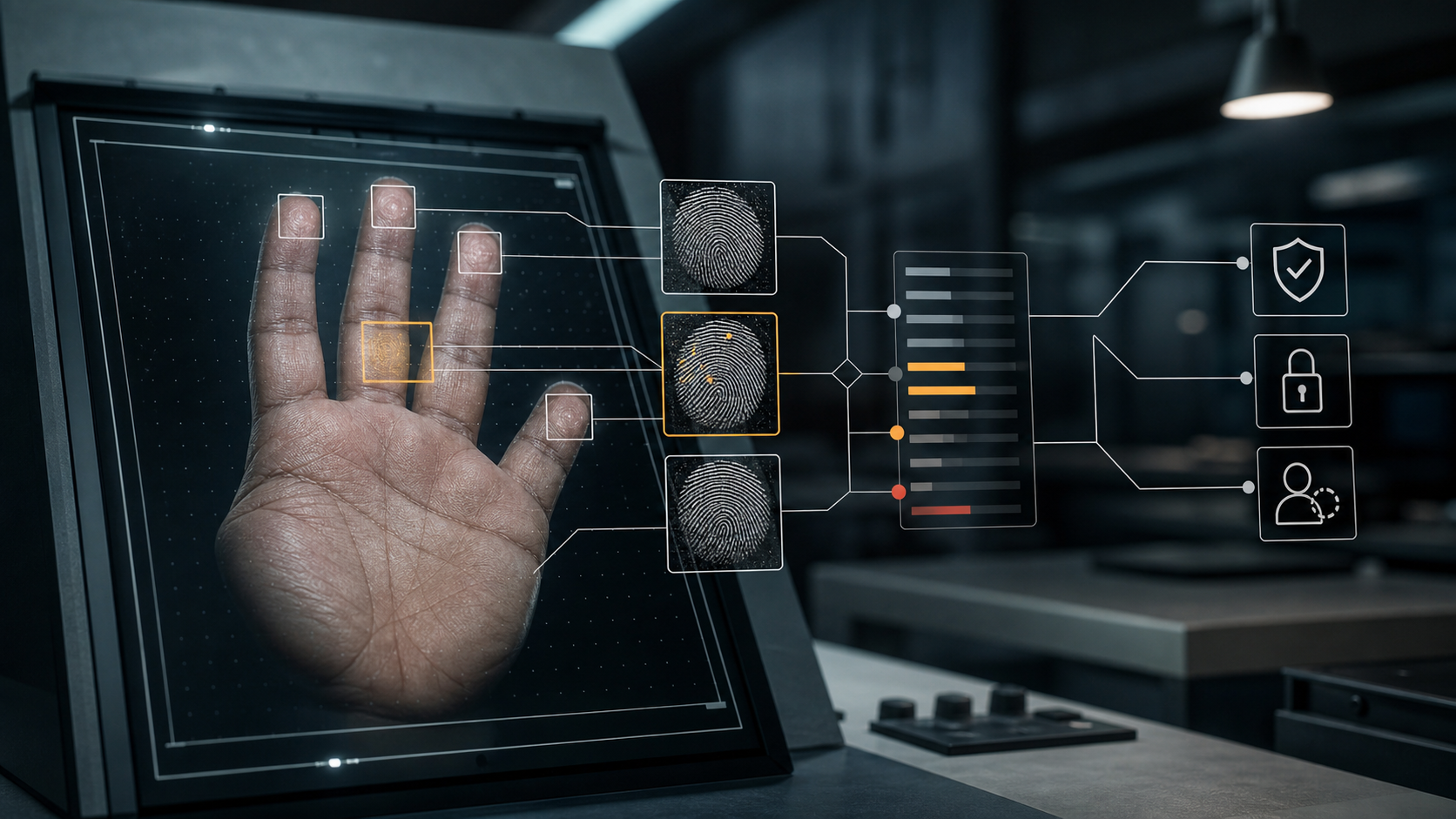
The Problem Is Triage
The useful question is not whether every selfie now leaks a working fingerprint. It does not.
The useful question is narrower and more operational: can software make it cheaper to decide which ordinary images contain fingerprint detail worth attacking?
That is where AI-enhanced imaging changes the risk. A bad photo remains a bad photo. Motion blur, shallow focus, bad lighting, finger angle, compression, and distance still matter. But attackers do not need universal extraction. They need a filter. They need to sort a pile of public images into likely junk, possible ridge detail, and material worth manual work.
That turns biometric leakage from a curiosity into a workflow.
Recent reporting revived the selfie version of the story, warning that high-resolution images with visible fingers may expose ridge detail under favorable conditions. TechSpot correctly notes the caveat: earlier demonstrations were possible but often required multiple good images, controlled conditions, and specialist processing. The barrier is moving because phone cameras and computational photography keep improving (TechSpot).
The same direction is visible in the research literature. A 2026 Cluster Computing paper on contactless fingerprint identification used 2,143 images from 175 people and reported 93.5% identification accuracy in a controlled study, while also emphasizing the hard parts: image quality, finger orientation, preprocessing, and environmental factors (Springer Nature).
That is not proof that Instagram can open a bank account. It is proof that the capture boundary is less fixed than old biometric threat models assume.
Fingerprints used to be treated as either present or absent. The next phase is more annoying. They are present with a quality score.
NIST Shows The Direction Of Travel
NIST’s recent fingerprint work is not an attack manual. It is forensic infrastructure. That distinction matters.
In March 2026, NIST said Special Database 302 now includes about 10,000 fingerprint images from 200 consenting volunteers, with annotations designed to help train human examiners and machine-learning algorithms. NIST also released OpenLQM, open-source software that returns a fingerprint quality score from 0 to 100 and can be used standalone or inside other tools (NIST).
The benign use case is clear. Fingerprint examiners need faster, more reproducible ways to separate useful latent prints from smudges. Quality scoring helps with that. NIST’s older NFIQ 2 work makes the same point at standards level: fingerprint image quality can be linked to operational recognition performance, numerically calibrated, and standardized for sensor deployments (NIST NFIQ 2).
That is good science. It also describes the shape of the security problem.
Once quality becomes measurable, it becomes automatable. Once it is automatable, it becomes cheap to apply before an attacker spends time on reconstruction, spoofing, account recovery, or social engineering. AI does not need to invent fingerprints from noise. The more plausible near-term risk is a ranking pipeline that says: this crop is useless, this one is maybe usable, this one deserves attention.
That is enough to change risk management.
Security teams already understand this in other domains. A phishing kit does not need to fool every user. It needs to identify enough vulnerable users. A vulnerability scanner does not need to exploit every host. It needs to rank where a human or automated exploit should go next. Fingerprint leakage is moving toward the same economics.
The ridge pattern is only one input. The business risk comes from what the institution does after seeing a biometric match.
Biometrics Are Not Authenticators By Themselves
NIST’s digital identity guidance is blunt on the point institutions often blur. In SP 800-63B, NIST says biometric characteristics are not secrets and can be obtained without consent, including latent fingerprints from objects people touch and iris patterns from high-resolution cameras. It also says a biometric characteristic is not recognized as an authenticator by itself; it needs to be paired with a physical authenticator, with local biometric verification preferred over central comparison (NIST SP 800-63B).
That maps cleanly onto the product risk.
A fingerprint should activate a credential. It should not be the credential. The credential should be a device-held key, a passkey, a hardware authenticator, or another cryptographic object that can be invalidated, rotated, and scoped to a relying party. The biometric should unlock that object locally, under rate limits and liveness checks.
FIDO’s privacy principles make the same architectural separation in plainer product language: user verification happens locally, remote authentication happens through cryptographic protocols, and biometric data should not leave the user’s personal computing environment (FIDO Alliance).
This is why the selfie panic is too small. The institution’s design decision matters more than the photo.
If a bank treats a fingerprint match as enough to recover an account, add a payee, approve a high-value transfer, or enroll a new device, then leaked biometric detail becomes a serious account-takeover input. If the fingerprint only unlocks a local authenticator that signs a scoped transaction, the same leak is less useful. Still bad. Not magic.
The difference is not marketing. It is liability.
The Irrevocable Credential Problem
Passwords are weak because people reuse them and leak them. But passwords have one redeeming feature: they can die.
Fingerprints do not. A user can enroll another finger. They cannot revoke the biological surface that appears in old photos, on glasses, on door handles, and in latent prints. Once a usable representation enters an attacker’s collection, the user is stuck managing downstream policy.
That shifts the burden from the consumer to the institution.
Every biometric-authentication program should have a compromise playbook. It should answer four questions before the incident:
What can be rotated if a biometric pattern is suspected to be exposed?
Which actions are never approved by biometric unlock alone?
Which fallback paths avoid turning customer support into the real attack surface?
How does the system treat old biometric enrollments after a device, account, or template compromise?
The wrong answer is “enroll a different finger.” That is a bandage with a product demo.
The better answer is layered. Revoke and reissue device credentials. Require step-up authentication for recovery and payment changes. Bind sensitive actions to transaction intent, not just session unlock. Keep biometric comparison local where possible. Rate-limit attempts. Test presentation-attack detection. Preserve a non-biometric fallback that is not weaker than the biometric path.
NIST’s SP 800-63B guidance points in that direction with requirements for multi-factor use, failure limits, sensitive handling of biometric data, and presentation-attack detection for fingerprint modalities. Those controls sound dry because standards are paid by the syllable. They are also the line between a convenience feature and a permanent credential leak.
The Business Risk Is All Three
Avery’s framing asks whether the business risk is account takeover, irrevocable biometric compromise, authentication fallback design, or all three.
It is all three, but not equally.
Account takeover is the visible loss event. It is what the fraud dashboard records. It is also the last step in the chain. The earlier risk is that a biometric identifier becomes permanently more available to attackers while the institution still treats it as if it were private.
Fallback design is the multiplier. If support agents, recovery flows, or device-reenrollment paths trust a biometric match too much, the attacker does not need to beat the strongest part of the system. They use the copied body signal to reach the weakest process.
That is the serious gap. AI-enhanced imaging turns public photos and latent traces into candidate biometric material. Quality tools make candidate material easier to rank. Weak recovery design turns ranked material into account risk.
The implication is not “ban fingerprints.” Fingerprint unlock remains useful. It reduces friction, blocks casual device misuse, and can improve security when it activates a strong local authenticator.
The implication is narrower: stop designing as if a fingerprint is a secret.
The institutions that get this right will treat biometric leakage like a credential-compromise scenario with worse revocation. They will assume the body signal may become observable. They will make the rotatable part of the system carry the trust.
That is the only sane bargain. The finger is permanent. The credential should not be.


Discussion
Sign in to join the discussion.
No comments yet. Be the first to share your thoughts.