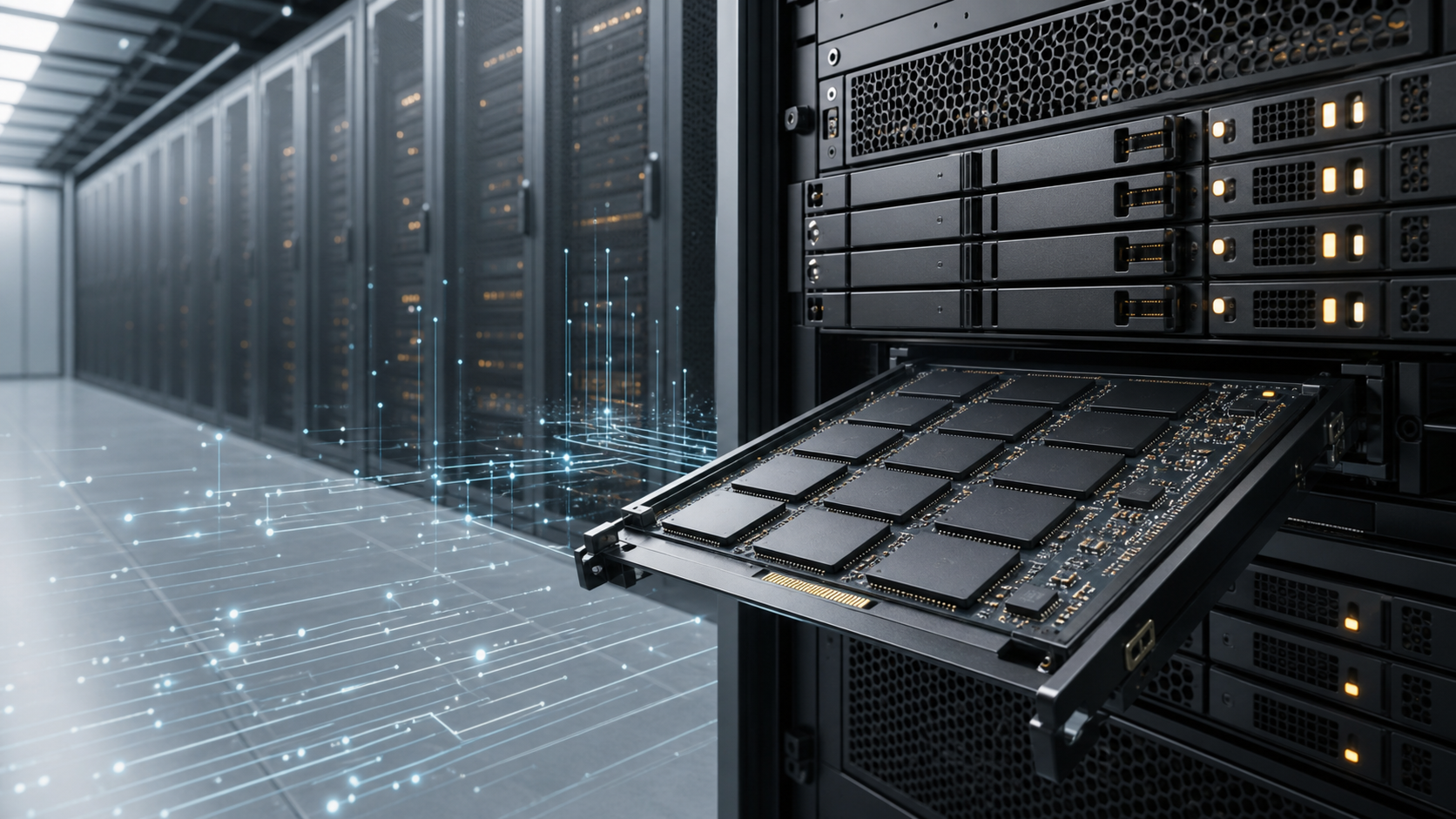
AI infrastructure coverage still behaves as if the scarce bill of materials has two important lines: GPUs and high-bandwidth memory. That was defensible during the first wave of accelerator shortages. It is now incomplete.
Kioxia’s latest fiscal-year numbers make the sharper point. Storage is being pulled into the same AI data-center cycle. Not as a sleepy peripheral budget. As a pricing, margin and capital-access story.
For the year ended March 31, 2026, Kioxia reported revenue of 2.3376 trillion yen, up 37.0 percent, and operating profit of 870.4 billion yen, up 92.7 percent. That is not the usual memory-cycle recovery story with better utilization and a little inventory relief. Management said the revenue increase was driven mainly by higher average selling prices after strong demand from generative-AI-centered data-center customers.
That phrasing matters. It points to a shift in bargaining power. AI demand is not only increasing bit consumption. It is changing what buyers are willing to pay for storage capacity that keeps accelerators useful.
The Bottleneck Moved Down The Stack
The lazy version of the AI buildout says storage is where data goes after the expensive compute has done the real work. The actual architecture is less polite.
Training pipelines, retrieval systems, long-context inference, data lake ingestion, checkpointing and vector search all turn storage into active infrastructure. The GPU rack is idle theatre if data cannot arrive fast enough, close enough, and cheaply enough. Expensive accelerators do not care that the bottleneck is unglamorous.
Kioxia’s March quarter shows how quickly that demand can hit the income statement. The company reported March-quarter operating profit of 596.8 billion yen, up 454.0 billion yen from the December quarter. Over the same period, SSD and storage revenue rose by 299.9 billion yen quarter over quarter.
The important detail is mix. Kioxia describes SSD and storage as including products for PCs, data centers and enterprises. But the accompanying commentary says AI-server demand at data-center and enterprise customers increased while the overall flash market continued to grow. The direction is clear: the margin story is attached to higher-value storage, not only to commodity mobile bits bouncing off a trough.
That is why this is more than a NAND-price headline. If AI data centers need denser, lower-latency, more power-efficient storage, the vendor selling the right SSD architecture gets paid differently from the vendor selling undifferentiated capacity.
Storage Is Becoming Compute-Adjacent
Kioxia has been unusually explicit about this technical direction. In March, it announced a new SSD model for GPU-initiated workloads, saying the drive lets a GPU directly access high-speed flash as an expansion to HBM. The company tied the work to NVIDIA’s Storage-Next initiative and to the problem everyone in AI infrastructure quietly understands: HBM is fast, expensive and finite.
That does not make NAND a substitute for HBM. It makes storage part of the memory hierarchy that determines whether large AI workloads can be run economically. Once storage is close enough to the GPU path, its value is no longer measured only in dollars per terabyte. It is measured in utilization, latency, power draw and footprint.
Kioxia’s product announcements are consistent with the financial result. In May, Kioxia and Dell described a 2U PowerEdge configuration with 9.8 petabytes of flash storage using 40 Kioxia LC9 Series 245.76 TB SSDs. The companies framed the system for AI, large-scale data lakes and data-intensive enterprise workloads. Kioxia also said a comparable 9.8 PB configuration using 30.72 TB drives would require seven additional servers and 280 additional drives, with eight times the power consumption.
That is vendor math, so it should be read as a marketing comparison, not an industry law. But it explains the buyer logic. If flash density removes racks, power and operational complexity, storage has a total-cost story that procurement teams can understand. AI teams get the capacity. Finance teams get a path to fewer boxes. Data-center teams get a smaller power problem. Everybody still complains, but now they can do it in one spreadsheet.
Kioxia’s vector-search work points in the same direction. The company said its AiSAQ technology demonstrated 4.8 billion high-dimensional vectors on a single server, with GPU acceleration cutting one index-build test from 31 days to four days end to end. The specific benchmark is less important than the design premise: retrieval-augmented generation and vector databases are becoming storage-heavy AI workloads, not just software features parked above generic infrastructure.
Capital Follows The Demand Signal
The other tell is financial structure. On the same day as the full-year results, Kioxia disclosed that it is preparing to list American depositary shares representing common shares on a U.S. stock exchange. The company said the plan is contingent on regulatory approval and that the schedule, market and method have not been decided.
That caveat is real. A preparation notice is not a listing. Still, the timing is not hard to read.
AI infrastructure investors have already learned the accelerator supply chain. They know NVIDIA, TSMC, HBM suppliers, advanced packaging and the power equipment names. Storage is a less crowded way to express the same physical buildout thesis, especially if earnings show that AI demand is already lifting ASPs and margins.
Kioxia wants a broader investor base while its financials are telling a cleaner story. Total equity attributable to owners of the parent rose from 737.6 billion yen at March 2025 to 1.399 trillion yen at March 2026, while retained earnings moved from an accumulated deficit to 367.0 billion yen. The balance sheet now speaks a different dialect than it did during the memory downturn.
The risk is cyclicality. NAND remains a brutal market. Supply can return, customers can pause, and AI data-center demand can concentrate around a small number of buyers with immense negotiating power. Storage vendors are not magically immune because the word AI appears in the workload description.
But Kioxia’s year shows the memory cycle is being rewritten at the top end. AI workloads are not just consuming more capacity. They are pulling storage into performance architecture, power planning and capital allocation. That is why the ADS preparation belongs in the same story as the SSD revenue surge.
The GPU remains the obvious symbol of the AI buildout. Kioxia’s numbers are a reminder that symbols are not systems. The system needs somewhere to put the data, a way to move it near compute, and enough density to keep the power bill from becoming parody. NAND is not the headline chip. It is becoming one of the constraints underneath it.


Discussion
Sign in to join the discussion.
No comments yet. Be the first to share your thoughts.