The chatbot story is too small
China’s most important AI signal this week did not come from a model leaderboard. It came from a factory tour.
In a May 19 Xinhua readout carried by China Daily, Chinese Premier Li Qiang used a Beijing inspection trip to argue for the “deep integration” of artificial intelligence and advanced manufacturing. The same readout said Li was briefed on intelligent robots, inspected research-and-development applications across scenarios, and framed robots as a key vehicle for linking AI with manufacturing. The English mirror dates the tour photos to May 18 and says the trip focused on turning AI into production systems, not just research assets.
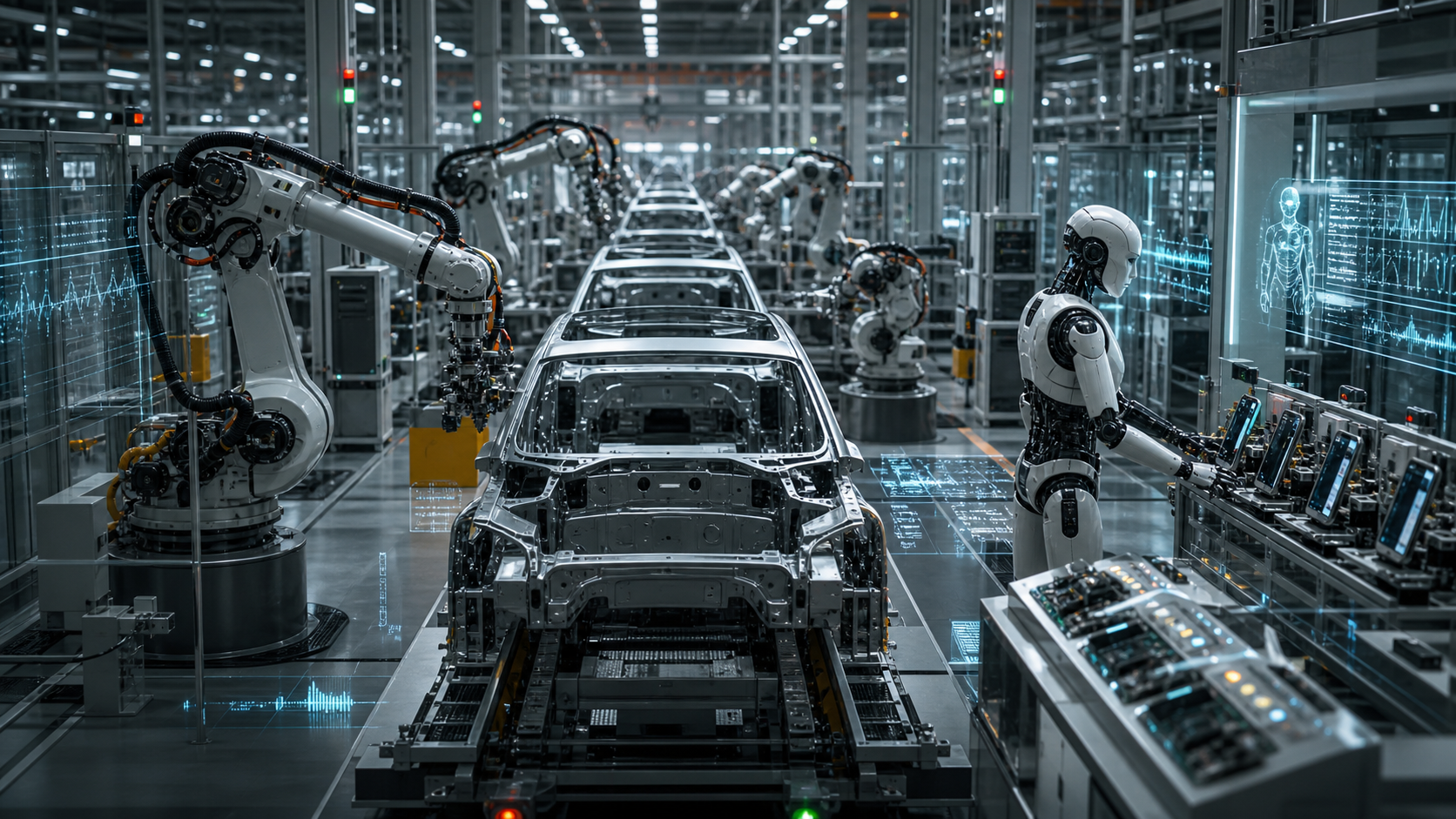
That distinction matters. The usual outside reading of Chinese AI still overweights chatbots, chips and model releases. Those matter. But Beijing’s next scaling story is physical: models in inspection systems, robot bodies, electric-vehicle lines, consumer devices and factory management software.
That is a different game from winning a benchmark. Benchmarks reward capability in controlled tests. Factories punish variance. A model that looks impressive in a demo becomes expensive if it slows a line, misreads a defect, drops a part, or needs constant supervision.
China’s bet is that its manufacturing base gives it enough real-world repetition to make physical AI improve faster than lab-only systems.
The official message is deployment
The readout’s language is not subtle. Li called for basic research and core-technology breakthroughs, but the operational center of gravity was application. He urged innovation in complete machines, key components, intelligent decision-making and control systems. He also pointed to China’s supersized market, complete industrial chains and rich application scenarios as advantages for robotics.
Those are not generic AI talking points. They are a checklist for industrial diffusion.
The same logic appears in Beijing’s humanoid-robot infrastructure. In January, the Beijing Innovation Center of Humanoid Robotics opened a pilot manufacturing and validation platform meant to move robots from small-batch prototypes toward scalable production. China Daily reported that the launch also included the center’s 1,000th customized prototype robot.
The center has also built the software side of the stack. Beijing E-Town said the center’s open-source community includes Tiangong documentation, RoboMIND data and an embodied algorithm training toolchain. It reported more than 100 partners using Tiangong for secondary development and more than 15,000 RoboMIND downloads across the center’s site, Hugging Face and Beijing’s public AI computing platform.
None of that proves China has solved humanoid robotics. It does show the policy shape: open platforms to lower entry cost, shared validation facilities to reduce duplicated pilot work, and application scenarios to force the systems out of conference videos.
Xiaomi is the useful symbol
The Xiaomi piece is why the tour matters beyond robotics.
Chinese local coverage of the same Beijing inspection says Li visited the Beijing Humanoid Robot Innovation Center and Xiaomi Auto, where he looked at intelligent-robot applications, factory production, intelligent manufacturing and quality inspection. That coverage is useful, but it should be read carefully. It is political-industrial signaling, not independent proof that every claimed system works at scale.
The signal still matters. Xiaomi sits at the intersection Beijing wants: phones, cars, connected devices, factory automation and robotics. It can move AI through consumer hardware and production hardware at the same time.
That is the physical-AI stack in miniature. An AI phone is not just a handset with a bigger assistant. It is an edge device, sensor package, local inference endpoint and distribution channel. An EV plant is not just a car factory. It is a high-throughput robotics environment with inspection data, machine vision, motion planning constraints and supplier feedback loops. A humanoid robot is not just a body. It is a test of whether perception, planning, manipulation and safety systems can survive messy industrial time.
Beijing’s industrial strategy is to connect those surfaces. If a company can collect manufacturing data, ship intelligent devices, run EV production and test robot bodies, it becomes more than a consumer brand. It becomes a deployment lab.
The hard part is that deployment labs expose weakness fast. A factory does not care that a model has elegant reasoning if the gripper misses a component. A quality-control system does not get partial credit for detecting most defects. A humanoid robot that works in a staged demo but needs a handler off camera is a very expensive training prop.
Physical AI changes the cost curve
This is why Li’s emphasis on application scenarios and industrial adoption costs is the most important part of the message.
In software AI, marginal deployment can be cheap once the model exists. In physical AI, the model is only one cost center. Sensors, actuators, safety systems, fixtures, maintenance, integration labor, downtime risk and factory-process redesign all matter. The unit economics are less forgiving.
China’s advantage is not that those costs disappear. It is that the country has more places to amortize them. A giant manufacturing base gives developers more production lines, more suppliers, more edge cases and more state-backed incentives to test automation. Beijing’s Shijingshan district, for example, opened the third phase of a humanoid-robot training center with simulated homes, hotels, supermarkets and factories where more than 100 robots can train and collect data.
But it can also hide bad economics. Subsidized pilots can make adoption look broader than it is. Local governments can encourage demonstration projects that do not survive normal return-on-investment math. State media can turn a partial deployment into a national technology narrative before the operations team has decided whether it wants a second shift of the same system.
That is why the right question is not whether China is “ahead” in physical AI. The right question is where the feedback loop is real. Are robots doing tasks that improve throughput or quality? Are models reducing inspection misses without raising false alarms? Are factories redesigning jobs around autonomy, or merely adding robots to satisfy a policy direction?
The implication for rivals
For the US, Europe, Japan and Korea, the lesson is uncomfortable. Physical AI will not be won by model labs alone. It will require a dense connection between model developers, component suppliers, industrial users, safety regulators and factory integrators.
China is trying to build that connection as a policy stack. The State Council readout supplies the political message. Beijing’s humanoid-robot center supplies shared infrastructure. Xiaomi supplies the consumer-and-factory bridge. EVs supply an automation-heavy market with brutal cost discipline.
That does not make the outcome guaranteed. Humanoid robots remain early. Factory autonomy is slower than demo culture admits. Open-source robot models still need bodies, data, safety cases and customers. The closer AI gets to steel, glass, batteries and workers, the less tolerant the world becomes of hallucination.
Still, the direction is clear. China’s AI push is moving from “who has the largest model?” toward “who can make models useful inside the physical economy?” That is a more durable question. It is also harder to answer with a press release.
The benchmark era rewarded clean screenshots. The factory era will reward boring uptime, lower scrap, faster retooling and fewer humans standing next to machines wondering why the robot has stopped again. Beijing appears to understand that. Now it has to prove it.


Discussion
Sign in to join the discussion.
No comments yet. Be the first to share your thoughts.