Problem
Korea’s stock-market reform is usually sold as an invitation.
More foreign capital. Better governance. More useful listings. Less of the old Korea discount. In 2026, that pitch is arriving with a harder companion: worse public companies are being shown the exit faster.
On May 13, the Financial Services Commission approved revised Korea Exchange listing regulations at its ninth regular meeting. The stated aim was to make domestic markets more dynamic by allowing innovative companies in and removing unviable companies more quickly (FSC).
That matters because Korea is in the middle of a semiconductor-led equity rush. Reuters reported that Samsung Electronics and SK Hynix have been driving a record KOSPI rally, with SK Hynix nearing a $1 trillion market value as AI demand pulls global investors toward Korean memory suppliers (Reuters via Investing.com). A bull market makes market reform easier to market. It also makes weak-company cleanup harder to ignore.
The reform is not just about attracting capital. It is about refusing to let weak issuers squat inside the market while the index is carried upward by chip giants.
Analysis
The most visible change is the market-capitalization threshold.
The FSC’s May 13 release says the delisting floor for KOSPI companies rises from KRW20 billion today to KRW30 billion from July 1, 2026, then KRW50 billion from January 1, 2027. For KOSDAQ, the clean schedule in the FSC’s February plan and first-tier Korean coverage is KRW15 billion today, KRW20 billion from July 1, 2026, and KRW30 billion from January 1, 2027 (FSC February plan, Korea JoongAng Daily).
The numbers are modest by global large-cap standards. That is the point. These are not thresholds designed to eject merely unpopular companies. They are minimum public-market hygiene tests. If a listed company cannot sustain a market value of KRW20 billion or KRW30 billion in the KOSDAQ market, the question is not whether it deserves patience. The question is why public investors should keep supplying the venue.
The reform also attacks the old survival mechanics.
Under the previous market-cap rule, a company that fell below the threshold for 30 straight trading days could enter a watch-list period. It could then escape if it stayed above the threshold for 10 straight trading days and 30 cumulative trading days within the 90-day period. The revised rule is harder to game. During the 90 trading days after watch-list designation, the company must stay above the threshold for 45 consecutive trading days or face delisting (FSC).
That sounds procedural. It is actually the core of the policy.
Short rescue rallies are common in distressed small caps. A company can issue optimistic disclosures, attract speculative buying, benefit from sector heat, or ride a thinly traded squeeze just long enough to clear a mechanical test. Ten straight days is an invitation to stage a survival rally. Forty-five straight days asks for something closer to durable market support.
Then comes the penny-stock rule. The FSC is creating a new delisting standard for shares trading below KRW1,000. If a stock stays below that line for 30 consecutive trading days, it goes on the watch list. If it cannot stay above KRW1,000 for 45 consecutive trading days during the next 90 trading days, it faces delisting (FSC).
This is where the anti-circumvention language matters. Companies have been able to use share consolidations or capital reductions to make a low share price look less low. The revised rules restrict repeat maneuvers after a company enters the micro-cap watch list and block excessive consolidation ratios above 10-to-1 during the relevant period. Korea is not only setting a line. It is trying to stop companies from redrawing the ruler.
The other two standards make the same point from different angles.
Total capital impairment used to matter mainly at fiscal year-end. The revised rules add semiannual assessment: full impairment at year-end remains an immediate delisting condition, while midyear full impairment triggers a delisting review. Disclosure discipline also tightens. The yearly demerit threshold falls from 15 points to 10, and serious intentional disclosure violations can trigger delisting review even without a prior points history (FSC).
This is a broader definition of market quality. A company can fail the market-cap test, the price test, the balance-sheet test or the disclosure test. The common theme is simple: a listing is not a permanent asset.
The KOSDAQ context explains the urgency. In February, the FSC said 1,353 companies had entered KOSDAQ over 20 years while only 415 had exited. Over that period, KOSDAQ market capitalization rose 8.6 times, but the index price rose only 1.6 times. The agency also cited a KRX simulation suggesting the reforms could lift the number of KOSDAQ companies subject to delisting this year to about 150, in a 100-to-220 range, versus a prior forecast of about 50 (FSC February plan).
That is not a rounding error. It is an admission that Korea’s growth market has been too easy to enter and too hard to leave.
Implications
For investors, the reform changes the risk map of Korean small caps.
The old habit was to treat listing status as a weak but persistent floor. Even distressed companies could trade as options on rescue financing, sector momentum or regulatory patience. The new rules make that floor less reliable. Companies close to the threshold now need sustained market support, not a brief spike. Companies below KRW1,000 need more than a reverse split and a press release.
For the KRX, the reform is a credibility trade. Delisting more companies can create volatility, lawsuits and political complaints. Not delisting them creates a quieter cost: a market where zombie issuers absorb attention, invite manipulation and make stronger issuers share the same venue discount.
For Korea’s capital-market project, this is the useful hard edge. Governance reform, English disclosure, index-upgrade ambition and foreign-investor access are all easier to discuss than exits. But public markets need churn. If the exchange cannot remove companies that no longer meet the public-market bargain, the listing system becomes inventory storage.
The timing also matters. The AI-chip rally makes Korea look larger, richer and more strategically important. It also concentrates attention on a narrow set of national champions. That can hide weakness underneath the index. Cleaning up delisting rules during a bull market is less glamorous than celebrating trillion-dollar chip names, but it is better market engineering.
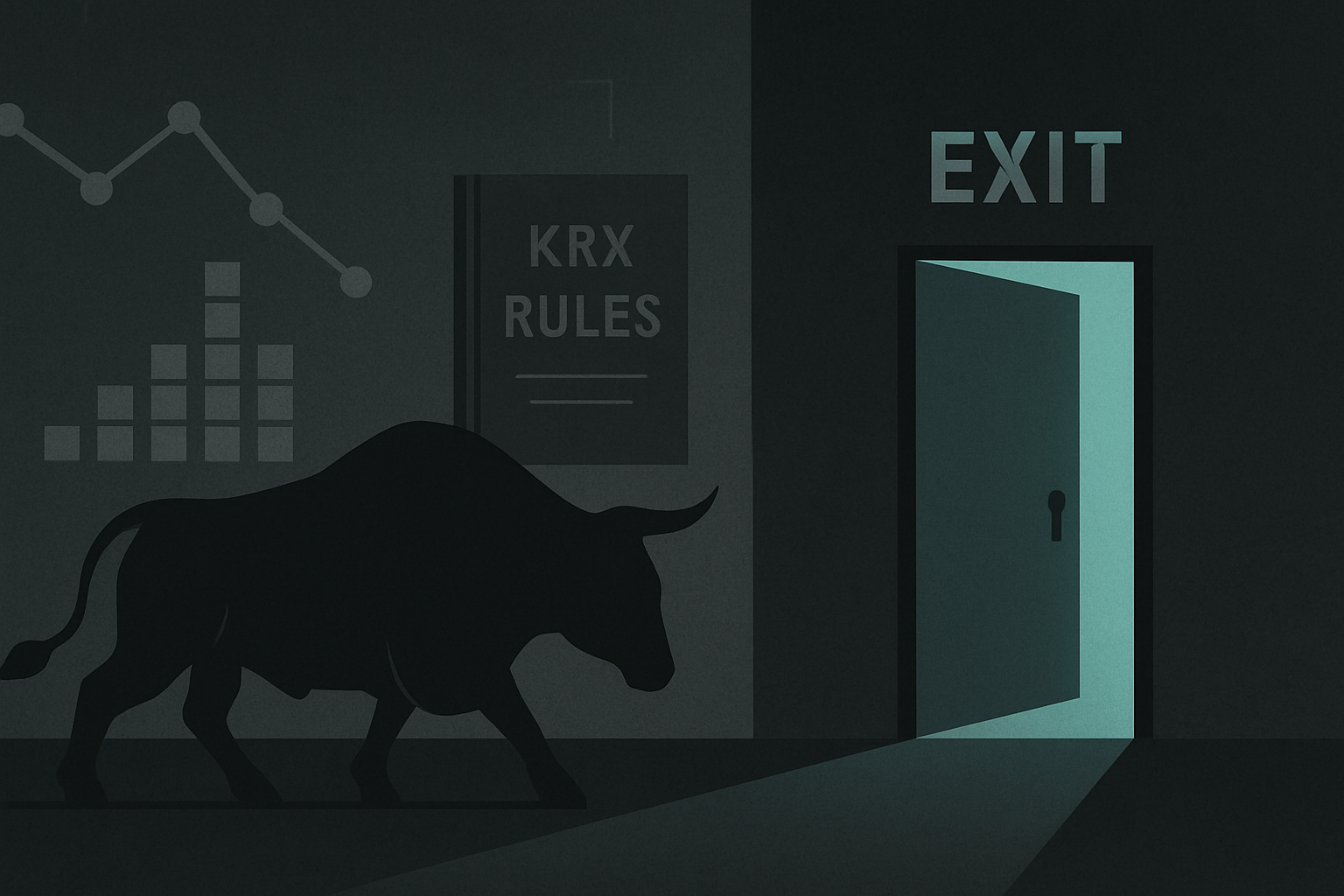
A real reform market has two doors. One lets promising companies in. The other works when companies fail the bargain.
Korea has spent years trying to make the first door more attractive. The May 13 KRX rule approval is about making the second one harder to jam open with a temporary price pump.


Discussion
Sign in to join the discussion.
No comments yet. Be the first to share your thoughts.