RAG made enterprise AI feel safer because it moved answers closer to approved documents.
That was useful. It was not enough.
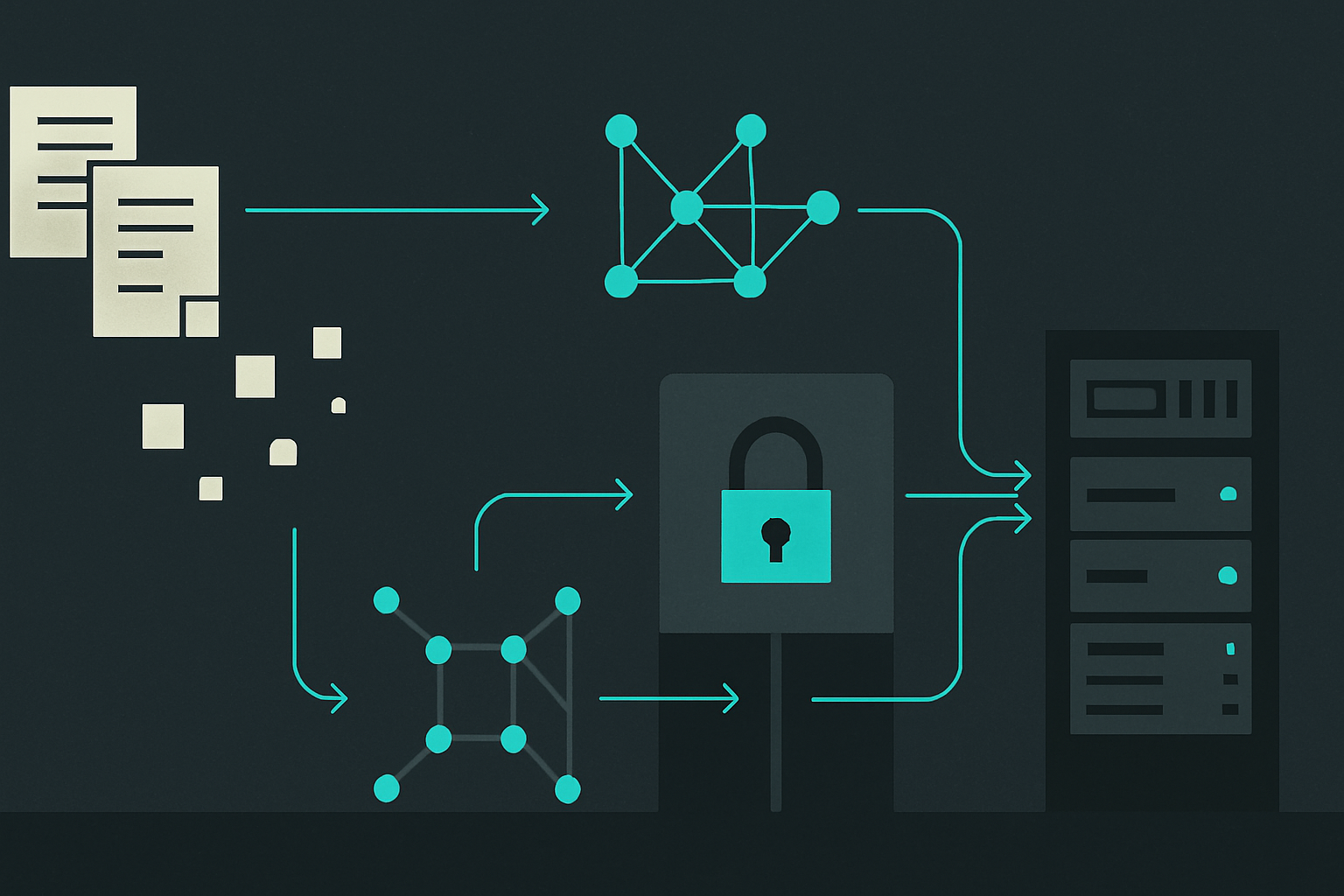
Retrieval-augmented generation turns the model into one component in a wider knowledge pipeline: document stores, embedding indexes, retrievers, access controls, ranking logic, context windows, tools and external interfaces. Once the model depends on that pipeline, attackers do not have to beat the model directly. They can poison what it retrieves, manipulate what it is allowed to see, or exploit what it does with retrieved context.
That is the next security boundary.
A 2026 RAG security taxonomy argues that secure RAG is fundamentally about protecting the external knowledge-access pipeline, not only hardening the prompt surface. The authors separate threats that are introduced or amplified by RAG across pre-retrieval knowledge corruption, retrieval-time access manipulation, downstream context exploitation and knowledge exfiltration (arXiv).
That framing is useful because it fixes a common mistake. Prompt injection is real. It is not the whole system.
Retrieval Creates A New Supply Chain
Classic prompt security focuses on what the user tells the model.
RAG security has to care about what the organization tells the model through its knowledge layer. That includes the internal wiki, ticket history, code search, policy library, CRM notes, incident reports and vendor documents. It also includes whatever cleanup jobs, document parsers and access rules feed those sources into the retrieval index.
If a hostile document gets into the corpus, the model may retrieve it later. If metadata is wrong, the retriever may surface material for the wrong user. If ranking is weak, low-quality or manipulated context can outrank authoritative sources. If citations are cosmetic, the answer can look grounded while the pipeline is not.
This is why pre-retrieval corruption matters.
The attacker does not need to prompt the model at runtime if the poisoned source is already in the index. A support article, pull request, markdown file or shared document can become delayed-execution context. The model retrieves it later and treats it as enterprise memory.
That is not a chatbot issue. That is a data-governance issue wearing an AI badge.
Access Control Moves To Retrieval Time
RAG also changes authorization.
In normal applications, access checks often happen at the database or service layer. In RAG systems, retrieval may combine semantic search, vector similarity, document chunks and user context. The security question becomes: did the retriever enforce the same access boundary the source system would have enforced?
If not, the model becomes an accidental data broker.
Retrieval-time access manipulation can be blunt, like indexing documents with the wrong permissions. It can also be subtle: chunks detached from their source ACLs, embeddings shared across tenants, cached answers reused for the wrong user, or tool calls that retrieve more context than the task requires.
This is where “grounded in company data” becomes less comforting.
Grounded in whose data? Retrieved under whose authority? Logged where? Visible to which tools? Retained for how long? The answers determine whether RAG is a control or a leak path.
Agents Make The Boundary Softer
Agentic systems make the retrieval problem worse because they carry more state across more boundaries.
A separate 2026 paper on confidential computing for agentic AI describes agents moving credentials, memory and tool access across trust boundaries, then argues for hardware-backed isolation and stronger execution guarantees around agent workflows (arXiv).
The exact mitigation stack will vary. The risk shape is clear.
An agent that can retrieve documents, call tools, remember prior steps and act on external context has a wider attack surface than a one-shot question-answering box. A poisoned retrieved chunk may influence a tool call. A tool result may become model-visible context. A memory item may carry stale or sensitive data into the next task. A credential may be available to a tool the model should not have used.
That is why RAG security and agent security are converging.
The organization cannot protect only the prompt. It has to protect the corpus, the retriever, the tool boundary, the execution environment and the logs that explain what happened.
The Web Is Also Context
External context is the part teams underestimate.
Browser-agent research published in May 2026 shows that hostile websites may identify AI agents through passive UI traces such as click behavior and timing, then adapt content or attacks for the agent before the user sees anything (arXiv).
That is not RAG in the narrow product sense. It is the same structural problem.
The model is reading the world through a mediated context layer. If that layer can be fingerprinted, shaped or poisoned, the model’s next action can be influenced. A web page, retrieved document, tool output or chat transcript can all become instructions-by-proximity.
This is the practical reason to stop treating prompt injection as a weird text trick. Modern AI systems are context machines. They assemble working memory from many surfaces. Every surface is a candidate control point and a candidate attack point.
What Enterprises Should Do
The control list is not glamorous.
Maintain provenance for every indexed document. Preserve ACLs at chunk level. Separate tenant indexes unless there is a strong reason not to. Scan and quarantine newly ingested documents. Track retrieval sources in logs. Require citations that map to source IDs, not just pretty links. Limit tool access by task. Strip sensitive tool outputs before they become model context. Test retrieval poisoning, not only prompt injection. Monitor for unusual retrieval patterns and cross-boundary context reuse.
None of that sells like a model upgrade. It is the part that keeps the upgrade from becoming a data spill.
RAG vendors should also be judged differently. The question is not only answer quality. It is whether the system can prove which sources were retrieved, which permissions applied, which tools were called, and which context reached the model.
If the answer is “trust the assistant,” the system is not ready for sensitive work.
The Implication
RAG was supposed to make enterprise AI more reliable by attaching answers to approved knowledge.
It still can. But the security perimeter has moved. The important boundary is now the knowledge pipeline: what enters it, who can retrieve from it, how context is assembled, which tools can act on it and what evidence survives afterward.
The next serious RAG security programs will look less like prompt-policy decks and more like data-platform security: provenance, access control, isolation, logging, testing and incident response.
That is less fashionable than arguing about jailbreaks. It is also where the useful failures will happen.


Discussion
Sign in to join the discussion.
No comments yet. Be the first to share your thoughts.