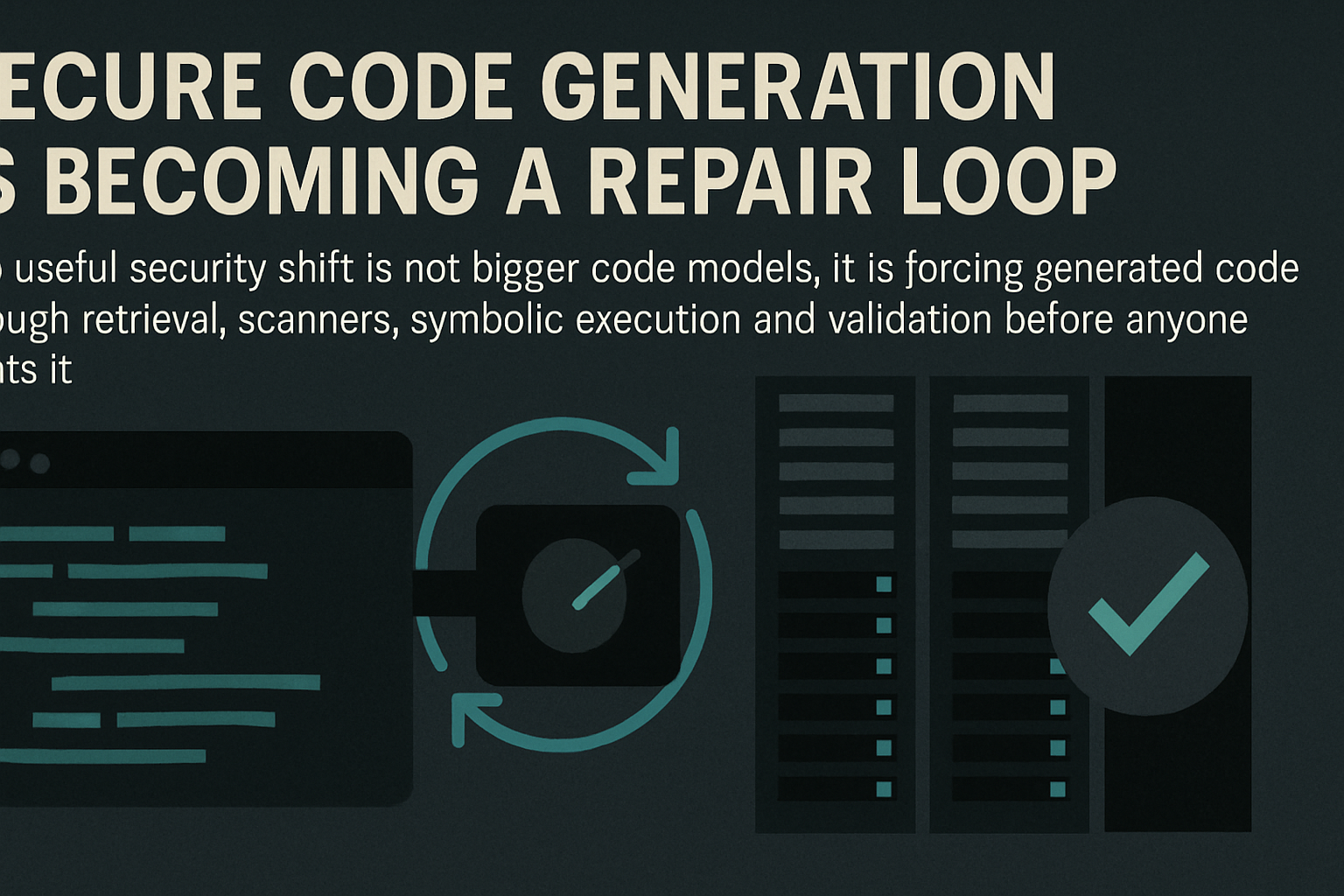
The security problem with generated code was never that models could not write syntax.
It was that they could write plausible, compiling, insecure code at machine speed. That is a different failure mode. A junior developer may copy a bad pattern. A coding model can stamp it into every service, wrapper and helper function before the review queue finishes breakfast.
The next defensive pattern is becoming visible: do not ask the model to “be secure.” Put the model inside a repair loop.
A January 2026 paper on secure code generation tested a retrieval-augmented, multi-tool workflow using compiler diagnostics, CodeQL security scanning and KLEE symbolic execution. The authors evaluated 3,242 generated programs from DeepSeek-Coder-1.3B and CodeLlama-7B. They reported a 96% vulnerability reduction for DeepSeek-Coder and said CodeLlama’s critical security defect rate fell from 58.55% to 22.19% after tool feedback and iterative repair (arXiv).
That is the real story. Security is moving from prompt wording to workflow design.
The Model Is Not The Control
Coding assistants are usually sold as model capability. That is the wrong unit of analysis for security.
The control is the loop around the model: retrieval context, static analysis, compiler output, symbolic execution, tests, patch review and deployment policy. A model that produces a weak first draft can still become useful if the system forces it through evidence. A stronger model can still be dangerous if it emits confident code into production without checks.
This sounds obvious because it is how serious software teams already work. The difference is that generated code changes the volume and tempo. More code is created earlier. More defects can be introduced automatically. Reviewers are asked to inspect code whose author is not a person.
The answer is to make generation subordinate to verification.
The January paper’s tool chain is instructive because it combines three different kinds of feedback. Compiler diagnostics catch broken structure. CodeQL catches known vulnerability patterns. KLEE explores execution paths symbolically. Retrieval adds examples of previous successful repairs. None of those is sufficient alone. Together, they turn code generation into a repair pipeline.
RAG Belongs In The Repair Layer
Retrieval-augmented generation is usually discussed as a way to give models better documents.
For secure coding, the more interesting use is narrower: give the model security-relevant repair memory. The January paper used a lightweight embedding model to retrieve previously successful fixes, then fed those examples back into the generation loop. That makes retrieval a control surface, not a trivia source.
The same pattern appears outside ordinary software code. A March 2026 SecureRAG-RTL paper applied retrieval-augmented, multi-agent LLM workflows to hardware vulnerability detection. The authors reported about a 30% average detection-accuracy improvement across model architectures when domain-specific hardware-security knowledge was added to the process (arXiv).
The hardware context matters. HDL security has a dataset problem. Public examples are scarce, and vulnerabilities can be tied to subtle design behavior. Retrieval gives the model a better map.
That does not make RAG magic. It makes RAG an engineering dependency.
The retrieval store has to be curated. The examples have to be current. The retrieved fixes have to be checked. Bad examples can teach bad repairs. If generated code becomes only as safe as the context warehouse behind it, then that warehouse needs ownership, versioning and audit.
CodeMender Is The Adoption Signal
Academic benchmarks are useful. They are not the market.
The adoption signal is that major labs are building agents around validation and repair, not just code completion. Google DeepMind said its CodeMender research agent upstreamed 72 security fixes to open-source projects in its first six months, including projects as large as 4.5 million lines of code. DeepMind describes the system as reactive and proactive: patching known vulnerabilities, then rewriting code to eliminate broader classes of weaknesses (Google DeepMind).
The mechanism is the important part. DeepMind says CodeMender uses program-analysis tools, static and dynamic analysis, differential testing, fuzzing, SMT solvers and multi-agent critique to validate patches before human review.
That is the direction coding tools should follow.
Autonomous code repair is only credible when the autonomy is boxed in by tools that can falsify the patch. Does it compile? Did the root cause change? Did the patch introduce a regression? Does it satisfy the security property or merely move the bug?
If the answer is “the model said so,” the system is not ready. If the answer is a chain of tool outputs, tests and review artifacts, the system is getting closer.
The OpenAI Signal Is Defensive Infrastructure
OpenAI’s April 2026 cybersecurity action plan frames AI as a way to help defenders identify vulnerabilities, automate remediation and respond faster, while also warning that attackers can use the same capabilities to scale their work (OpenAI).
That dual-use framing is common. The practical implication for secure coding is less common: defenders need infrastructure that turns model speed into controlled remediation, not uncontrolled code churn.
A secure-code agent should be treated like a build-stage participant. It needs least-privilege repository access, scoped credentials, isolated execution, deterministic test evidence, scanner output, patch provenance and human review gates. It should not be allowed to spray commits across a monorepo because a prompt sounded urgent.
There is a procurement angle here. Buyers should stop asking only which model powers a coding assistant. They should ask what repair loop ships with it.
Does it integrate static analysis by default? Does it support CodeQL or equivalent rules? Can it run symbolic execution or fuzzing where appropriate? Does it preserve the evidence trail? Can security teams tune retrieval sources?
What Changes For Engineering Teams
The old coding-assistant adoption path was individual productivity first, security later. That order is backwards for generated code. Once a tool can produce large patches and refactors, security controls need to sit inside the workflow from day one.
The better operating model is simple:
Approve the retrieval corpus. Run generated code through scanners before review. Use compiler diagnostics and tests as feedback, not as post-merge cleanup. Route high-risk changes through stronger validation, including symbolic execution or fuzzing where the code justifies it. Keep patch evidence with the pull request. Measure defect rates before and after the tool, not just developer satisfaction.
The point is not to make every commit a formal methods exercise. Most code does not deserve that ceremony. The point is to match the validation loop to the blast radius.
Generated code makes cheap code cheaper. It does not make insecure code cheaper to own.
The Implication
The secure-code market is splitting into two stories.
One story is autocomplete with better demos. The other is repair infrastructure: models wrapped in retrieval, scanners, execution feedback, tests and review artifacts. The second story is less flashy. It is also the one security teams can defend.
The lesson from the 2026 papers and CodeMender is direct. Model quality matters, but workflow quality decides whether generated code becomes an asset or a vulnerability factory.
The winning coding assistants will not be the ones that write the most code. They will be the ones that make insecure code harder to ship.


Discussion
Sign in to join the discussion.
No comments yet. Be the first to share your thoughts.