The least useful AI phishing story is that attackers can write better emails now.
They can. Everyone knows. The inbox did not need a poetry upgrade.
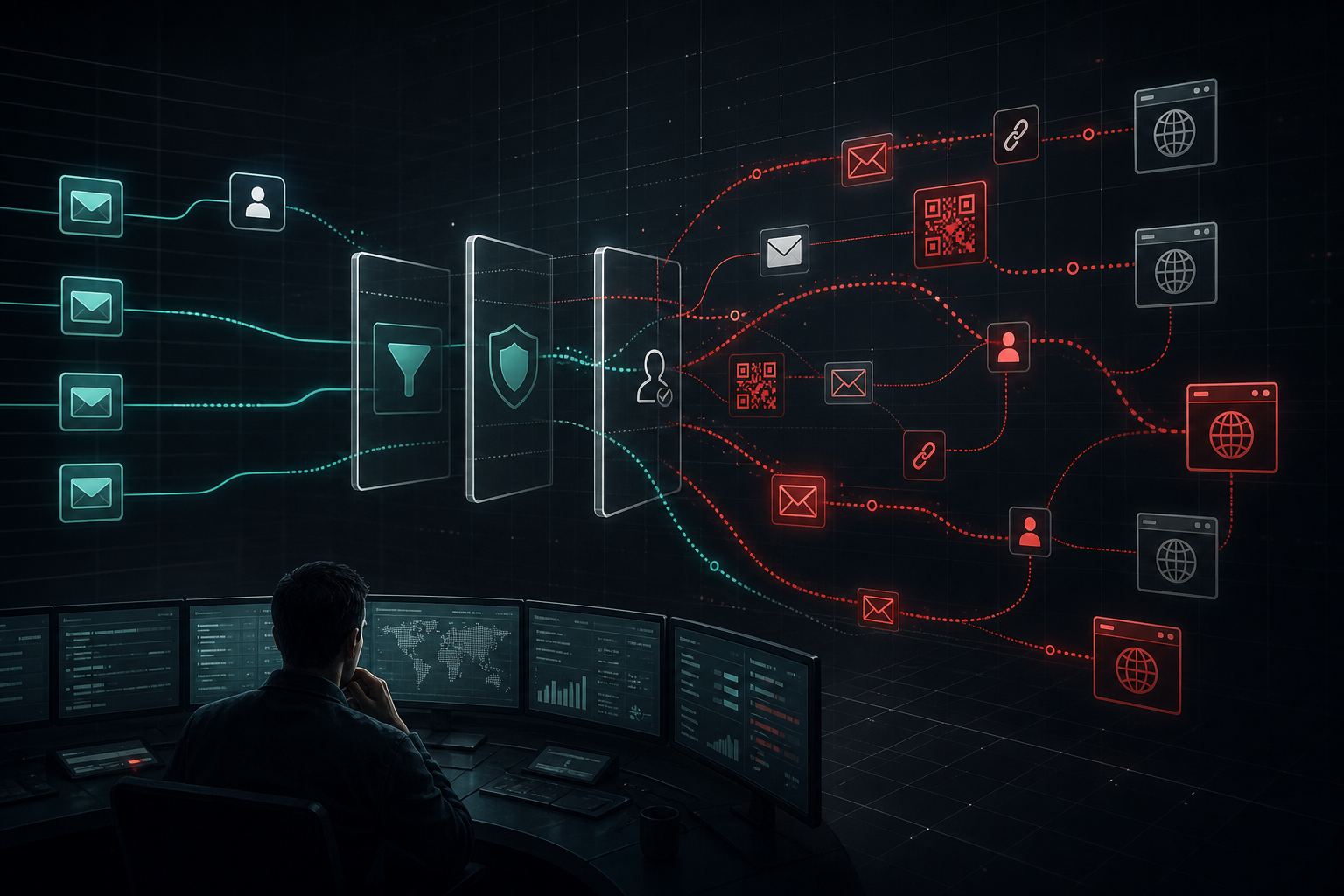
The more important story is control drift. Defenders tuned email security for known payload types, reputation signals, user awareness, text patterns and attachment behavior. Attackers are now moving across those seams faster: links instead of attachments, QR codes instead of visible URLs, CAPTCHA gates instead of direct credential pages, compromised accounts instead of obvious impostors, relationship abuse instead of generic spam.
AI makes that drift cheaper.
Microsoft Threat Intelligence says it detected about 8.3 billion email-based phishing threats in the first quarter of 2026. It also says QR code phishing more than doubled over the quarter, and PDF attachments leading to CAPTCHA-gated phishing sites rose 356% in March.
That is not just more phishing. It is phishing shaped to dodge the control stack.
The problem is not that phishing looks smarter. The problem is that the old filters are answering yesterday’s delivery question.
The Problem: Email Attacks Are Moving Sideways
Classic phishing defense wants a stable pattern.
Bad sender. Suspicious domain. Malicious attachment. Known kit. Obvious urgency. Strange language. Commodity lure.
Those signals still matter. They are no longer enough.
Microsoft’s Q1 report shows why. It says 78% of email threats were link-based, while malicious payloads were a smaller share. QR codes jumped from 7.6 million attacks in January to 18.7 million in March. CAPTCHA-gated phishing more than doubled in March to 11.9 million attacks, the highest Microsoft observed over the prior year.
The attacker logic is simple. Move the malicious step outside the cleanest inspection point.
A QR code can push the user to a mobile device. A CAPTCHA page can delay automated analysis. A PDF can carry the lure without looking like a conventional executable. A compromised internal account can borrow trust instead of faking it. A hosted credential page can rotate infrastructure faster than a block list can settle.
This is why AI phishing should be treated less as a writing problem and more as a system problem.
Generative tools can improve copy, localization and personalization. But the attacker’s real advantage is iteration. Draft more lures. Test more payload formats. Rewrite faster. Adjust themes to a company, department or role. Use public data to make a relationship feel familiar. None of that requires genius. It requires cheap variation.
Security controls drift when attacker variation outpaces defender tuning.
The Analysis: Human Risk Is Now A Control Surface
Proofpoint’s 2026 AI and Human Risk Landscape work makes the same point from the organizational side. Its press release says half of global organizations experienced AI incidents despite having AI security controls in place. It also says 42% reported a suspicious or confirmed AI-related incident, and many organizations still lack full confidence in their AI data governance.
The headline is not “controls failed.” The headline is that controls are unevenly aimed.
Organizations can deploy AI controls and still miss the practical attack path. A control may watch sanctioned AI tools but not detect a phishing lure generated by an attacker. It may classify sensitive prompts but not detect a QR-code credential campaign. It may train users annually but not intercept a trusted supplier account asking for a payment update. It may block known malicious domains but not a fresh CAPTCHA-gated landing page.
That is control drift.
Email defense has to move closer to behavior and relationship context. Who normally emails this person? Is the request consistent with the relationship? Has the sender’s account changed location, cadence or style? Is a payment instruction unusual? Is the user being pushed from managed email to an unmanaged mobile browser? Is the attachment only a staging layer?
Those questions are harder than scanning text for suspicious wording. They require identity, email, endpoint, browser, data and user-behavior signals to talk to each other. They also require fewer fake certainties. A perfect-looking email from a real account can still be hostile.
The Implications: Training Alone Is Not A Strategy
User training remains necessary. It is not sufficient.
Attackers are not only asking users to click. They are engineering around the moment where the user would notice. QR codes move the action to a phone. CAPTCHA pages create a fake legitimacy checkpoint. Compromised accounts remove the obvious outsider cue. Business-email-compromise lures ride on routine work: invoice review, document signing, payment confirmation, HR notices, voicemail alerts.
The best training can make employees more skeptical. It cannot make every employee a real-time threat analyst.
Controls have to reduce the decision burden. Rewrite URL inspection for QR and image-based paths. Treat CAPTCHA gates as suspicious when they appear after business-document lures. Put stronger friction around payment-change workflows. Use relationship graphs for supplier and executive impersonation. Prioritize phishing-resistant MFA where adversary-in-the-middle kits target session capture. Watch internal accounts for abnormal sending behavior before they become trusted launchpads.
Abnormal Security’s 2026 attack-landscape report points in the same direction: modern email attacks exploit human behavior, trusted relationships and compromised internal accounts rather than only technical exploits. That is the email-security version of a broader AI lesson. Defenders need context, not just signatures.
The cost is complexity. Relationship-aware controls are harder to tune. They create false positives in weird business processes. They require security teams to understand money movement, vendor workflows, executive assistants, HR cycles and customer operations. Dry work. Necessary work.
The Takeaway
AI phishing is not dangerous because it makes bad emails sound polished. It is dangerous because it accelerates attacker experimentation across the whole email control stack.
The right response is not panic about perfect lures. It is control recalibration.
Email defense has to assume the payload will move, the relationship may be real, the text may be clean, the link may be hidden behind a QR code, and the user may be pushed outside managed inspection. That means defending the transaction, the identity, the browser path and the behavior around the message.
The inbox is still the front door. AI just made the lock easier to test.


Discussion
Sign in to join the discussion.
No comments yet. Be the first to share your thoughts.