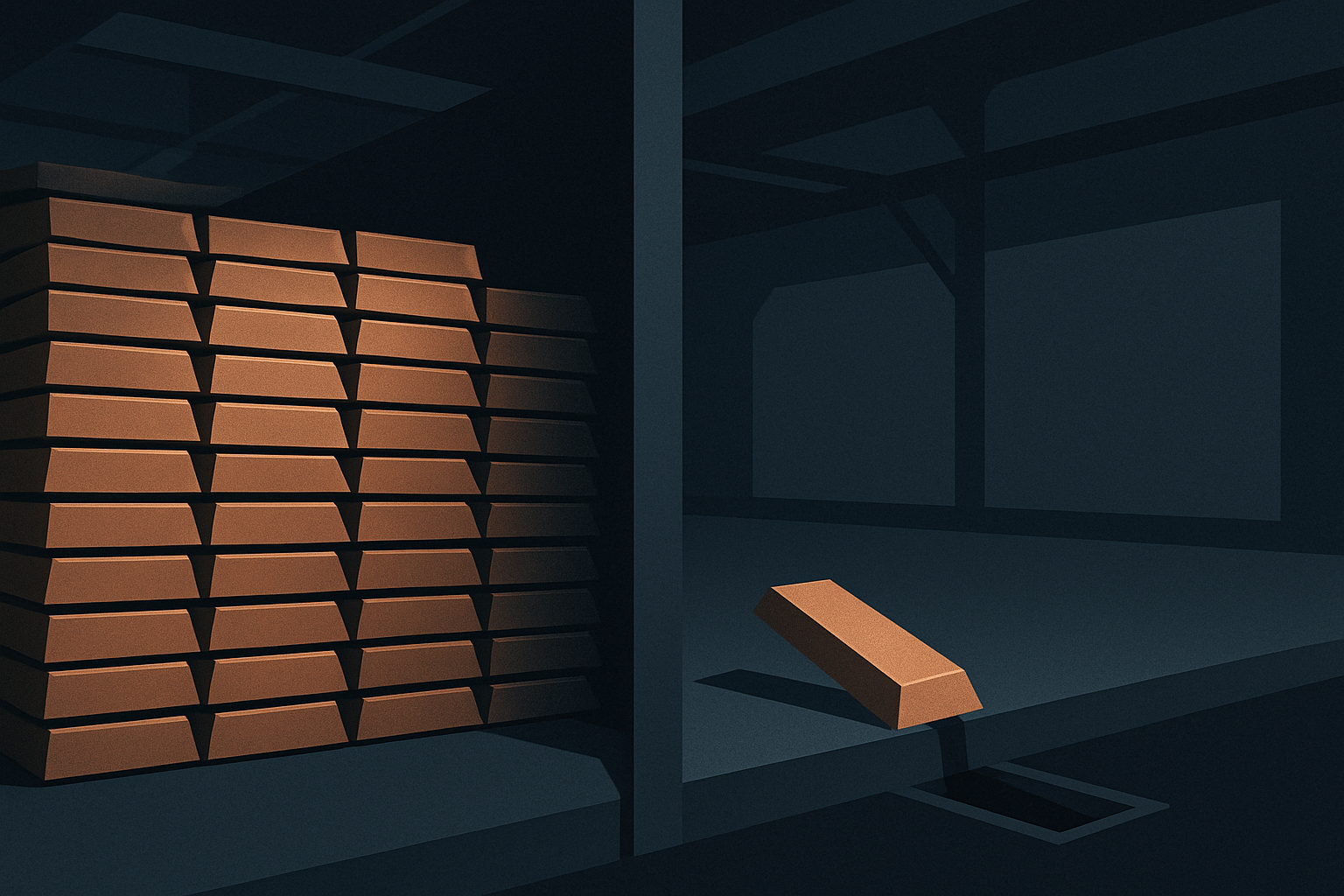
Washington spent a year teaching the copper market to fear a tariff. The market learned the wrong lesson.
Since the Commerce Department opened its Section 232 copper investigation in early 2025, traders have shipped metal into the United States on one assumption: that anything landing after the duty took effect would cost 50% more. They were half right. When the tariffs arrived, they hit semi-finished products (pipes, wires, rods, sheets, tubes) at 50% of full customs value, and copper-intensive derivatives such as cables and connectors at 25%. What they did not touch was refined cathode, the exchange-deliverable form of the metal, along with ores, concentrates, anode and scrap.
That carve-out is the whole story, because cathode is exactly what piled up. As of the 14 July close, COMEX-registered stocks had swelled to a record near 650,000 tonnes, a seven-year high, while LME warehouses had drained toward roughly 352,000 tonnes, a multi-month low. The COMEX premium over the London price had hit a record near 27%. The spread is a bet on a tax that, as written, does not apply to the thing being traded.
The signal broke away from the policy
Both the COMEX and LME copper contracts settle in Grade 1 electrolytic cathode. Cathode is the metal exchanges price, warehouse and deliver. And cathode is precisely what the tariff exempts. So the widest US-versus-London copper spread in a generation is not, in any literal sense, a tariff on the copper it is quoting.
It is three other things wearing a tariff’s clothes.
First, it is stranded inventory. The front-running was real: US buyers pulled forward a year of imports to beat a duty that, in the end, spared their cathode. That metal is now sitting in American warehouses. Re-exporting it is uneconomic, so it clears against domestic demand at a domestic price, and a domestic price, after a supply shock of imports, still carries the memory of the scramble that created it.
Second, it is a physical bifurcation the tariff caused indirectly. Every tonne hoarded into COMEX is a tonne not available on the LME. The London drawdown is the mirror image of the American glut. Two exchanges that used to arbitrage smoothly now quote two different physical realities: too much metal inside the tariff wall, too little outside it.
Third, and most important, the spread is a wager on the exemption itself. Nothing in Section 232 makes the cathode carve-out permanent. The original investigation contemplated refined copper; sparing it was a policy choice, and policy choices reverse. A COMEX premium near 27% on exempt metal is the market pricing the tail: the chance that the next proclamation extends the duty to cathode and re-rates every stranded tonne into a windfall.
What the premium is really asking
Read that way, the copper trade is an asymmetric bet with an awkward base case.
If the exemption holds and imports normalize, the COMEX stockpile is dead weight. A seven-year high in registered stock is not scarcity; it is the opposite. As the front-loading fades, that inventory should compress the premium, not defend it. Anyone long the arbitrage on a “tariffs mean higher copper” thesis is, on the current rulebook, long a spread that the rulebook argues against.
If the exemption is removed, the trade inverts. Extend 232 to cathode and the stranded metal inside the wall becomes the only cheap copper in America. The premium re-rates higher; the hoard becomes the point. That is the scenario the bulls, including the roughly $14,000-a-tonne calls that circulated when the duties landed, are implicitly underwriting. It is a real possibility. It is not the printed policy.
The manufacturing consequence is already fixed, whichever way the spread breaks. Domestic semis producers now sit behind a 50% wall and have pricing power they did not have in 2024. Downstream fabricators that import finished shapes pay the duty in full. The cathode exemption was meant to protect the feedstock those fabricators and domestic smelters buy, but the price they pay tracks COMEX, and COMEX is elevated by the very front-running the tariff set off. The carve-out protects the input in name while the market taxes it in practice.
The implication
Copper has become a case study in the gap between a tariff’s text and a tariff’s shadow. The 50% headline number tells you what importers of pipe and wire pay. It tells you almost nothing about the metal that clears on the world’s two benchmark exchanges, which the duty exempts and the market has hoarded anyway.
For anyone trading the spread, the discipline is to name which bet they are actually in. This is not a levy on cathode. It is a wager on whether one becomes law, laid on top of a pile of stranded metal that, absent that law, wants to mean-revert. The tariff drew a line through the copper market. The most expensive copper in the world is sitting on the wrong side of it.


Discussion
Sign in to join the discussion.
No comments yet. Be the first to share your thoughts.