Problem
Mexico’s president has sent Congress a bill that would require the Finance Ministry to decide which sectors may be moved to digital-only payments. Article 13 gives the ministry that sector-selection power. The Third Transitional clause sets a 15-business-day deadline, starting when the decree enters into force, for the initial sector determination. Sector regulators would then set conditions and a gradual transition timetable.
That distinction matters. The bill’s Article 15 permits cash or cheques when a contingency makes digital acceptance impossible. Petrol stations and tolls are industry expectations reported by El Economista, not sectors named in the bill.
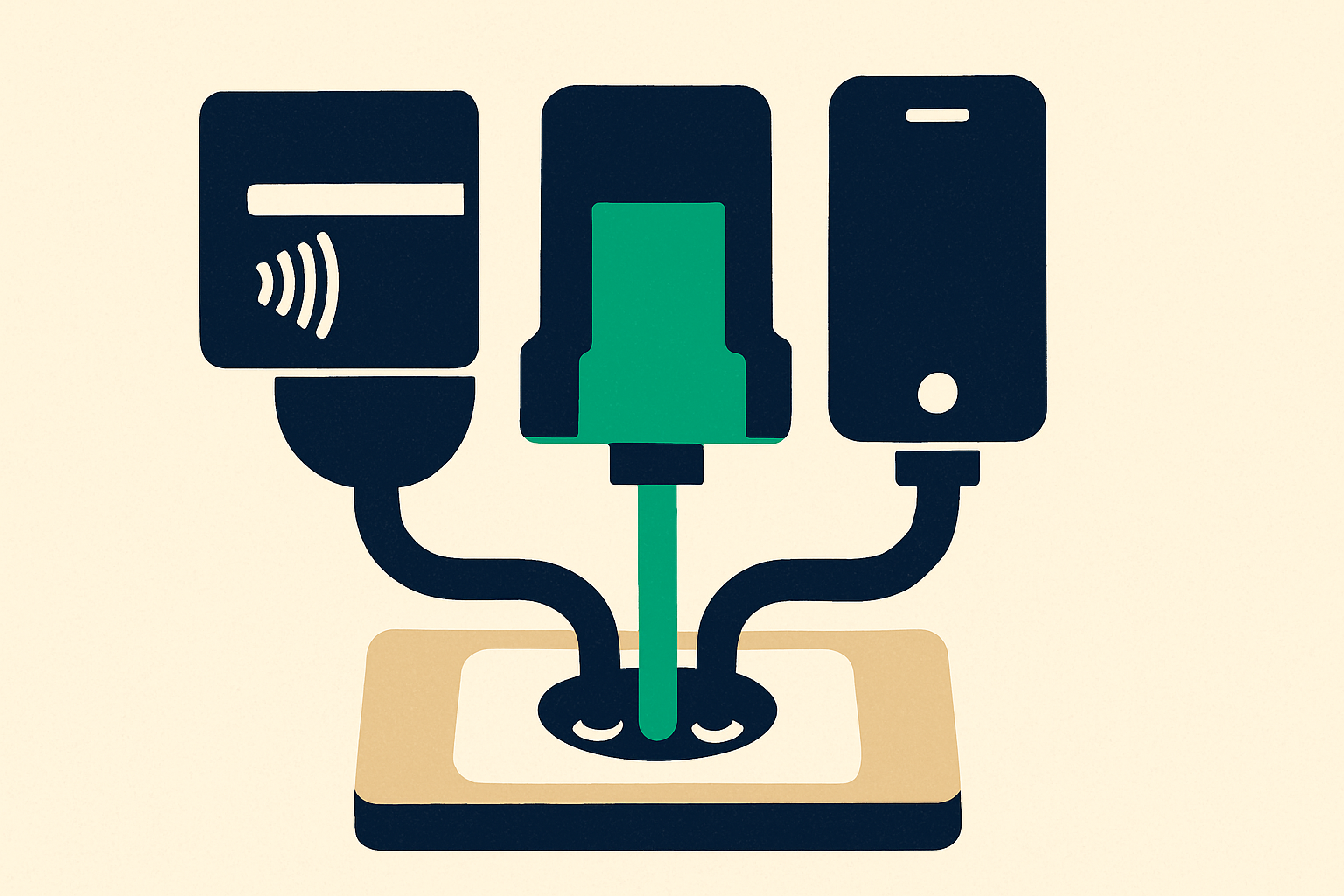
The government is pairing that prospective demand mandate with a second intervention. On August 27, the banking regulator and central bank opened a consultation on lower card interchange fees and universal terminal acceptance. Together, the measures form an operating model: compel demand in selected sectors, reduce one cost of card acceptance, and make each terminal work across issuers, acquirers and networks.
The starting point is stubborn. In the 2024 National Financial Inclusion Survey, among people aged 18 to 70, 85.2% named cash as their frequent payment method for purchases of 500 pesos or less, and 73.5% did so for larger purchases. Physical cards were named by 10.4% and 19.0%, respectively. Transfers or mobile apps were named by 4.4% and 7.6%. INEGI based the survey on face-to-face interviews across 15,263 homes.
The figures explain why another wallet would be a weak answer. Mexico already has digital rails. Acceptance remains the constraint.
Analysis
The bill supplies legal force. Article 10 requires authorities at all three levels of government to take the steps needed to accept digital payments for public services and administrative procedures. Article 11 says private providers may implement the same methods. The ministry could identify sectors where digital payment may become the only form accepted, while Article 14 assigns implementing rules and a gradual transition to the relevant regulators.
The card consultation attacks a different bottleneck. The CNBV says comments remain open until 6pm Mexico City time on September 24. Its two stated aims are a gradual reduction in interchange fees and stronger interoperability, requiring every point-of-sale terminal to accept every card regardless of issuer, acquirer or network.
Interchange is not the merchant’s entire acceptance cost. Banxico defines it as the fee paid when a card’s issuing bank differs from the bank behind the merchant’s terminal. Merchants pay a broader discount rate that can also include acquiring, processing, hardware and risk costs. A lower interchange fee therefore creates room for cheaper acceptance. It does not guarantee pass-through.
A lower interchange fee only matters to a small merchant if the saving reaches the merchant discount rate.
Universal terminals remove another friction. A merchant should not need to understand which bank, network or processor sits behind a customer’s card. Interoperability turns the terminal into neutral acceptance infrastructure. The dry technical obligation is also a distribution policy.
CoDi shows why the three layers must work together. Banxico’s QR and NFC service converts a merchant’s payment request into a transfer, operates around the clock, confirms payment immediately and adds no commission. It is already the low-cost route the policy theory calls for.
Adoption remains narrow. INEGI put the share of people who had used CoDi at 12.8% in 2024, up from 8.3% in 2021. Banxico’s 2024 market-infrastructure report counted 35 SPEI participants offering CoDi, plus 51 third-party developers serving 1,020 enrolled merchants. It also counted 86 government entities using the service.
The rail works. Distribution has not followed automatically. CoDi still requires an account, a compatible app, a phone and connectivity. Cards require a terminal and pricing a merchant will accept. A mandate can create transaction volume, but it cannot make a weak connection settle a payment.
Implications
Mexico is treating checkout as regulated infrastructure. That is more coherent than promoting one branded payment method. It is also harder to execute.
The first test is scope. If Hacienda selects only large, connected businesses, the mandate will formalise behaviour already common. If it reaches cash-heavy small merchants too quickly, the policy can turn inclusion into exclusion. The contingency rule will then become the real payment rule.
The second test is pass-through. Regulators should track merchant discount rates, terminal deployment and active transaction shares, not only interchange schedules or enrolled accounts. A fee reduction that stops between issuer and acquirer changes bank margins. It does not change the till.
The third test is neutrality. Universal acceptance should let merchants choose providers on price and service without losing customers whose cards sit on another network. CoDi can compete beside those terminals as a zero-commission account-to-account option.
The proposal’s strength is that it recognises three separate failures: demand, price and access. Its risk is assuming that one decree can synchronise them. Mexico does not need another payment acronym. It needs each existing rail to work at the moment a merchant asks to be paid.


Discussion
Sign in to join the discussion.
No comments yet. Be the first to share your thoughts.