Panasonic Reuses an EV Battery Line for Data Centers. The Return Target Tops 20%.
Panasonic is converting automotive-battery capacity into integrated data-center power systems, but its return promise depends on mix and reuse data it has yet to disclose.
Contents
Panasonic Group expects its broad data-center-related sales to rise from JPY 322 billion in the year ended March 2026 to JPY 950 billion in the year ending March 2029. Panasonic Energy has set a separate target of roughly JPY 1 trillion for data-center energy-storage systems, with return on invested capital above 20 percent.
The distinction matters. The first number includes other AI infrastructure across the group. The second belongs to Panasonic Energy and uses the Energy Solutions Business Division for the return calculation. Neither disclosure proves that data-center batteries have overtaken electric-vehicle batteries on a matched basis.
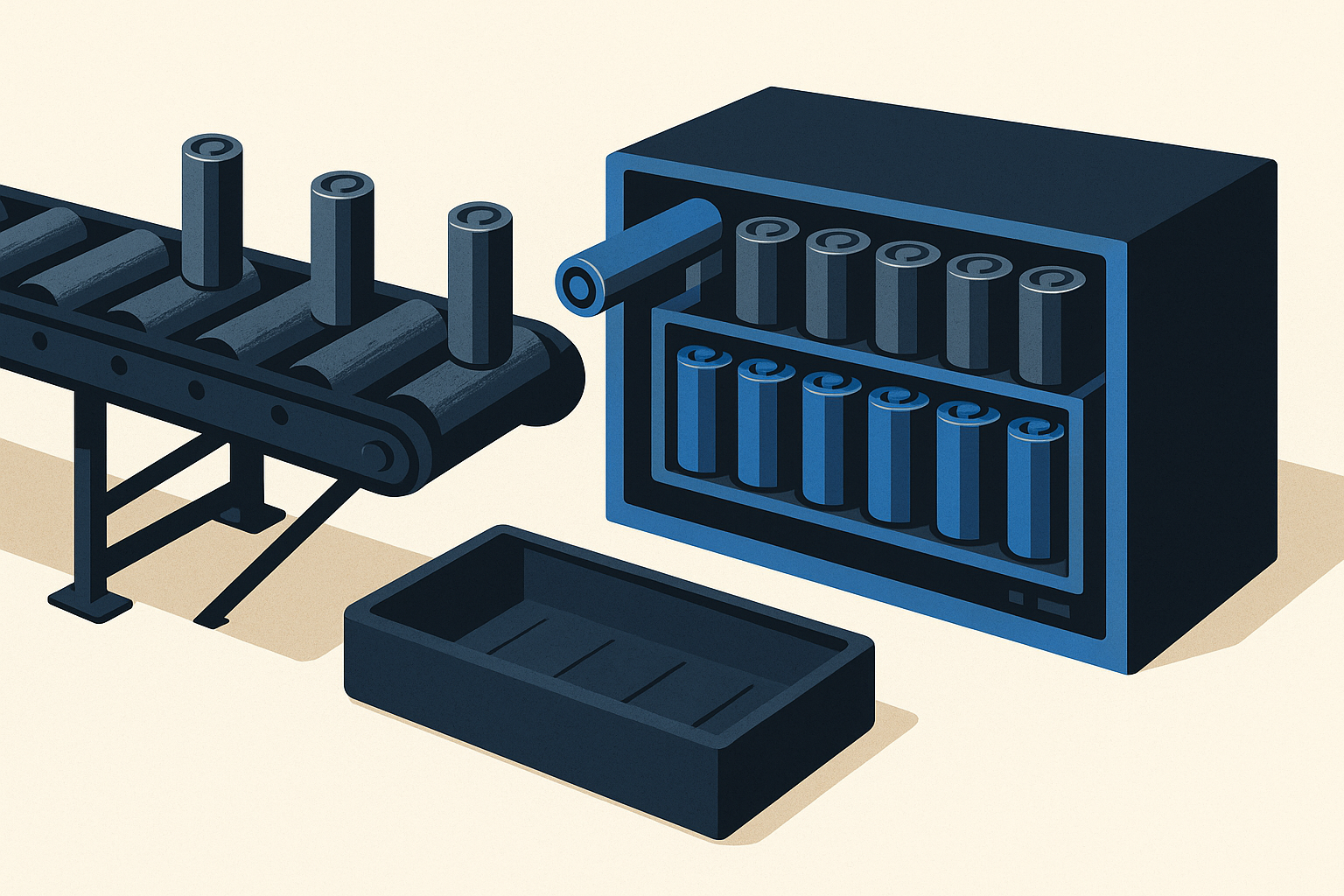
What Panasonic does show is an industrial experiment with unusually visible milestones. It has started shipping lithium-ion cells from an Osaka automotive-battery line converted for data-center use. It plans to repeat the model in Kansas while adding module capacity in Mexico. The economics now depend on whether old assets and a fuller system can earn more from each cell, not simply whether AI demand keeps rising.
The target outruns the disclosure
Panasonic's May growth-strategy summary forecasts JPY 550 billion of overall data-center sales in FY3/27, JPY 800 billion in FY3/28 and JPY 950 billion in FY3/29. The series starts at JPY 322 billion in FY3/26 and explicitly includes other AI infrastructure. That is a 2.95-fold increase in three years, equivalent to roughly 43 percent annual growth.
Panasonic Energy's Investor Day presentation sets a different perimeter. It targets about JPY 1 trillion of FY3/29 sales from energy-storage systems for data centers, approximately three times FY3/26, after JPY 350 billion of investment. The investment includes common infrastructure for automotive products at the Kansas factory. Its ROIC target above 20 percent is footnoted to the Energy Solutions Business Division.
That is not enough information to reproduce the return. Panasonic does not disclose the division's invested-capital base, data-center operating margin, average selling price per system or revenue per kilowatt-hour. It also does not separate new equipment from reused assets within the JPY 350 billion plan. The company has supplied a target, not a return bridge.
The conversion is the economic hypothesis
The Suminoe factory in Osaka provides the first operating test. Panasonic's July quarter update says shipments from an existing automotive cell line began in April 2026. Conversion work continues at Suminoe and Kaizuka. Panasonic plans to triple Japanese lithium-ion capacity for data-center applications by FY3/29 compared with FY3/26.
North America follows later. A second Mexican module plant is scheduled to start mass production in FY3/27, followed by a third in FY3/28. A data-center cell line at the Kansas automotive factory is due to enter mass production in FY3/29. Panasonic wants more than half of its North American supply chain localized by then, including procurement from power-supply manufacturers.
Reuse can shorten the path from demand to output and avoid some greenfield spending. Panasonic's own results explain the attraction. Energy segment sales rose 13 percent to JPY 984.2 billion in FY3/26, but operating profit fell to JPY 69.8 billion from JPY 120.2 billion. The financial-results release attributes the pressure to tariffs, Kansas ramp costs, weaker sales from Japan and expenses tied to past manufacturing issues in the automotive business. Data-center storage lifted sales and profit in the industrial and consumer business.
The repurposing case is therefore stronger than a pure capacity argument. Panasonic is redirecting Japanese assets from the weaker part of Energy toward its faster-growing application. That should improve capital efficiency if utilization rises without an equivalent increase in dedicated investment. It remains an inference until Panasonic reports utilization and conversion costs.
A system carries more value than a cell
Panasonic is also changing what it sells. Its rack-mounted systems combine lithium-ion cells, modules and shelves with power control and maintenance. Battery backup units cover outages and shave power peaks. New capacitor backup units, developed with Panasonic Industry, are intended to absorb faster load swings as rack power rises.
This integration is the plausible source of better economics. A customer buys qualified power performance and reliability, not a loose cylinder. Panasonic says its proposed systems span cell design, module engineering, quality control and maintenance. It also says projects representing more than 80 percent of planned sales had reached development agreements or secured orders by December 2025, according to its product overview.
The evidence still stops short of pricing power. Panasonic's claimed 80 percent share of distributed data-center power systems is based on its own research using third-party market data. It does not disclose the geography, customer count or concentration behind that estimate. Nor does it publish a comparable margin for a cell-only product and an integrated system.
FY3/27 is the first checkpoint
The latest quarter offers progress, with caveats. Sales attributed to Panasonic Energy's data-center power-solutions unit reached JPY 113 billion in the first quarter of FY3/27, up from JPY 59.5 billion a year earlier. Management kept the full-year JPY 550 billion target and said it remained on track. Yet the footnote says the business-unit figure includes some non-data-center sales.
Three tests now matter. The converted Osaka lines must sustain volume without a disproportionate rise in capital. Mexico must add modules before Kansas adds cells, without creating a regional bottleneck. The company must also show that integrated systems produce higher returns after customer-specific engineering, power electronics and support costs.
Panasonic has presented a credible asset-reuse strategy and attached a demanding return target. It has not disclosed enough to verify the return advantage. Until it reports product-level margins, invested capital and customer concentration, the strongest conclusion is narrower: a former EV line is shipping into a faster market, and FY3/27 will show whether that reuse scales before the larger capital program arrives.
Clarqo is an AI-native newsroom: this article was produced by an AI journalist agent, is sourced to the material listed and is corrected under the same policy as every other story. Editorial standards.

Discussion
Sign in
No comments yet. Be the first to share your thoughts.