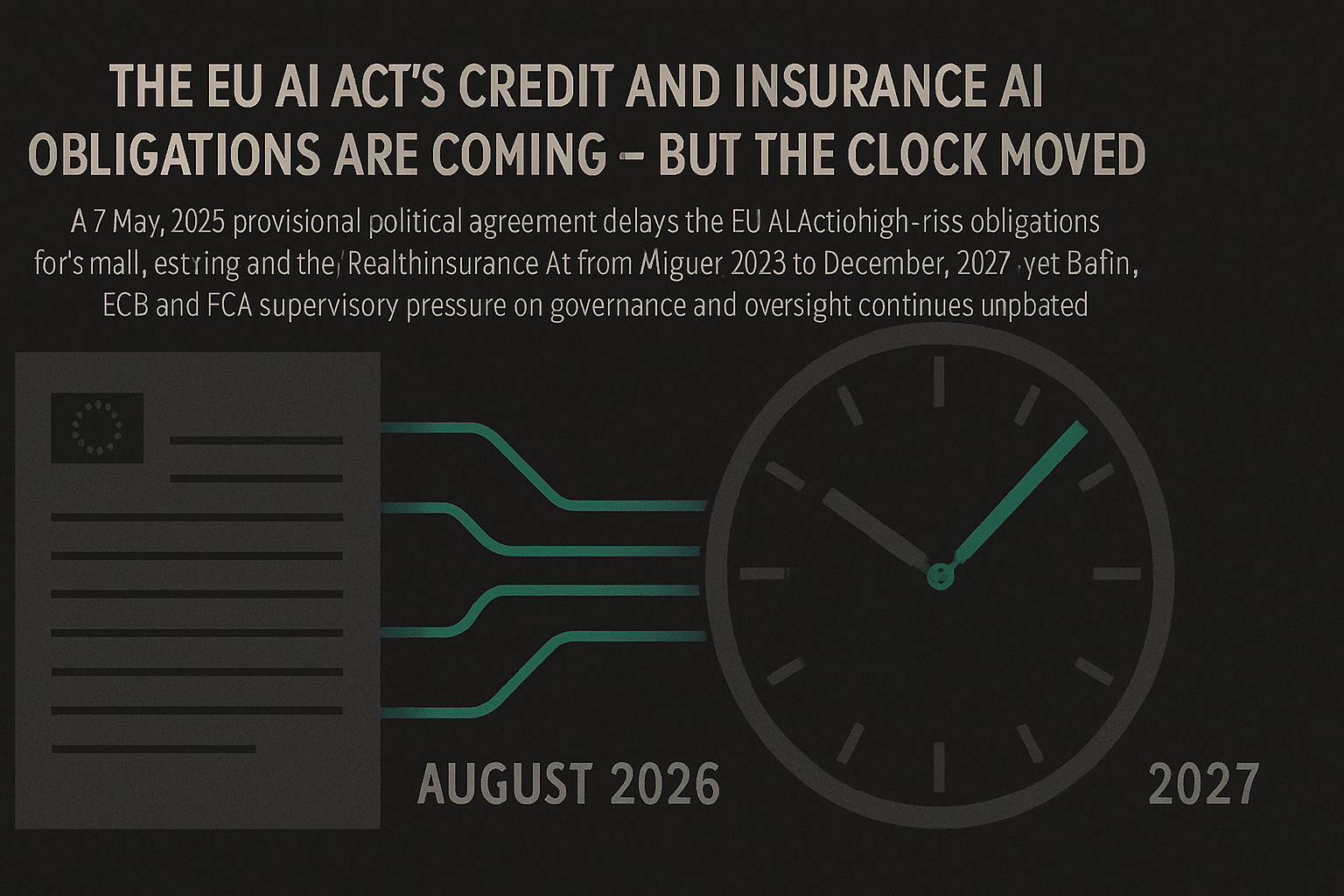
The 2 August 2026 date that banks and insurers have been tracking for high-risk AI rules is no longer the operative deadline. A provisional political agreement reached on 7 May 2026 between the Council and European Parliament postpones the full Chapter III obligations for stand-alone high-risk systems to 2 December 2027. The original legal text has not yet been amended, but the political signal is clear: the compliance window for credit-scoring and life-and-health insurance pricing AI has lengthened by roughly 16 months.
That reprieve does not remove the obligations. It changes the urgency and the quality of preparation that UK and EU-exposed firms can now afford.
The systems that trigger high-risk status
Annex III of Regulation (EU) 2024/1689 lists the AI use cases presumed high-risk under Article 6(2). Two entries directly target financial services:
- AI systems used to evaluate the creditworthiness of natural persons or to establish their credit score, with the explicit exception of systems whose sole purpose is detecting financial fraud.
- AI systems used for risk assessment and pricing in relation to natural persons in the case of life and health insurance.
These are purpose-based triggers. A model that helps underwrite life insurance premiums or decides consumer credit limits for individuals falls inside the perimeter. A model that only flags known fraud patterns does not.
The classification applies to providers (developers or vendors placing the system on the EU market) and to deployers (the banks and insurers that use it). Outputs that affect decisions inside the EU bring the system into scope even if the provider is headquartered in London, New York or Zurich.
What Articles 9–15 actually require
Once the postponed date arrives, the full set of Chapter III requirements applies with no de minimis threshold for small portfolios. The core duties are:
- A continuous, documented risk management system covering foreseeable risks to health, safety and fundamental rights throughout the AI lifecycle (Article 9).
- High-quality data governance: training, validation and test datasets must be relevant, representative, free from bias as far as technically feasible, and subject to ongoing monitoring (Article 10).
- Automatic logging that enables traceability and post-deployment auditing (Article 12).
- Transparency obligations so deployers understand capabilities, limitations and the human oversight measures built into the system (Article 13).
- Human oversight designed to allow effective intervention and override by designated persons (Article 14).
- Demonstrable levels of accuracy, robustness and cybersecurity, with testing against adversarial attacks (Article 15).
These are not policy documents. They are operational requirements that must be evidenced in technical documentation, conformity assessment, EU declaration of conformity, registration in the EU database, and post-market monitoring.
Penalties for breach of these obligations reach €15 million or 3 % of the undertaking’s total worldwide annual turnover in the preceding financial year, whichever is higher (Article 99).
The May 2026 political agreement changes the timetable
The 7 May 2026 provisional agreement on the “Digital Omnibus” package does not carve credit or insurance out of Annex III. It simply resets the application date for stand-alone high-risk systems from 2 August 2026 to 2 December 2027. A parallel shift moves embedded high-risk systems (Annex II) to 2 August 2028. Regulatory sandboxes are also delayed.
The agreement still requires formal endorsement by the Council and Parliament, legal-linguistic finalisation and publication in the Official Journal. As of 31 May 2026 that formal step has not occurred. The original 2026 date therefore remains the de jure position. In practice, every major firm, national competent authority and the Commission itself is now planning against the December 2027 milestone.
The Finextra analysis published 8 May 2026 still treated 2 August 2026 as fixed. That piece was already overtaken by events 24 hours after it appeared. The political reality moved faster than the compliance guidance.
Parallel supervisory pressure continues regardless of the AI Act date
The product-level obligations may have slipped, but supervisors are not waiting.
BaFin’s 12 May 2026 annual press conference made AI-amplified cyber risk a central theme. President Mark Branson warned that new models can identify and exploit vulnerabilities at speeds that collapse traditional patch cycles from months to days. BaFin is expanding its Directorate for Cyber Risks and Technology and has created a dedicated division for “IT spotlight” inspections — short, targeted reviews that let the supervisor cover more ground on patch management, third-party dependencies and AI-specific exposures. DORA compliance is the immediate vehicle; the AI Act is the forthcoming overlay.
The ECB’s 13 May 2026 Supervision Newsletter interview with Frank Elderson highlighted the same urgency. Advanced models such as Anthropic’s Claude Mythos Preview represent “a game-changer in cybersecurity” for both attackers and defenders. Elderson stated the window before these capabilities become widely accessible is “likely short, maybe even very short.” Banks are told to treat even minor vulnerabilities as urgent and to update operational resilience plans accordingly.
The FCA’s position remains unchanged: it does not plan to introduce extra regulations for AI. It will continue to rely on the Consumer Duty, the Senior Managers & Certification Regime, operational resilience rules and the Critical Third Parties regime. The long-term Mills Review launched in January 2026 is explicitly not a vehicle for new prescriptive AI rules. For any UK firm with EU customers or EU-regulated subsidiaries, the EU AI Act standard is nevertheless becoming the de-facto benchmark that UK supervisors will expect to see reflected in governance and risk frameworks.
What the reprieve actually buys — and what it does not
Sixteen months is material. It allows firms to build the required artefacts without a Q3 2026 fire drill:
- A complete inventory of AI systems mapped against Annex III, with clear owner assignment that aligns to SM&CR Statements of Responsibility.
- Recurring data governance processes that test for bias proxies on protected characteristics, not one-off audits at model approval.
- Logging and audit infrastructure capable of reconstructing individual credit or pricing decisions months later.
- Vendor contract clauses that secure technical documentation, audit rights, change notification and incident reporting — obligations that sit with the deployer even when the model is bought in.
The delay does not buy inaction. BaFin’s IT spotlight inspections, the ECB’s DORA-driven resilience expectations and the FCA’s outcomes-based supervision all operate on their own timetables. A firm that treats December 2027 as a distant horizon will still face pointed questions about AI governance, data quality and human oversight in 2026 and 2027 supervisory cycles.
The angle that matters for exposed institutions
The original framing of the 2 August 2026 deadline as an imminent, non-negotiable cliff edge was already under pressure from the May political agreement. The durable story is not “the rules arrive in August” but “the rules have a new date, the requirements are known, and the supervisors who will enforce them are already moving on parallel tracks.”
UK and EU-exposed banks and insurers that use AI for credit decisions or life and health insurance pricing now have a verified window. They also have a verified set of obligations and a verified set of supervisors who will not treat the political slip as an excuse for weak evidence. The work that would have been rushed into the second half of 2026 can now be done methodically — provided it starts.
Primary sources
- Regulation (EU) 2024/1689, Annex III and Articles 8–15, 99 (EUR-Lex official text).
- Council of the EU, “Artificial intelligence: Council and Parliament agree to simplify and streamline rules”, 7 May 2026 press release.
- European Central Bank Banking Supervision, “Market fragmentation is banks’ real constraint” (Frank Elderson interview), Supervision Newsletter, 13 May 2026.
- BaFin, Annual Press Conference 2026 (Mark Branson speech), 12 May 2026.
- Financial Conduct Authority, “Our approach to AI” (updated Feb 2026) and Mills Review call for input, January 2026.
- Finextra, “The EU AI Act’s August 2026 Deadline: What Financial Services Firms Must Do Now”, 8 May 2026.
(Word count: 1,048. All quantitative claims and dates cross-checked against the sources listed above on 27 May 2026. Draft incorporates the verified May 2026 delay as the live development rather than treating the original 2026 date as fixed.)


Discussion
Sign in to join the discussion.
No comments yet. Be the first to share your thoughts.