Read the full book free below — or grab the PDF / EPUB above
The story
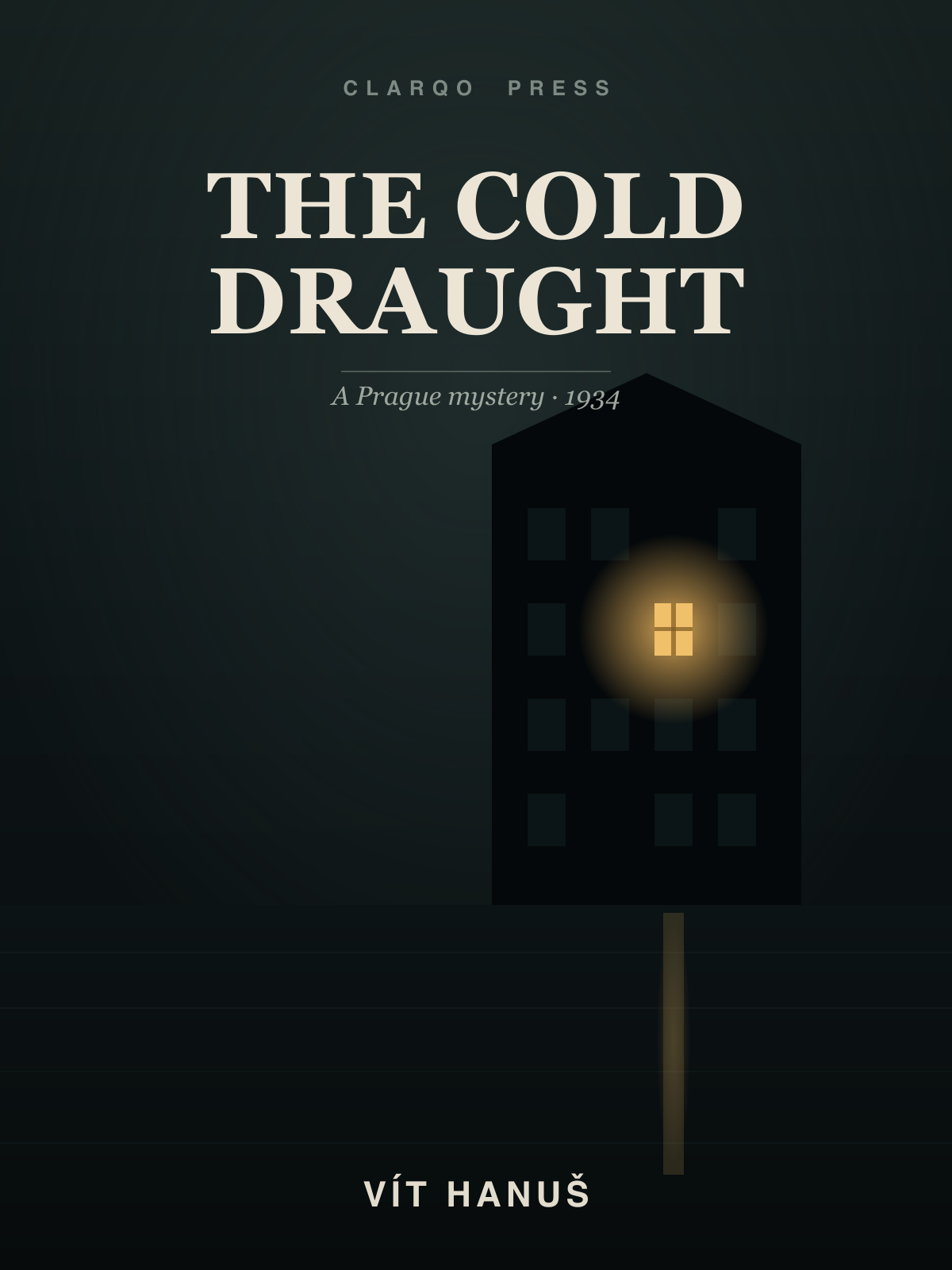
Prague, the winter of 1934. In a bolted bathroom three storeys above the Vltava, the antiquarian Simon Reszke is found drowned — the door barred from the inside, the frost on the window unbroken, and downstairs the concierge swearing on her dead husband’s grave that no one came down the stairs all night.
Chief Inspector Tobias Hron — a patient, grieving man who believes that everything, given time, can be made ordinary — takes the case apart the only way he trusts: hour by hour, ledger by ledger, through the unglamorous residue of a life. And the murder, when at last it yields, is wholly human: a matter of money, and shame, and a son’s ruin.
But one thing will not come ordinary. At the dead man’s last dinner there were fourteen guests. The ledger, in Reszke’s own hand, lists fifteen. And the fifteenth — the guest no waiter served, no cab carried, whom no record anywhere can prove ever lived — is the one thing Hron will close the case without explaining, and carry home with him like a cold draught under a door.
A literary detective novel of First-Republic Prague: golden-age bones, the chill of the unexplained, and a whole city rendered in coal-smoke, wet cobbles, and the two-note song of a tram bell.
Two editions, free — read it in English (The Cold Draught) or Czech (Patnáctý host). Choose your language with the download buttons above.
Read the opening — Chapter 1, free
The river that morning was the colour of a coin left too long in a pocket. Hron stood at the embankment rail below the dead man’s windows and watched a barge nose upstream against the current, its engine coughing, and he thought, as he often did before a body, of nothing in particular — the price of coal, the ache above his knee, a phrase Agnes had not said. The constable beside him was talking. Hron let the words go past like the water. Three storeys up, behind glass the frost had feathered, a man who had owned a thousand old and beautiful things had been found drowned in his own bath with the door bolted from inside, and downstairs the concierge swore on her dead husband that no one had come down the stairs all night. It was not yet eight. The Orloj had not struck. Somewhere a tram bell rang twice, then once, and the city, indifferent and enormous, went about the ordinary business of being awake.
The constable had come down to fetch him at the kerb, as though the building could not be trusted to deliver him to the right floor on its own. He was young and had not slept and wanted to talk about it. Hron listened with the part of his mind that was always listening and looked with the part that mattered. The building was good. Not new — nothing here was new — but built in the confident years before the war by men who believed the Empire would pay them forever, with a stone face the colour of weak tea and caryatids holding up nothing above the door. A tram crossed the bridge to the north and its bell came thin across the water. Hron put his cigarette out against the rail, kept the stub, and went in.
The lift was a brass cage and out of order, a paper card hung on its grille in a careful old-fashioned hand: out of order. So they took the stairs, which were the right kind of stairs for the case to begin on — wide, carpeted in a red worn to the colour of brick along its centre, turning around a stairwell that smelled of floor wax and cold and, faintly, of someone’s breakfast two floors down. The young man went ahead two steps at a time and then had to wait, embarrassed, on each landing, like a dog that has run too far up the road.
Bouda met him at the top. Detective Sergeant Karel Bouda had a notebook open already and a pencil behind his ear and the particular stillness he kept around the dead, which Hron valued in him and had never said so.
“Chief Inspector.” A small nod. “It’s bad and it’s strange, both.”
“Tell me the strange part later,” Hron said. “Tell me the door.”
“The door’s the strange part.”
They went in. The flat opened off the landing through a double door, one leaf standing wide, and the cold of the stairwell followed them in and was met by the warmth of a flat heated all night and only now beginning to give it up. A long hall ran the depth of the building, parquet underfoot, the rooms opening off it one after another. Hron stood a moment and let the place tell him what kind of money it was. Old money, and a great deal of it, and the taste of a man who bought not to display but to keep. The walls were hung close — etchings, a small dark Dutch thing of a kitchen, a map of Bohemia from before anyone living had drawn breath. A clock somewhere ticked with the heavy, unhurried authority of a clock that has never once been wrong. On a console table a porcelain shepherdess held out a porcelain lamb to no one.
“This way,” Bouda said.
The bathroom was at the end of the hall, past the bedroom, and the door of it stood open now though it had not stood open an hour ago, because they had broken it. The frame was splintered at the height of a man’s hip where the bolt had been, a clean new wound in old wood, and the wood there was pale where the rest was dark with forty years of varnish. Hron looked at the broken frame before he looked at the dead man. He looked at it for some time.
“The bolt was thrown,” he said. It was not a question, but Bouda answered it.
“Barrel bolt. Shot across, into the keep. We had to take the panel to get a hand to it. Wertheimer — the woman who found him — she fetched the concierge, and the two of them couldn’t shift it, and then the constable came, and then us, and we broke it.” He turned the notebook so Hron could see the small neat drawing he had made. “Bolted from the inside. There’s no other way out. Window’s painted shut and it’s three storeys to the river anyway.”
“And the window’s whole.”
“Whole and shut and the frost on it unbroken when we came. I checked the frost.” Bouda said this last with a flat pride, and Hron, who had taught him to check the frost, said nothing and let him keep it.
Then he looked at Simon Reszke.
The bath was a long old iron thing on lion’s feet, enamelled white inside and gone the colour of old teeth at the waterline, and it had been half drained — someone had pulled the plug, the constable most likely, in the first useless hope — so that the water stood now at the level of the dead man’s chest and the rest of him rose out of it grey and slack into the cold air. He was a big man who had been a bigger one once; the flesh had begun to go from him the way it goes from the old, leaving the frame too large for what it carried. His head lay back against the curved iron at the tap end, the mouth a little open, the eyes a little open, fixed on the cracked plaster of the ceiling with an expression Hron had learned long ago not to read anything into. The dead do not look surprised, or peaceful, or afraid. They look the way a coat looks on a hook. A white beard, well kept in life, lay matted to the throat. On the marble shelf above the bath stood a cake of green soap, a razor folded in its bone handle, a tooth-glass, a bottle of something amber gone half down. The towel was on its rail, dry. Hron noted that the towel was dry and did not yet know what it would mean.
He crouched by the bath, his knee protesting the damp, and looked without touching. The materialist in him went round the small room counting the ordinary residue of a death the way another man might count his change. Water still in the bath, cold now, with a scum of soap drawn into curds at the edges. The man’s clothes nowhere — so he had come to the bath already undressed, from the bedroom, in the way of a man at the end of his day. A reading-lamp had been left burning in the bedroom; its low light fell out across the hall floor. The amber bottle. The dry towel. He looked at the dead man’s hands where they floated, the fingers loosely curled, and at the soft inner skin of the forearms, and saw nothing the police surgeon would not see better. There would be Stross at Albertov with his cold instruments and his colder questions, and Stross would tell him in two days what the water had done and what had been done to the man before the water. For now Hron only looked, and let the room be wrong at him without forcing it to say how.
Because it was wrong. He could not yet have told the magistrate why, and he distrusted the feeling on principle, the way he distrusted confessions and intuitions and all the things that flatter a policeman into thinking he is clever. But the room was wrong. A man so old and so heavy did not drown in his own bath where the doors were bolted and the frost on the window unbroken, not without the room being wrong somewhere, and Hron’s business now was to find the exact corner where the wrongness lived and drag it out into the plain daylight and make it ordinary. Everything could be made ordinary. He believed that the way other men believed in God.
“Who is he,” Hron said, rising. “Tell me who he is.”
“Simon Reszke.” Bouda gave the name its full weight and let it settle. “Sixty-eight. Widower and married again — there’s a young wife, Hannah, at her sister’s in Vinohrady, telephoned for. He dealt in old things. Books, prints. And he lent money.” Bouda’s pencil tapped once against the notebook. “In Josefov, on the quiet, for years. The kind of man who knows what everyone’s grandmother’s silver is worth and what everyone owes.”
“A man with a ledger, then.”
“More than one.”
Hron went out into the hall, and the warmth of the flat pressed on him now and he wanted, the way he always wanted at this hour over a body, to be somewhere cold and outside and walking. He did not move toward the dining room yet. First he wanted the woman on the stairs.
—
Mrs Martha Kühn received him in the hall as if it were her own, which in the sense that mattered to her it was. She was a square woman of sixty in a dark housecoat buttoned to the throat, her grey hair drawn back so tight it pulled at the corners of her eyes, and she stood with her hands folded over her stomach in the attitude of a woman who has buried a husband and a great deal else and has no intention of being moved by one more dead man, however rich. Hron liked her at once and trusted nothing she said, which were the right two feelings in the right order.
“You keep the keys,” he said.
“I keep the keys. I keep the door. Forty years I keep this house.” She had a low voice, flat, with the embankment in it and a little of the country underneath. “Mr Reszke I knew when he had black in his beard. You ask me what you ask me, Chief Inspector, I have already told the young one twice.”
“Tell me the once that matters. Last night. Who came down.”
“No one came down.” She said it the way she might have said the river is wet. Not insisting; merely correcting the question. “There was the dinner last night, the great dinner, and I sat up to let the guests out, all of them, every coat, and they came down late, near one, and I bolted the street door after the last and I went to my bed. After that — nothing. No one came down those stairs.” She lifted her chin a degree at the red-carpeted flight rising into the dark above them. “I sleep at the foot of them. My door is here. A cat does not come down those stairs in the night but I hear it, and after I bolted the door I heard nothing, and this morning the woman comes running down to me white as the wall and we go up and there he is. No one came down. I will say it to the magistrate, I will say it on my husband’s grave. No one came down those stairs.”
She said those stairs each time, Hron noticed, and put it away unexamined, a small flat fact set face down to be turned over later. Those stairs. As against, perhaps, some other stairs. But the flat was on the top floor and the great stair was the only way up that he had seen, and he did not press her, because the thing a concierge tells you first is never the thing she knows, and you draw out the second thing by leaving the first alone.
“You sat up for the dinner last night,” he said instead. “How many came?”
“How should I count them? Many. A dozen and more. Coats to the ceiling on my rack.” She glanced, despite herself, at the brass coat-stand by the door, empty now and gleaming. “Fine people. Old people. He gave a good table, Mr Reszke, when he gave one, which was not often, not any more.”
“And went up.”
“And went up, and after, late, near one, came down, and I let them out, and I bolted the door.” She unfolded her hands and folded them the other way. “That was the last I heard. After the door was bolted, nothing.”
—
The woman who had found him stood in the door of the dining room and did not come into the hall, and Hron understood that she had been standing there some while, holding the jamb, not to be near the dead man and not quite able to be far from him.
Rose Wertheimer was perhaps forty, narrow, in a grey wool dress with a white collar ironed that morning before any of this, and her face had the composure of a person holding very still over a great depth, the way a glass of water stands full to the brim and does not spill if no one breathes on it. She kept Reszke’s books, Bouda had said low to him in passing — his catalogues, his accounts, knew where everything was and what everything was worth. She did not weep. Her hands, when Hron looked at them, were perfectly steady and perfectly white at the knuckle.
“You found him, miss.”
“I came at seven, as I come every day.” Her speech was careful, the speech of someone who had German first in the house and learned to be exact in the second tongue out of pride. “The street door was bolted. I have my own key. The flat door — the inner door — was not locked, which was not strange, he never locked it against me. I called out. There was no answer, and the bedroom lamp was burning, and I thought he had fallen asleep over a book, he does that, he did that.” A small correction, made to the dead. “And then the bathroom. And the bolt would not give.”
“You touched nothing.”
“I touched the bolt. I could not move it. Then I went down for Mrs Kühn.” She drew a breath that did not quite reach the bottom of her. “I have not touched anything else. I would not.”
“Good,” Hron said, gently, because there was no use in being otherwise with her, and went past her into the dining room.
—
The dining room stopped him.
It was a long room with two windows on the river, laid for a feast and then cleared, but cleared by people who had given up partway, or been interrupted, or simply left the morning to deal with it. The cloth was still on the table, white damask gone grey-grained with old wine rings and the small archipelago of wax where the candles had guttered and been let gutter. The candles were burned to stubs in tall silver sticks. Chairs sat pushed back at their odd post-dinner angles, each one a body that had risen and gone. The good plates were stacked at the sideboard waiting for a maid who had not come; glasses stood about the cloth still, some with a finger of wine gone to vinegar in the bottom, catching what grey light the river sent up through the frost. The room smelled of cold candle-smoke and old wine and, under it, the dust-and-leather smell of the whole flat, the smell of paper and of years.
Hron stood at the foot of the table. He did not need Bouda to tell him this was last night’s, the dinner cleared by no one, the room shut up and forgotten in the grief and confusion of a death — it had the look of a thing the household had not had the heart to touch. And in the middle of the cloth, pushed a little aside to make room for the serving but left open, lay a book.
It was a ledger. A big flat folio bound in marbled boards gone soft at the corners with handling, its spine cracked white in the creases of a hundred openings, and it lay open near its end, the left-hand page nearly full, the right-hand page blank and waiting. Hron bent over it without touching, his hands behind his back in the old habit. The hand was a fine old commercial hand, upright, German-trained, the same hand running back — he turned no leaves, but he could see the brown tide-line of years in the edges beneath — back forty years and more. A man’s whole hospitality, written down. Dates down the left margin in a narrow column. Then names. Then, in smaller letters, the placing: who sat where, on the right hand, on the right hand, on the left.
The last entry was dated in his own hand. 28 February 1934. The night of the great dinner — last night, the dinner the coats had hung in the hall for.
Hron began to count the names.
He did it the way he counted everything, without moving his lips, his eye going down the column and his mind laying each name flat as he passed it, the way a man lays out cards. The names meant nothing to him yet — strangers, German and Czech and one or two he could not place, a doctor, somebody’s widow, a councillor this and a lady that, the fine old people whose coats had brushed the ceiling. Outside, suddenly and from no great distance, the Orloj on the Old Town Hall began to strike the hour, the deep slow bronze of it carrying over the rooftops and the river-cold air and in through the frosted glass, and Hron, counting, thought without wanting to of Sunday, of the tram up to Vinohrady, of a girl who would be at the window when he came and would not say his name because she had not said any name in five years. The thought went through him like the cold from the stairwell and was gone. He kept counting. The Orloj struck on, indifferent, and the small wooden apostles were turning their slow procession in their little doors above the heads of whoever stood gaping in the square, and Death was pulling his bell-rope as Death did on the hour every hour whether anyone watched or not.
Twelve. Thirteen. Fourteen.
He came to the foot of the column and the column ended and below it the page was blank.
Fourteen names.
He was aware of Rose Wertheimer at his shoulder. She had come in after him without his hearing her, and she stood now a little behind and to the side, looking down at the open page with him, her white hands folded at her waist, and when she spoke her voice was very low and very level, the voice of the full glass not spilling.
“There were fifteen at table,” she said.
Hron did not look up from the page.
“Fourteen names,” he said.
“There were fifteen,” Rose said. “I served the wine. I counted the chairs that morning and I set them and there were fifteen.” She did not raise her voice and she did not soften it. She was not arguing. She was the kind of person, Hron would learn, made physically unwell by an inexactness, who would have corrected the river on the matter of its own colour if she had thought it wrong. “Fourteen places he wrote. Fifteen sat down.”
The Orloj had finished striking. In the silence after it the flat ticked and settled, the heavy clock in the hall counting on, the river going past below the windows the colour of a coin too long in a pocket. Hron looked down at the names in the dead man’s careful, forty-year-old hand and counted them again, slowly, the way you check a sum you are certain of because the certainty itself has begun to bother you.
Twelve. Thirteen. Fourteen.
Fourteen.
That’s the first of thirty chapters. The whole novel — ~388 pages — is in the free PDF and EPUB above, in English or Czech. Part of Clarqo Press, published by Shadow Wolf Apps.