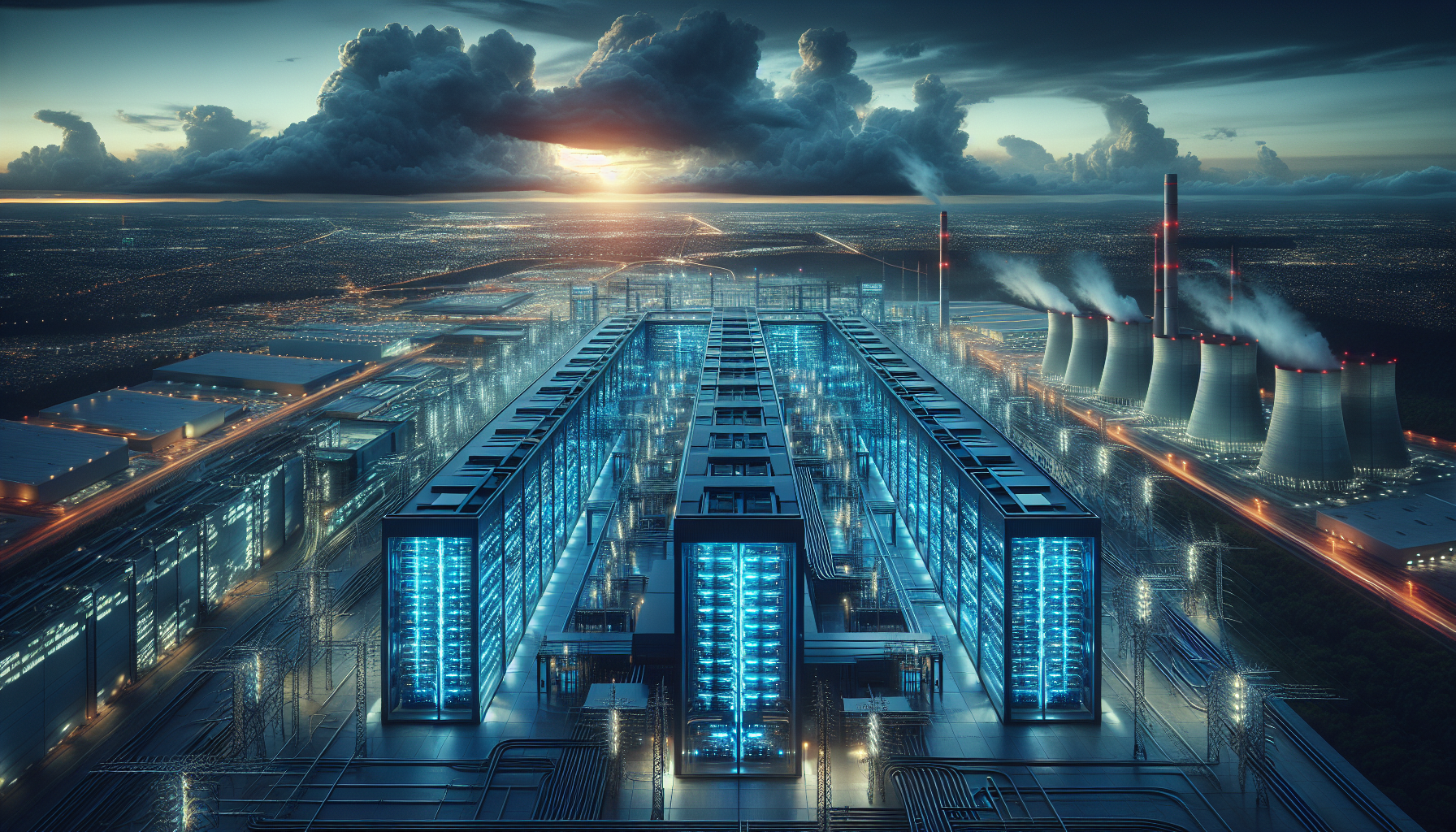
The artificial intelligence boom has produced a secondary crisis that utilities, governments, and investors can no longer ignore: an insatiable hunger for electricity that is straining power grids from Virginia to Singapore.
Data centres dedicated to AI training and inference now consume an estimated 5.2% of global electricity, up from roughly 2% in 2023, according to the International Energy Agency’s March 2026 report. By 2028, that figure could reach 8–10% if current investment trajectories hold. The numbers are staggering — and they are forcing a reckoning with how the world powers its most ambitious technology.
The Hyperscale Arms Race
Every frontier AI model release triggers a cascade of infrastructure spending. Microsoft, Google, Amazon, and Meta collectively committed over $320 billion in capital expenditure for 2026, the majority earmarked for data centre construction and power procurement. Microsoft alone is building or leasing more than 150 new facilities globally this year, with campuses in Ohio, Wisconsin, and the UK each requiring dedicated substations — the British sites placing significant new demands on National Grid capacity.
The bottleneck is no longer chips — it is electrons. NVIDIA’s Blackwell Ultra GPU clusters, which power the latest generation of large language model training runs, draw up to 120 kilowatts per rack. A single 50,000-GPU training cluster can consume as much electricity as a small city of 40,000 homes. Cooling systems for these installations add another 30–40% overhead.
Grid operators in Northern Virginia — the world’s densest data centre market — have warned that the region faces potential capacity shortfalls as early as late 2027. Ireland and Singapore have already imposed moratoriums or strict caps on new data centre licensing, citing grid stability concerns. The UK’s own National Grid Electricity System Operator has flagged rising demand from data centre connections as a growing pressure on southern England’s transmission infrastructure.
Nuclear as the Unlikely Saviour
The response from hyperscalers has been a striking pivot to nuclear power. Microsoft signed a 20-year power purchase agreement in March 2026 to restart Pennsylvania’s Three Mile Island Unit 1, which came back online in late 2024. Google has contracted with Kairos Power for a fleet of small modular reactors (SMRs) expected to deliver 500 megawatts by 2030. Amazon’s AWS has made similar commitments with NuScale and X-energy.
“Nuclear is the only baseload carbon-free source that can be co-located or directly contracted at the scale AI requires,” said Maria Chen, energy analyst at BloombergNEF, in a March 2026 briefing. “Solar and wind, even with battery storage, cannot provide the round-the-clock, flat power profile these clusters demand.”
For the UK, this dynamic carries particular resonance. The government’s commitment to new nuclear capacity at Hinkley Point C and the planned Sizewell C project aligns in principle with the energy profile that AI infrastructure demands. Several technology companies have expressed interest in long-term power purchase agreements with UK nuclear operators, though formal deals have not yet been announced.
SMRs remain largely pre-commercial, however, meaning the near-term gap is being filled by natural gas — a significant complication for companies with net-zero commitments. Google’s 2025 sustainability report quietly acknowledged that its emissions had risen for the third consecutive year.
The Economic and Geopolitical Stakes
The energy arms race has created lucrative tailwinds for utilities and infrastructure investors. Shares of NextEra Energy, Constellation Energy, and Vistra Corp have collectively gained over 60% in the past 18 months as investors price in long-term power purchase agreements. The Invesco Utilities ETF hit an all-time high in February 2026.
Governments are waking up to the strategic dimension. The United States Department of Energy fast-tracked permitting for data centre-adjacent power infrastructure under a January 2026 executive order, framing AI compute capacity as a matter of national security. The EU’s AI Factories initiative is channelling €10 billion into European data centre buildout, paired with requirements to procure a minimum share of renewable power.
The UK, navigating its post-Brexit position, is pursuing its own path. The AI Opportunities Action Plan, published by the Department for Science, Innovation and Technology, has identified AI infrastructure — including compute capacity and its power requirements — as a strategic national priority. Decisions about where the next generation of hyperscale data centres are sited will have lasting consequences for Britain’s industrial geography and grid investment plans.
Meanwhile, countries with abundant hydroelectric power — Canada, Norway, Iceland — are marketing themselves as AI infrastructure havens. Iceland, with its geothermal surplus and naturally cold climate that reduces cooling costs, has seen data centre investment enquiries rise fivefold in the past two years.
What Comes Next
Efficiency improvements offer some relief. NVIDIA and AMD are both promising a 3–5× improvement in performance-per-watt in their next GPU generations, and inference-optimised chips from startups like Groq and Cerebras are reducing the energy cost of deployed models. Algorithmic advances — smaller, more efficient models achieving parity with larger predecessors — could dampen growth in training compute demand.
But the industry’s own forecasts suggest efficiency gains will be outpaced by demand growth through at least 2030. The AI revolution, it turns out, runs on power — and the world is only beginning to reckon with the bill.
Sources: International Energy Agency, BloombergNEF, company earnings reports, US Department of Energy, National Grid Electricity System Operator.


Discussion
Sign in to join the discussion.
No comments yet. Be the first to share your thoughts.