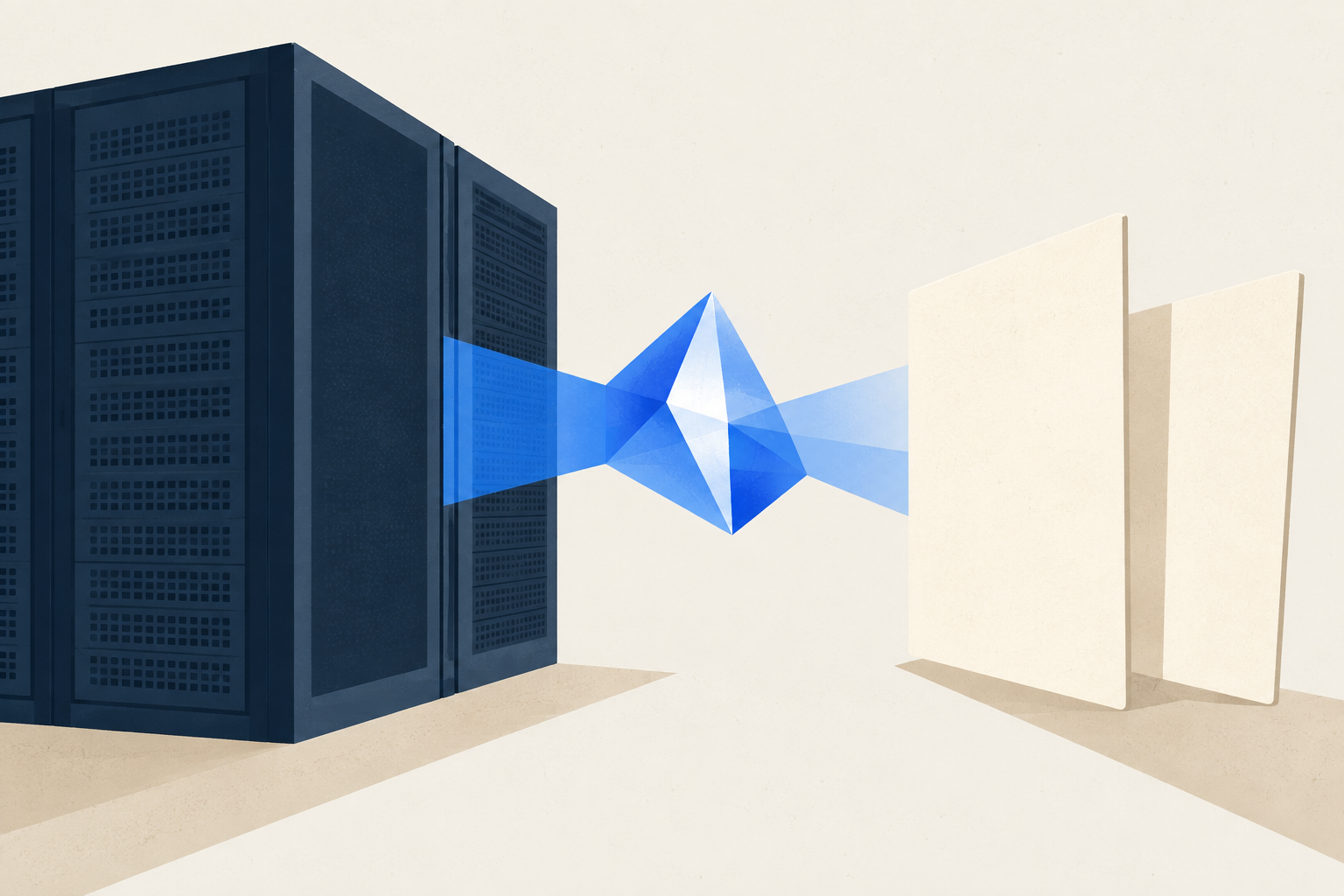
AISI seeks safety evidence during frontier AI development
AISI wants evidence from training, internal use and testing, plus clearer access for independent evaluators. Its new agenda is voluntary research, not a UK compliance rule.
Platforms, chips, software and the UK technology economy.
AISI wants evidence from training, internal use and testing, plus clearer access for independent evaluators. Its new agenda is voluntary research, not a UK compliance rule.
The UK cyber agency wants evidence on where autonomous defenders work, how they fail and when people must retain control. Its new chapter is a research agenda, not a deployment standard.
The government says two pilots helped find and address more than 1,000 potential weaknesses. A published case study details 407 findings from one pilot, while proposed AI reporting rules remain under review.
The figure covers at least 21 of 40 trusts in a national benefits claim, but mixes completed data-cleaning work, paused modules and wider platform use, making it an audit of retention rather than proof that trusts abandoned the Federated Data Platform.
The chips have a 2027 timetable. The reported grid timetable does not, and the gap now determines whether Britain's compute promise reaches customers or another postcode.
The published incentive rewards participation in security assessments and access to sustainability standards, without asking for audit findings or proof that recommendations were implemented.
The Cyber Security and Resilience Bill would start 24-hour and 72-hour duties when an operator becomes aware of a significant incident. Ofcom has not said what evidence will make an AI alert dependable enough to start that clock.
Ofcom's amended code recommends hash matching for in-scope services from 30 September, while the binding safety duties allow an equally effective alternative; its own evidence shows why a fingerprint cannot find a file that has never been fingerprinted.
July computer-programming activity added 0.12 percentage points to GDP, but the data cannot show how much came from AI. The industry contribution is measurable; the AI claim is not.
Abolishing the technology department turned AI oversight from a departmental science function into a centre-of-government one. The AI Security Institute's own website still names the department that closed in July.
London startup Quantum Motion says its $160 million Series C can push silicon quantum hardware into ordinary data-centre racks, giving Britain's quantum strategy a commercial stress test.
Rightmove kept its 2026 outlook intact after lifting active AI projects to 43, but less than 0.5 per cent of traffic still comes from large language models, showing how stubborn UK home-search habits remain.
Britain's largest retail bank is constructing an internal marketplace where teams can build, publish and deploy AI agents across the group — but a compliance report warns that without clearer governance, AI-driven mis-selling could compound faster than any regulator can catch it.
Greg Jackson's energy-platform business is being readied for separation, and the City is paying attention. April brings the clearest signs yet that Kraken Technologies will become a standalone, eventually listed company — and that London still has a fair shot at hosting it.
The National Quantum Strategy passes the halfway point of its first phase with funded national infrastructure in place but a widening US capital gap. The next 18 months decide whether UK quantum stays a sovereign capability or quietly outsources to American frontier labs.
Investors want proof that Compute Subsystems and Armv9 royalty uplift can outrun a softer smartphone cycle and Beijing's domestic-chip push. Numbers land in the first week of May.
Thirteen months after the Online Safety Act's illegal-content duties came into force, Ofcom has opened more than 20 formal investigations and is moving its first cases towards provisional penalty notices, turning a code-driven supervisory phase into something tech compliance teams must now budget for in pounds, not policy hours.
A year on from Matt Clifford's AI Opportunities Action Plan, the UK's first AI Growth Zone is taking shape on a former fusion site — but the wider rollout is still gated by a connection-queue reform that Ofgem only approved last spring.
Eight months after the cloud market investigation closed, City lawyers expect the Competition and Markets Authority to open a formal SMS designation case on hyperscalers within weeks — bringing binding conduct rules within reach for the first time.
The private credit market has surpassed $2 trillion in assets under management, overtaking traditional leveraged loan markets and drawing new regulatory scrutiny as institutional capital floods into direct lending.
OpenAI's GPT-5 arrives with a one-million-token context window, native multimodality, and benchmark scores that leave its predecessors in the dust — but the real story is what it means for AI's role in complex knowledge work across British law firms, banks, and public services.
A trio of competing quantum research teams have independently demonstrated error-corrected logical qubits that outperform physical qubits — the milestone the industry has been chasing for a decade.
From China's digital yuan to the European Central Bank's advancing digital euro, central bank digital currencies are moving from pilot to policy — with profound implications for financial privacy, banking, and monetary sovereignty.
As hyperscale AI infrastructure expands at breakneck pace, the world's power grids are buckling under demand — and tech giants are racing to nuclear power as a solution.