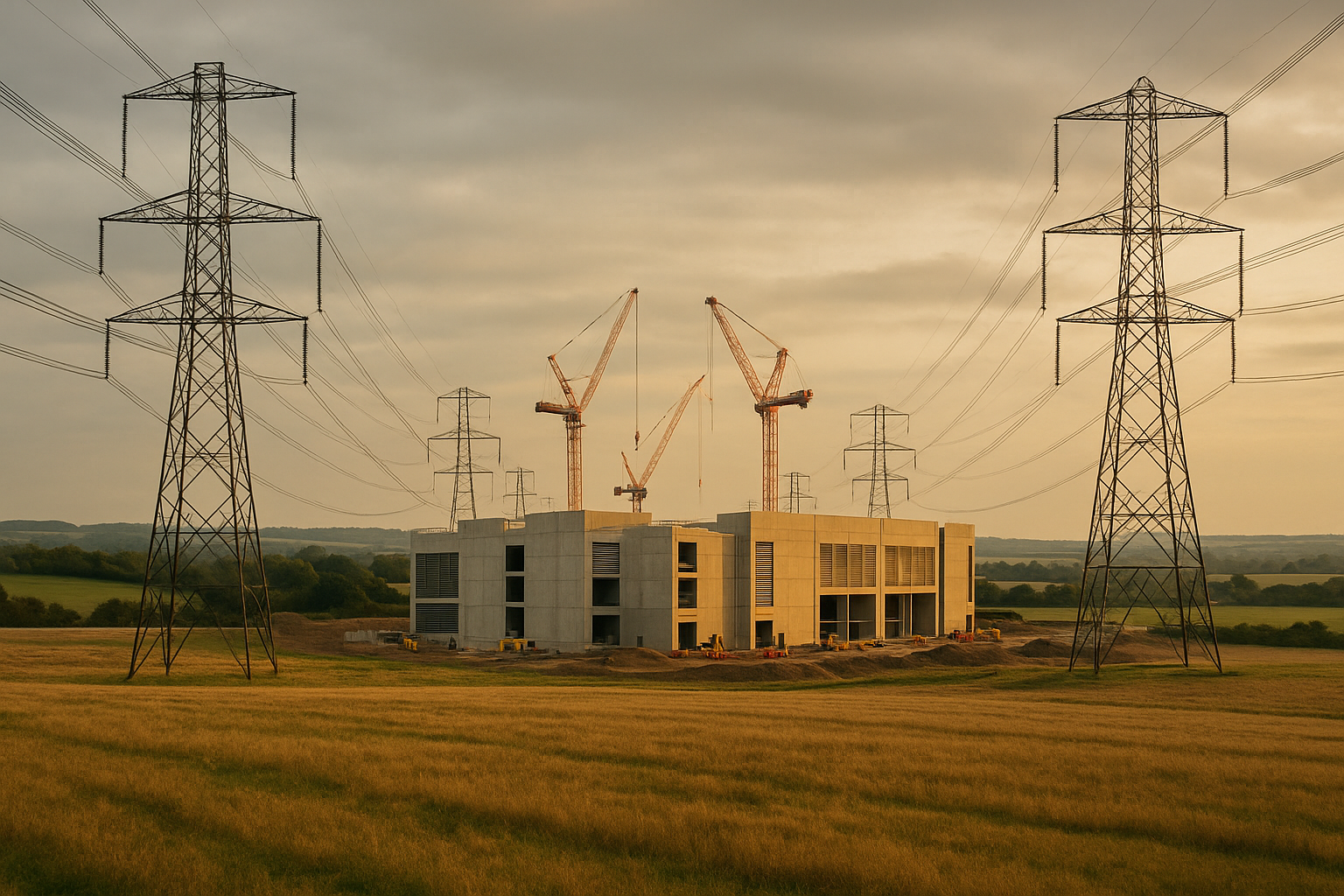
Twelve months after Sir Keir Starmer accepted all 50 recommendations of the AI Opportunities Action Plan in a high-stakes Westminster set-piece, Britain’s flagship industrial-policy bet on artificial intelligence is approaching its first hard test: turning planning announcements into concrete, megawatts and racks.
The Culham site in Oxfordshire — designated the UK’s first AI Growth Zone (AGZ) in January 2025 on land controlled by the UK Atomic Energy Authority — is the most visible litmus test. Backed by the Department for Science, Innovation and Technology and the £14bn pledge from Vantage Data Centers, Nscale and Kyndryl announced alongside the Action Plan, Culham was always going to be the showcase. The bigger question, twelve months in, is whether the model is replicable elsewhere.
From planning fast-track to grid reality
The AGZ designation strips out much of the friction that has historically made British data-centre delivery slow: it bundles preferred planning treatment, access to public land and a defined point of contact across Whitehall. What it cannot do alone is conjure a grid connection. By early 2025, the queue managed by what was then National Grid ESO had grown past 700GW of contracted capacity for projects the system operator privately conceded would never all be built — clogging the path for genuine, near-term demand.
That is the gap the National Energy System Operator (NESO), which took over from National Grid ESO on 1 October 2024, has been working to close. Ofgem’s approval of NESO’s TMO4+ connection-queue reform in spring 2025 introduced a ‘first-ready, first-connected’ model and began stripping out zombie projects to free capacity for genuinely deliverable ones, with explicit prioritisation rules that have since been used to favour data-centre and AI compute loads in strategic locations. The first material reordering of the queue under TMO4+ has been visible across late 2025 and into 2026, but cluster-specific transmission upgrades — particularly around the Thames Valley, the South West and the central belt of Scotland — still drive most live AGZ siting decisions.
Sovereign compute and the AIRR question
The other half of the AI Action Plan — sovereign compute — is on a tighter delivery cycle. Bristol’s Isambard-AI, hosted by the University of Bristol and built around NVIDIA Grace Hopper hardware, has carried much of the load through the AI Research Resource (AIRR) framework alongside Cambridge’s Dawn cluster, while DSIT works through the Action Plan’s commitment to a substantial AIRR expansion. Successive ministerial statements have framed the AIRR scale-up as the foundation that makes British model training credible without permanent dependence on US hyperscalers — an argument that has only sharpened as the Competition and Markets Authority moves toward Strategic Market Status designation of AWS and Microsoft Azure under the Digital Markets, Competition and Consumers Act.
What to watch this summer
For Whitehall, the next inflection points are concrete. DSIT is expected to confirm a second wave of AGZ designations in the coming months, with North East England and South Wales among the most-watched candidates given grid headroom and political signalling. NESO is due to publish its next iteration of strategic spatial-energy planning, which will tell investors which transmission upgrades carry firm delivery dates rather than aspirations. And the Treasury, which has so far positioned the AI Growth Zones programme as growth policy rather than industrial subsidy, will face renewed pressure to clarify how the funding envelope around AGZs interacts with the next public-spending review. Britain has the planning rhetoric. The grid, the silicon and the timetable will decide whether the rest follows.


Discussion
Sign in to join the discussion.
No comments yet. Be the first to share your thoughts.