Most of the AI-in-finance regulation Clarqo has covered over the past fortnight has the same shape. A supervisor — RBI, FCA, BaFin, ECB, Bank of England — writes a rulebook for how the supervised population should govern its own AI models. Inputs, controls, evidence files, audit trails. The regulator is the rule-writer; the bank, insurer, or fintech is the AI user.
India’s securities regulator has reversed that order.
On 22 May 2026 the Securities and Exchange Board of India issued an interim order banning seven individuals — led by Hemant, Rohan and Aniket Gupta — and connected entities from the Indian securities market, freezing their bank accounts and impounding the alleged wrongful gains. The mechanism is familiar: small- and mid-cap stocks, many of them SME-platform listings, pumped through Telegram and WhatsApp channels with handles such as @WealthSolitaire and @desiwallstreet carrying more than 54,000 combined followers, then dumped at a profit. SEBI puts the wrongful gains at roughly ₹20.25 crore across 82 stocks, with the group’s combined gross trade value rising from ₹548.62 crore to ₹1,023.40 crore between the pre-examination and examination windows.
That is the news peg. The structural story sits underneath it.
How SEBI found them
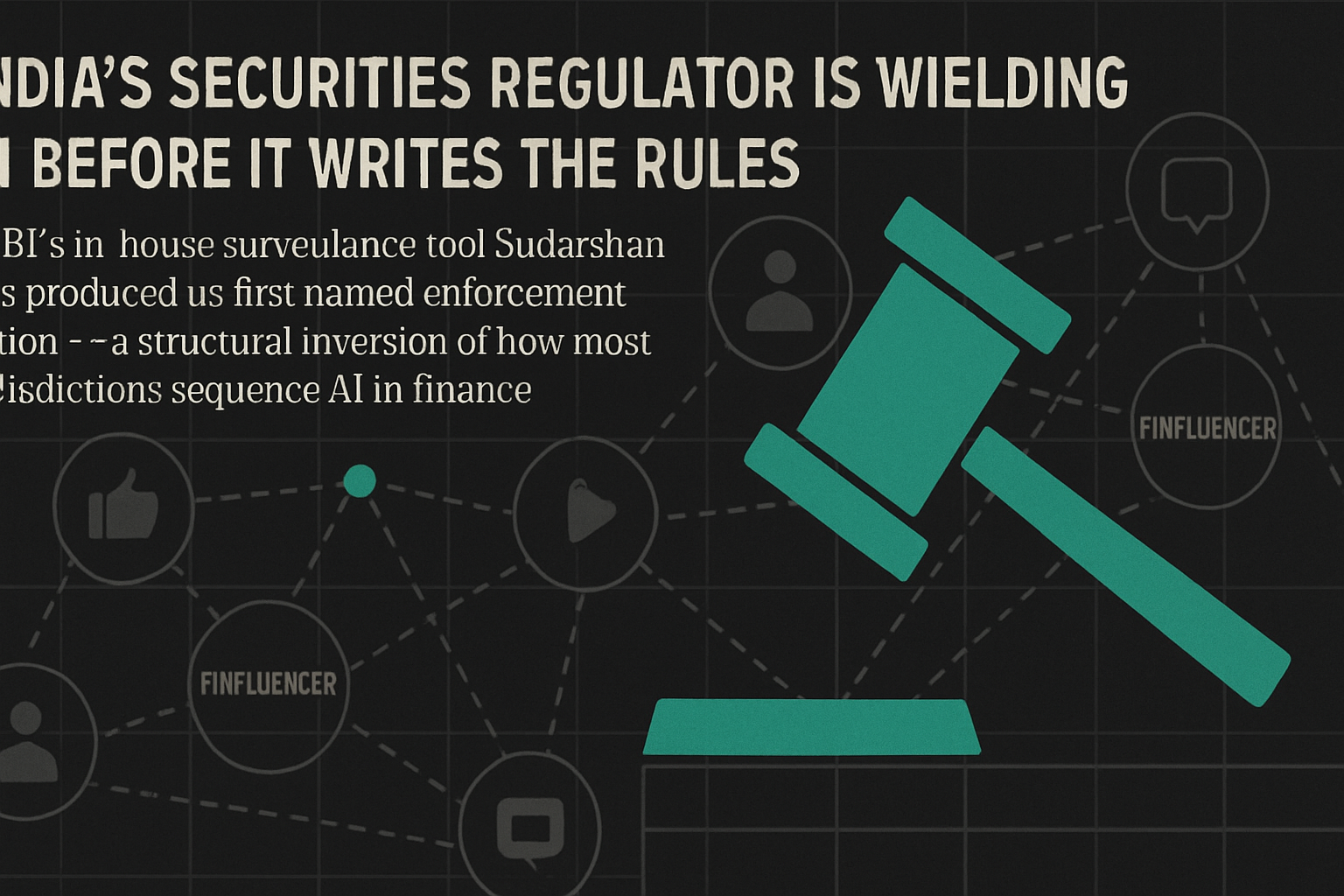
The interim order is the visible output. The invisible input is an in-house AI surveillance system SEBI has named Sudarshan. According to SEBI’s own statements via Chairman Tuhin Kanta Pandey, reported in early March 2026, Sudarshan scans social-media content across formats — audio, video, text — in multiple Indian languages, identifies patterns indicative of unregistered investment advice or misleading claims, and routes those signals into SEBI’s enforcement workflow.
By that early-March reporting, Sudarshan had already been associated with the removal of more than 1.2 lakh (~120,000) misleading finfluencer posts. The figure has been quoted consistently since. It is the concrete, time-stamped output that establishes Sudarshan as operational rather than aspirational. A pilot does not produce six-figure takedown volumes; an operating system does.
What Sudarshan is not — and SEBI has not claimed it is — is a fully autonomous enforcement engine. The 22 May order is signed by SEBI staff, names specific human respondents, and follows the standard interim-order template. Sudarshan sits upstream: it is the tool that makes a population of around 120,000 ambient posts a tractable supervisory surface, not the actor that decides which seven people to restrain.
Regulator as AI user, not regulator of AI
This is the part rest-of-world should read carefully.
Almost every other AI-in-finance regulatory action of the past two weeks has the supervisor on the rule-writing side of the line. The RBI’s FREE-AI framework tells Indian banks how to govern their model lifecycle. The FCA’s AI Live Testing programme tells UK firms what evidence file an AI system needs before it touches a customer. BaFin’s IT spotlight inspections tell German banks how their AI risk will be examined. The ECB’s AI compliance calendar tells euro-area banks when those exams will happen. The Bank of England’s frontier-AI workstream treats AI as a financial-stability variable to be monitored across the system.
In each case, the supervisor is governing somebody else’s AI.
Sudarshan is the supervisor’s AI. SEBI built it, runs it, and has now used it to produce a named enforcement action against named entities. The closest adjacency in Clarqo’s recent India coverage is the SEBI-MII cybersecurity advisory earlier this month — but that advisory governs supervised-entity AI risk. Sudarshan is supervisor-side AI tooling. Two pieces of the same regulator’s AI doctrine, visibly different shapes.
Regulator-built market-surveillance tooling is not novel — the SEC’s MIDAS, the FCA’s market-abuse analytics, and the ESMA central data hub all predate Sudarshan and all use machine learning in some form. What makes the SEBI version distinctive is the surface it covers (vernacular-language social media) and the visibility of the chain from tool to enforcement. A 120,000-post takedown figure attached to a named system, followed by a named interim order against named channel operators, is a tighter loop than Western regulators have historically presented in public.
The rulebook comes after the tool
The second beat is sequencing.
At an Association of Mutual Funds in India event in Odisha in mid-May 2026, Pandey signalled that SEBI is working on a framework for AI-driven trading, citing the growing share of algorithmic and AI-led order flow and the cyber-risk surface those systems open up. The framing was cautious — “working on guidelines”, not “issuing rules” — and the emphasis was on patch management, third-party vendor verification, and the dual-use nature of AI in markets. He also flagged Project Jagrook, an AI-enabled investor-awareness initiative.
The order matters. Sudarshan is already operational. The supervised-entity AI trading rulebook is still being drafted. The supervisor is using AI in production before it has finished writing the rules that supervised firms will have to follow.
That is the structural inversion. Most jurisdictions wrote the AI-governance rulebook — or at least published draft guidance — before standing up a public-facing AI tool of their own. SEBI has gone the other way. It built the surveillance tool, deployed it against the part of the market it could reach (social media, finfluencers, retail-investor information environment), proved an operational track record, and is only now turning to formal AI-trading rules for the supervised population.
For the supervised population, that means the eventual rulebook will be written by a regulator that has lived inside an AI deployment for at least a full enforcement cycle. SEBI will know — in a way most rule-writers do not — what its own AI tool over- and under-detects, what the false-positive and false-negative shapes look like in vernacular-language content, and where the operational seams between AI signal and human enforcement decision are most fragile.
What other emerging-market regulators are watching
The sequence SEBI is running — regulator-built AI surveillance, conventional interim-order enforcement on top of it, formal AI-trading rules last — is one that securities regulators in other large, retail-heavy emerging markets are likely to study. Brazil’s CVM, Indonesia’s OJK, the Philippines’ SEC, Nigeria’s SEC and South Africa’s FSCA all sit on retail-investor populations where social-media-driven manipulation looks structurally similar to what SEBI is now actioning. None has publicly named an equivalent in-house AI surveillance system.
The template is not “first jurisdiction to use AI in markets supervision”. It is narrower and more transferable: a publicly named surveillance system, a stated production-scale removal volume, a named interim order that closes the loop, and an explicit signal that the rulebook for supervised AI will follow. That sequence — tool, enforcement, rules — is what other supervisors can copy.
The risk SEBI is carrying is the one any operator-of-AI carries. A false positive at scale would mean lawful financial-education content removed at the regulator’s instigation; a high-profile miss would erode the assumption that 120,000 takedowns represent serious coverage rather than easy targets. The eventual AI-trading rulebook will be read against SEBI’s own operating record.
For now, the order on the table is straightforward: seven people, ₹20.25 crore in alleged wrongful gains, account freezes, market access withdrawn pending further directions. The structural read is less so. India’s securities regulator has spent the past year quietly becoming an AI operator, and is only now sitting down to write the rules for everyone else.


Discussion
Sign in to join the discussion.
No comments yet. Be the first to share your thoughts.