Microsoft Azure AI Revenue Surges in Q2 2026 as Copilot Reaches 100M Enterprise Seats
Azure grew 34% year-over-year with AI services driving 18 percentage points of that growth — the fastest cloud expansion Microsoft has reported since 2022.
Markets, banking, fintech regulation, capital allocation and the financial impact of technology.
Azure grew 34% year-over-year with AI services driving 18 percentage points of that growth — the fastest cloud expansion Microsoft has reported since 2022.
A 25bp move brings the deposit facility to its lowest level since 2022 and signals that Frankfurt now sees the trade war as a bigger risk than sticky services inflation.
On-chain stablecoin transactions surpassed the $30 trillion annual run rate in Q1 2026 — a sevenfold jump from 2023 — as JPMorgan, PayPal, and Stripe integrate dollar-pegged tokens into core payment rails
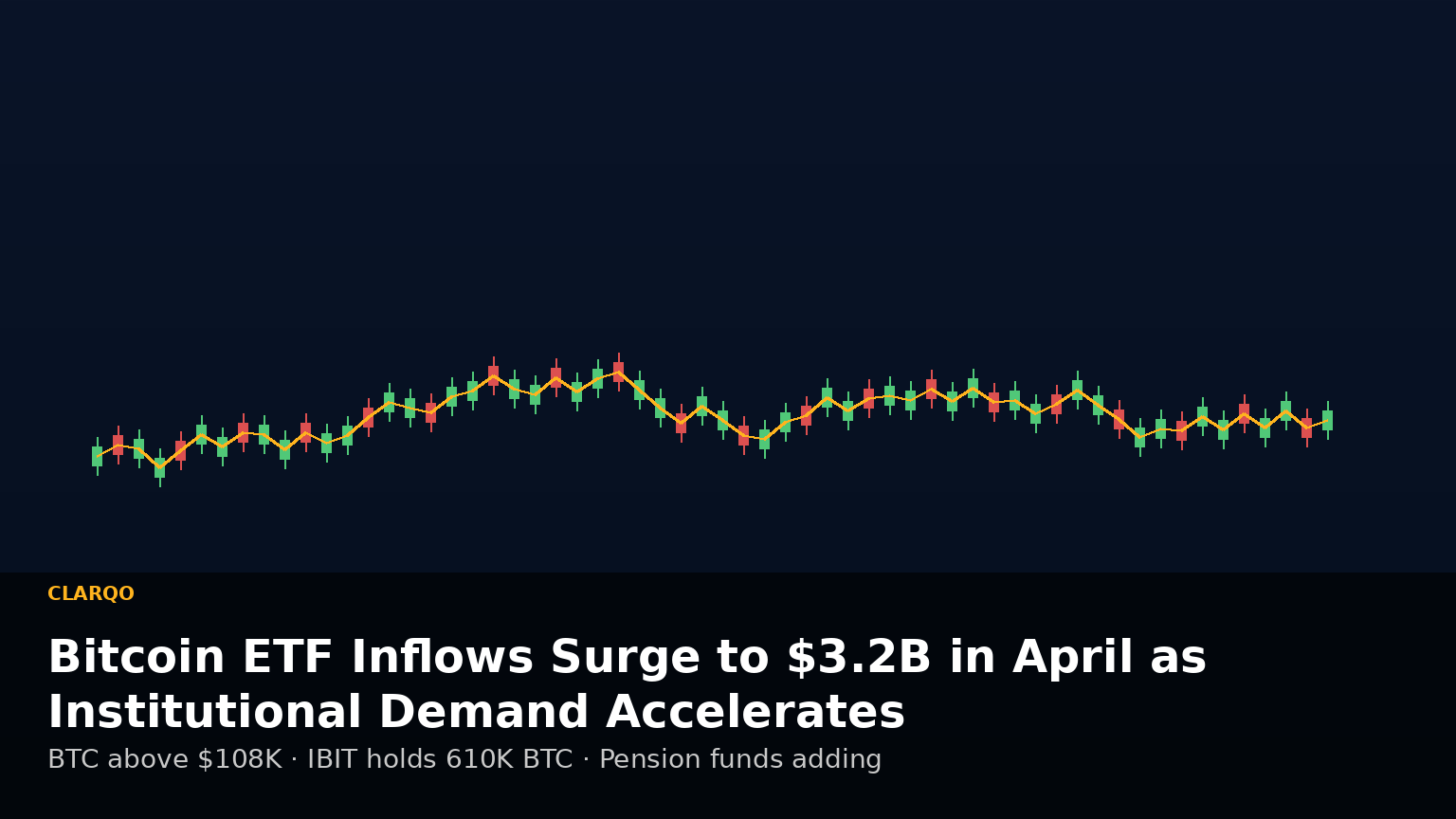
IBIT now holds 610,000 BTC as pension funds, RIAs, and family offices pile in through regulated wrappers — BTC trades above $108K within 4% of its all-time high
A widening Fed-BoJ rate gap and ¥2.3 trillion in weekly outflows have pushed the yen to a 40-year low, and Tokyo's next policy meeting on April 30 sets the stage for the hardest currency decision since 2024
The Fund's April World Economic Outlook marks its sharpest downward revision in four years, citing US tariffs and retaliatory measures as the primary drag on advanced and emerging economies alike
A record central-bank buying streak, combined with ETF inflows and a softer dollar, has pushed gold to fresh highs in April 2026 — and the composition of reserves on central bank balance sheets is shifting in ways that will outlast any single price cycle.
After three years of frozen exit markets, a wave of fintech companies is filing for public offerings. Klarna, Chime, and a dozen smaller challengers are betting the window won't stay open for long.
The private credit market has surpassed $2 trillion in assets under management, overtaking traditional leveraged loan markets and drawing new regulatory scrutiny as institutional capital floods into direct lending.
The GENIUS Act creates the first federal framework for payment stablecoins, forcing Tether, Circle, and a wave of bank entrants to operate under strict reserve and oversight rules.
From China's digital yuan to the European Central Bank's advancing digital euro, central bank digital currencies are moving from pilot to policy — with profound implications for financial privacy, banking, and monetary sovereignty.
With U.S. tariffs on Chinese goods hitting 145% and Beijing restricting rare earth exports, the global semiconductor supply chain is undergoing its most dramatic restructuring in decades.
What began as MicroStrategy's contrarian bet in 2020 has become a mainstream corporate treasury strategy — with 87 public companies now holding a combined $94 billion in Bitcoin reserves.
As US export controls tighten around advanced semiconductors, Beijing has deployed a calibrated response — restricting the rare earth and specialty mineral exports that underpin the entire global chip supply chain, forcing Washington and its allies to accelerate a costly domestic mining push.
Nvidia's latest quarterly results shattered records as Blackwell GPU revenue hit $39 billion, cementing the chipmaker's grip on the global AI infrastructure market.
Hyperscalers are committing record capital to AI infrastructure, but NVIDIA's Blackwell GPU supply crunch is forcing hard choices about who gets compute — and at what price.
With Bitcoin ETFs now holding over $120 billion in assets and sovereign wealth funds quietly accumulating, the asset's transformation from speculative instrument to institutional reserve is well underway.
As quantum processors cross practical thresholds, financial institutions are scrambling to replace decades-old encryption standards before the window closes.
The US Senate's GENIUS Act would establish a federal licensing framework for stablecoin issuers — and its passage could reshape the $230 billion stablecoin market overnight.
JPMorgan, Goldman Sachs, and Morgan Stanley are deploying AI agents that can execute multi-step financial workflows autonomously — and the numbers are beginning to show up in earnings.
China's DeepSeek releases R2, its most capable model yet, matching frontier US benchmarks at a fraction of the cost — and triggering fresh scrutiny of AI export controls.
Crypto exchange Kraken has confirmed a confidential SEC IPO filing at a $13.3 billion valuation, while U.S. spot Bitcoin ETFs recorded their second-largest single-day inflow of April — signs that institutional capital is returning to the asset class.
Microsoft's Q3 FY2026 earnings confirm the company's AI transformation is no longer a growth story — it's the core engine of an already-massive business.
The Senate's landmark stablecoin bill cleared committee with bipartisan support this week — marking the most significant shift in U.S. crypto regulation in years and reshaping how banks, fintechs, and consumers will interact with digital dollars.